How to Generate Leads on LinkedIn: 10 Proven Strategies for 2026
Unlock growth with our guide to LinkedIn lead generation strategies. Discover 10 actionable organic and paid tactics for agencies, founders, and GTM teams.

How do you generate leads on LinkedIn? The platform has evolved beyond a simple digital resume cabinet into the most critical B2B growth engine. However, many professionals only scratch the surface, sending generic connection requests and occasionally sharing company updates, which rarely produces meaningful results. The real power of LinkedIn lies in a deliberate, structured system.
This article provides a detailed breakdown of 10 specific, high-impact LinkedIn lead generation strategies that are effective right now. For each tactic, you will find a clear, step-by-step blueprint designed for immediate action, not just theory. We provide implementation guides, practical templates, and real-world examples tailored for agencies, sales teams, founders, and the ghostwriters who support them.
You will learn how to:
- Compare organic vs. paid methods to determine the best mix for your budget.
- Build a content engine that establishes authentic thought leadership.
- Execute targeted outreach that feels personal and avoids automation.
- Measure the key metrics that signal a true return on investment.
This guide is your definitive playbook for converting LinkedIn activity into a predictable pipeline of qualified leads. We will cover everything from optimizing your personal brand and creating compelling video content to running effective ad campaigns and mobilizing your entire team for employee advocacy. Let's begin.
1. How to Use a LinkedIn Content Strategy with an Authentic Voice and Personal Branding
This foundational strategy shifts your focus from generic corporate updates to creating a consistent, human-centric presence on LinkedIn. It involves publishing content that genuinely reflects your unique personality, expertise, and communication style. Instead of simply broadcasting achievements, this approach helps you build a personal brand that fosters trust and attracts followers who resonate with your perspective, turning your profile into a powerful engine for inbound leads.
This is one of the most effective organic LinkedIn lead generation strategies because people buy from people they know, like, and trust. An authentic voice cuts through the noise of overly polished marketing content, establishing you as a relatable authority.
Step-by-Step Guide to Implement This Strategy
- Step 1: Define Your Authentic Voice. To do this, analyze your top 10-15 past posts. Note recurring phrases, your use of humor, or specific ways you explain concepts. Document your unique vocabulary and communication quirks to create a voice guide.
- Step 2: Establish Your Content Pillars. A good comparison for a content mix is 60% educational (how-tos, industry insights), 25% inspirational (stories, lessons learned), and 15% personal (behind-the-scenes, relatable anecdotes). This keeps your audience engaged.
- Step 3: Maintain Posting Consistency. Post when your audience is most active, typically between 8-10 AM and 5-6 PM in their primary time zone. Consistency is more important than frequency; aim for a sustainable schedule you can stick to.
Key Insight: Your authentic voice isn't just about what you say; it's about how you say it. It’s the combination of your tone, vocabulary, and the unique lens through which you view your industry. This is what makes your content memorable and builds a loyal following.
For those managing multiple accounts or seeking to refine a personal brand, tools can help maintain consistency. To see how AI can analyze voice patterns to generate posts that feel authentically human, explore a case study on how Maria Carp scaled her ghostwriting business. This method works because it transforms your LinkedIn profile from a resume into a dynamic platform for thought leadership, attracting high-quality leads who are already invested in your expertise.
2. How to Use LinkedIn Sales Navigator for Targeted Outreach
This strategy involves moving beyond the standard LinkedIn search to employ its premium tool, Sales Navigator, for high-precision prospecting. It enables users to identify, track, and engage with ideal prospects using advanced filters and lead-saving features. Instead of casting a wide, generic net, this method focuses on quality over quantity, allowing B2B sales teams, recruiters, and consultants to connect with specific decision-makers through highly personalized outreach.

This is one of the most direct and measurable LinkedIn lead generation strategies available. A comparison to consider is: while an authentic content strategy builds inbound interest over time, Sales Navigator equips you to proactively find and start conversations with high-intent buyers now. It works because it provides access to data and filters unavailable on the free platform, turning LinkedIn into a powerful, searchable database of your ideal customers.
Step-by-Step Guide to Implement This Strategy
- Step 1: Build Your Ideal Customer Profile (ICP). Before searching, define your target. Document key attributes like industry, company size, specific job titles (e.g., "VP of Marketing," not just "Marketing"), seniority level, and geographic location.
- Step 2: Create Targeted Lead Lists. Use Sales Navigator’s advanced filters (like "Posted on LinkedIn in last 30 days" or "Changed jobs in last 90 days") to build hyper-specific lists of prospects who fit your ICP. Save these individuals as leads to receive updates on their activity.
- Step 3: Personalize Your Outreach Message. Craft connection requests or InMail messages that reference a specific piece of their content, a mutual connection, or a recent company announcement. Avoid generic sales pitches; your goal should be to start a genuine conversation.
Key Insight: The power of Sales Navigator isn't just finding people; it's understanding their context. Use its "Lead Alerts" feature to see when a prospect is mentioned in the news, posts content, or changes jobs. These alerts are perfect conversation starters that show you've done your research.
Combining this targeted outreach with an active content strategy creates a powerful one-two punch. Prospects who receive your message can see your profile and recognize you as a credible authority from your posts. This approach transforms cold outreach into a warm introduction, significantly increasing your response rates and generating qualified leads who are ready to engage.
3. How to Publish LinkedIn Articles and Long-Form Content
This strategy involves publishing detailed, long-form articles (1,500-3,000+ words) directly on the LinkedIn platform. Unlike short posts, these articles function as evergreen content assets that establish deep subject matter expertise, improve visibility within LinkedIn’s search algorithm, and attract high-intent leads through sustained thought leadership.
A comparison between posts and articles shows that while posts drive immediate engagement, articles build long-term authority. Publishing in-depth articles is one of the most powerful organic LinkedIn lead generation strategies because it positions you as a definitive authority. Instead of just sharing quick insights, you are providing a valuable, comprehensive resource that builds trust and draws in leads who are actively seeking solutions, not just scrolling their feed.
Step-by-Step Guide to Implement This Strategy
- Step 1: Research and Outline Your Article. Use LinkedIn's search bar or analytics to identify trending topics and common questions in your industry. Structure your article with clear H2/H3 subheadings, bullet points, and short paragraphs to make it highly scannable for busy professionals.
- Step 2: Write and Format for Maximum Value. Craft content that offers a unique perspective or provides a detailed solution to a significant pain point. Embed images, data visualizations, or blockquotes to break up the text. End with 3-5 clear, actionable takeaways the reader can apply immediately.
- Step 3: Optimize and Promote Your Article. Write a compelling, value-driven headline that sparks curiosity. Include a clear call-to-action (CTA) at the end, such as inviting readers to connect, download a resource, or book a consultation. Cross-promote the article with several short-form posts linking back to it over the following weeks.
Key Insight: A LinkedIn article is more than a blog post; it's a permanent fixture on your profile that signals deep expertise. The algorithm often surfaces older, high-performing articles in search results, giving them a much longer lifespan than a typical feed post and turning them into lead-generating assets that work for you 24/7.
This approach is especially effective for demonstrating complex knowledge that cannot be conveyed in a short post. To explore how to integrate this with other platform tactics, you can learn more about advanced LinkedIn content strategies. This method works because it transforms your profile from a social feed into a rich library of expert resources, attracting leads who are already convinced of your value before they even reach out.
4. How to Use LinkedIn Engagement for Community Building
This strategy involves actively participating in conversations within your niche by leaving thoughtful comments, sharing relevant content, and reacting to posts from your target audience. It requires a shift from being a passive broadcaster to an active community member. By consistently adding value to discussions, you increase your visibility, build genuine relationships, and position yourself as a helpful expert, which naturally attracts inbound leads.
This is one of the most powerful organic LinkedIn lead generation strategies because visibility breeds familiarity and trust. When potential clients repeatedly see your insightful comments, you become a recognized voice in their network. This consistent, value-driven presence ensures you are top-of-mind when they need the solutions you offer.
Step-by-Step Guide to Implement This Strategy
- Step 1: Curate Your Feed for Relevant Conversations. Identify and follow 15-20 key voices in your industry, including potential clients, partners, and respected thought leaders. This ensures your feed is filled with relevant conversations to join.
- Step 2: Add Value with Insightful Comments. Go beyond generic phrases like "great post." Write comments that ask insightful questions, share a relevant personal experience, or add a complementary perspective. Aim for comments that are 3-4 sentences long to demonstrate genuine thought.
- Step 3: Prioritize Reciprocity and Engagement. Make it a rule to reply to every comment on your own posts, especially within the first few hours. This signals to the LinkedIn algorithm that your content is engaging and helps foster a loyal community around your profile.
Key Insight: Strategic engagement isn't just about being seen; it's about being remembered for the value you add. A single, insightful comment on a popular post can drive more high-quality profile views and connection requests than one of your own posts.
Founders and sales professionals can use this method to warm up cold outreach by first engaging with a prospect's content. This simple act of showing up in their notifications builds name recognition and makes a subsequent connection request feel familiar rather than intrusive. It works because you are building social capital before you ever ask for anything, turning a cold interaction into a warm conversation.
5. How to Use a LinkedIn Lead Magnet and Gated Content
This strategy involves creating high-value resources, known as lead magnets, and offering them to your LinkedIn audience in exchange for their contact information, typically an email address. Instead of just sharing insights, you provide a tangible asset like a template, checklist, or guide that solves a specific problem for your ideal customer. By gating this content behind a form, you convert engaged followers into qualified leads for your email funnel.
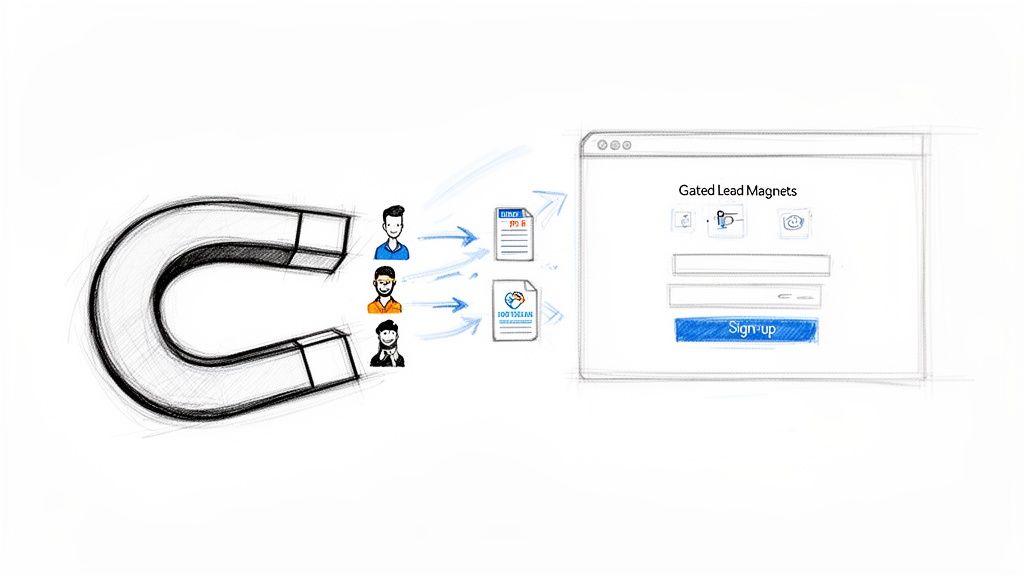
This method is one of the most direct LinkedIn lead generation strategies because it creates a clear value exchange. Your audience gets an immediate solution, and you get a direct line of communication to nurture them toward a sale. In comparing lead magnets vs. ungated content, lead magnets generate direct leads, while ungated content builds brand awareness. This strategy works well for moving prospects from the awareness stage to the consideration stage of the buyer's journey.
Step-by-Step Guide to Implement This Strategy
- Step 1: Identify a Core Problem Your Audience Faces. Determine the single most pressing challenge your ideal customer has. Your lead magnet should offer a direct, actionable solution to this one problem. Examples include HubSpot's free marketing plan templates or ConvertKit's guides on creator business models.
- Step 2: Create the High-Value Lead Magnet. Develop a high-quality resource. This could be a detailed PDF guide, a Notion template, a video workshop, or an interactive checklist. The format should be easy to consume and immediately useful.
- Step 3: Set Up a Landing Page and Form. Create a simple landing page that explains the benefit of the lead magnet and includes a form to capture names and emails. Using LinkedIn's native Lead Gen Forms for ads can reduce friction and increase conversion rates.
- Step 4: Promote Your Lead Magnet with a Teaser Post. Craft an organic LinkedIn post that highlights the problem and hints at the solution. Frame it as a story or a valuable insight, then introduce your free resource as the next step for those who want to dive deeper.
Key Insight: The success of a lead magnet isn't just the quality of the resource itself, but how well your promotional post builds demand for it. A great post creates a strong desire for the solution before you even mention the free download.
Once you capture a lead, the work isn't over. You need a well-crafted email nurture sequence that delivers the promised resource, provides additional value, and introduces your core offer. This strategy turns your LinkedIn profile into a consistent list-building machine, feeding your sales pipeline with warm, motivated prospects who have already received value from you.
6. How to Use LinkedIn Paid Advertising and Sponsored Content
This strategy involves using LinkedIn's paid advertising platform to place your content, offers, and brand messages directly in front of a highly specific target audience. A comparison between organic and paid reach shows that while organic efforts rely on the algorithm, paid ads provide a predictable and scalable way to reach decision-makers, generate qualified leads, and accelerate your sales pipeline. It works by targeting users based on precise professional data like job title, company size, industry, and seniority.
This is one of the most direct LinkedIn lead generation strategies for B2B marketers because it bypasses the need to build a large organic following first. For businesses with a clear Ideal Customer Profile (ICP), LinkedIn Ads offer a powerful tool to engage prospects who are actively in a professional mindset, making them more receptive to business-oriented messaging and offers.
Step-by-Step Guide to Implement This Strategy
- Step 1: Define Your Campaign Objective and Offer. Before launching a campaign, clarify your goal. Is it to drive webinar sign-ups, ebook downloads, or demo requests? Your offer must be compelling enough for someone to exchange their contact information. A valuable lead magnet is crucial.
- Step 2: Build a Precise Target Audience. Use LinkedIn Campaign Manager to build an audience based on your ICP. Start with narrow targeting (e.g., VPs of Marketing at SaaS companies with 50-200 employees in North America) and broaden it only if necessary. Layering attributes creates a highly qualified audience.
- Step 3: Create Compelling Ad Creative and Copy. Your ad needs to stop the scroll. Use benefit-driven headlines, concise copy that addresses a pain point, and authentic visuals like employee photos or customer testimonials instead of generic stock images. Test multiple ad variations to see what resonates.
- Step 4: Monitor, Analyze, and Optimize Performance. Track key metrics like Cost Per Lead (CPL), Click-Through Rate (CTR), and conversion rates. Turn off underperforming ads and reallocate your budget to the winners. Continuously refine your audience and creative based on performance data.
Key Insight: The most successful LinkedIn ad campaigns feel like helpful organic content, not disruptive advertisements. They offer genuine value upfront and are tightly aligned with the specific professional needs of the target audience, making the call-to-action a natural next step.
For companies looking to maximize their return, combining paid ads with a strong organic presence is key. Running ads to warm audiences, such as people who have engaged with your organic posts or visited your website, often produces a much higher conversion rate. This method works because it pairs the precision of paid targeting with the trust-building power of consistent, valuable content, creating a comprehensive lead generation system.
7. How to Use Personal Branding and Profile Optimization on LinkedIn
This strategy treats your LinkedIn profile not as a static resume, but as a dynamic landing page designed to convert visitors into leads. It involves meticulously crafting every element, from your headline and summary to your experience and media, to communicate a clear and compelling value proposition. A well-optimized profile acts as the central hub for all your LinkedIn activity, supporting content and outreach efforts by instantly qualifying you in the eyes of potential clients.
This is one of the most fundamental LinkedIn lead generation strategies because every other activity, from commenting to connecting, ultimately drives traffic back to your profile. If your profile fails to articulate who you help, how you help them, and what they should do next, you lose countless opportunities. It pre-sells your expertise before you even start a conversation.

Step-by-Step Guide to Implement This Strategy
- Step 1: Craft a Client-Centric Headline. Ditch your formal job title. Instead, use your target customer's language to state the outcome you deliver. A comparison: "CEO at Acme Corp" vs. "Helping B2B SaaS Founders Secure Series A Funding with GTM Strategy." The second option is far more compelling.
- Step 2: Write a Conversational "About" Section. Write your summary as if you are speaking directly to your ideal client. Address their pain points, explain your process, and showcase your unique solution. End with a clear call-to-action (CTA), such as "DM me for a GTM audit" or a link to your booking calendar.
- Step 3: Quantify Your Experience and Achievements. In your "Experience" section, go beyond listing responsibilities. Focus on measurable achievements. Instead of "Managed marketing campaigns," write "Led a content marketing initiative that generated a 200% increase in inbound leads in 6 months."
- Step 4: Gather Social Proof with Recommendations. Actively request recommendations from past clients or colleagues. Aim for at least five high-quality testimonials that speak to specific results and the experience of working with you. This builds immediate trust with profile visitors.
Key Insight: Your LinkedIn profile should answer three questions for a visitor in under five seconds: Who are you? Who do you help? And how can you help me? Clarity and a direct value proposition will always outperform a profile filled with industry jargon.
Optimizing your profile is the critical first step before launching any other campaign. It ensures that the traffic you generate has a destination designed for conversion. To dive deeper into the specifics of building a profile that attracts inbound interest, you can explore more ways on how to generate leads on LinkedIn. This approach works because it transforms your digital presence from a passive record of your career into an active, 24/7 lead generation asset.
8. How to Use LinkedIn Video Content for Thought Leadership
This strategy involves creating and distributing video content on LinkedIn to establish authority, increase engagement, and stand out from text-only posts. By sharing insights, lessons, and stories through video, you build a deeper, more personal connection with your audience. This format captures attention effectively in a crowded feed and humanizes your brand, making your profile a magnet for inbound leads.
Video is a powerful component of modern LinkedIn lead generation strategies because it communicates personality and expertise faster than text. The format builds trust by allowing viewers to see and hear you, creating a sense of familiarity that shortens the sales cycle. The LinkedIn algorithm also tends to favor native video, giving it greater reach.
Step-by-Step Guide to Implement This Strategy
- Step 1: Start Simple and Authentic. Use your smartphone to record vertical videos. A comparison of production styles shows authenticity often outperforms polished corporate videos. Focus on delivering clear, valuable information.
- Step 2: Hook Viewers in the First Three Seconds. This is a critical step. Start with a compelling question, a bold statement, or a promise of a specific outcome to grab attention and stop the scroll. For example, "Stop making this cold outreach mistake..."
- Step 3: Optimize for Silent Viewing with Captions. Add captions or subtitles to every video. A significant portion of LinkedIn users watch videos with the sound off, especially in a professional setting. This makes your content accessible and boosts engagement.
- Step 4: Repurpose and Combine Content. Break down long-form content like webinars or interviews into multiple 30-60 second clips. You can also create a video to complement a carousel post on the same topic, reinforcing your message across different formats.
Key Insight: The most effective LinkedIn videos are not sales pitches; they are mini-lessons or stories. Aim to educate, inspire, or entertain your target audience with each piece of content. Consistent value is what transforms viewers into followers and followers into qualified leads.
This method works because it combines the visual appeal of video with the trust-building power of thought leadership. It differentiates you from competitors who rely solely on text and images, establishing a memorable presence that attracts high-intent prospects who value your specific expertise.
9. How to Use LinkedIn Employee Advocacy for Team Broadcasting
This strategy turns your entire team into a powerful marketing force by encouraging them to share company content and their own insights on their personal LinkedIn profiles. It’s about building a system where employees amplify your brand’s reach organically, tapping into their trusted, individual networks which are often far more engaged than a corporate page's following.
This method is one of the most scalable LinkedIn lead generation strategies because it builds social proof and trust at a massive scale. A comparison shows a message shared by an employee is often perceived as more authentic and credible than the same message from a brand's official account, leading to higher engagement and warmer inbound inquiries.
Step-by-Step Guide to Implement This Strategy
- Step 1: Educate and Empower Your Team. Start with training sessions that focus on the personal benefits of building a professional brand, not just the company’s goals. Show employees how a strong LinkedIn presence can advance their own careers.
- Step 2: Provide Shareable Content and Resources. Create a central hub (like a Slack channel or internal document) with pre-written, yet customizable, content snippets. Offer variations of a single post so the team's feeds don't look identical.
- Step 3: Encourage Authentic Personalization. Instruct team members to add their own voice to every share. A simple introduction like, "I'm excited about this new feature because..." or "Here’s a key takeaway I learned from this report..." makes the post authentic.
- Step 4: Recognize and Reward Participation. Publicly acknowledge top advocates in team meetings or internal communications. Consider tying social engagement metrics to small incentives or performance goals to motivate participation.
Key Insight: True employee advocacy isn't about mandating shares; it's about creating a culture where employees are genuinely proud and excited to talk about their work. The goal is authentic ambassadorship, not robotic broadcasting.
To streamline this process, especially for larger teams, specialized tools can make a significant difference. Platforms can help generate unique, team-shareable content variations from a single source, ensuring everyone has something fresh to post. For instance, you could see how Brewbrand helps B2B SaaS teams multiply their reach. This strategy works because it decentralizes your content distribution, turning every employee into a potential node for generating trust, authority, and high-quality leads.
10. How to Use LinkedIn Communities and Groups
This approach centers on creating or actively participating in niche LinkedIn Groups and Communities to build relationships, establish authority, and generate leads. Instead of broadcasting messages to a broad audience, you engage in focused conversations within a dedicated space where your ideal customers are already gathered, solving problems and offering value.
This is one of the most effective long-term LinkedIn lead generation strategies because it builds social proof and trust at scale. By becoming a recognized, helpful voice in a community, you position yourself as the go-to expert, and leads naturally come to you when they need a solution. It’s about cultivating connections before ever making a sales pitch.
Step-by-Step Guide to Implement This Strategy
- Step 1: Identify and Join Relevant Groups. Search for 3-5 active LinkedIn Groups where your ideal customer profile (ICP) asks questions and shares challenges. A comparison of group quality shows that consistent engagement (daily posts and comments) is more valuable than large but inactive member counts.
- Step 2: Engage with a "Give First" Mentality. Dedicate 15-20 minutes daily to answering questions, offering insights on others' posts, and celebrating member wins. Your goal is to be helpful, not to sell. Track your contributions to ensure you are adding value consistently.
- Step 3: Share Your Pillar Content Strategically. After establishing yourself as a helpful member, share relevant posts from your own LinkedIn feed into the group. Frame it as an extension of an ongoing conversation, for instance, "Saw a few people discussing X, so I thought my recent post on the topic might be useful here."
- Step 4: Create Your Own Niche Community (Advanced Step). If you cannot find a suitable group for your specific niche, create one. This positions you as a central figure and gives you control over the community's direction, making it a powerful asset for lead generation and market research.
Key Insight: The most successful community builders don't just participate; they connect the dots for other members. They tag people in relevant conversations, make introductions, and summarize complex threads. This "community weaving" quickly establishes you as an indispensable resource.
This strategy works because it moves the interaction from a public feed to a semi-private, high-trust environment. Leads generated from communities are often more qualified because they've witnessed your expertise firsthand over time. Insights gathered from group discussions can also directly inform your content strategy, ensuring you are always addressing your audience's most pressing pain points. It transforms your presence from a visitor into a valued community pillar.
LinkedIn Lead Generation: 10-Strategy Comparison
From Strategy to System: Building Your LinkedIn Lead Engine
We've explored ten distinct yet interconnected linkedin lead generation strategies, from the magnetic pull of authentic content to the precision of Sales Navigator outreach. The journey from a passive observer to a lead generation powerhouse on this platform is not about finding a single "magic bullet." Instead, true success comes from architecting an integrated system where each tactic supports and amplifies the others. Think of it as building a well-oiled machine rather than just collecting a box of tools.
Your optimized personal profile isn't merely a digital resume; it's the landing page that validates every connection request you send. The consistent, value-driven content you publish acts as the warm-up act, building trust and familiarity before you ever slide into the DMs. Your thoughtful engagement in relevant communities and on others' posts? That’s what drives qualified eyes back to your lead magnets and long-form articles. Each strategy we've covered feeds into the next, creating a cycle of visibility, credibility, and conversion.
Your Actionable Blueprint for Implementation
The sheer volume of options can feel overwhelming. The key is to avoid trying to do everything at once. Start by selecting two or three strategies that align directly with your current resources, strengths, and business goals.
- For the Content-Driven Founder or Ghostwriter: Begin with (1) Authentic Content Strategy and (7) Personal Branding/Profile Optimization. Once your foundation is solid, layer in (3) LinkedIn Article Publishing to establish deeper authority.
- For the Results-Focused GTM Team: Prioritize (2) Sales Navigator and Targeted Outreach combined with (5) Lead Magnet Strategy. Your content efforts should directly support these by creating assets that your sales team can use to open doors and nurture conversations.
- For the Agency Building Community and Brand: Focus on (4) Community Engagement and (9) Employee Advocacy. These build social proof and create a wide net of influence, making any subsequent paid advertising or outreach far more effective.
The common thread woven through all successful linkedin lead generation strategies is consistency. A flurry of activity for one week followed by a month of silence will yield minimal results. The goal is to build momentum through sustained, rhythmic effort. This is where your process becomes just as important as your strategy.
From Manual Effort to Sustainable System
As you begin implementing these tactics, you'll quickly realize the biggest bottleneck is often the creation of high-quality, on-brand content. This is the fuel for your entire lead engine. Without it, your profile remains static, your outreach feels cold, and your engagement lacks a central hub of value. Manually ideating, drafting, and refining posts day after day is a significant drain on time that could be spent on direct revenue-generating activities like sales calls and strategic networking.
This is where you must transition from pure strategy to a sustainable system. A system involves documenting your processes, identifying your most effective content pillars, and finding ways to reduce the friction of execution. The objective is to make your content production so efficient that you can dedicate the majority of your time to the human elements: building relationships, engaging in meaningful conversations, and nurturing leads. By treating your LinkedIn presence as a core business asset, one that you measure, refine, and consistently invest in, you will transform your profile from a static page into a predictable and powerful engine for generating high-quality B2B leads. The initial effort pays dividends in the form of a pipeline that works for you, even when you're not actively prospecting.
Tired of the content creation grind holding back your lead generation efforts? Brewbrand uses AI to learn your unique voice and instantly generate dozens of on-brand LinkedIn posts, freeing you to focus on engaging with prospects and closing deals. Stop staring at a blank screen and start building your lead engine today at Brewbrand.
Generate LinkedIn content easier than ever before
Lorem ipsum dolor sit amet, consectetur adipiscing elit. Lorem ipsum dolor sit amet, consectetur.