10 Advanced Content Generation Ideas to Scale Your LinkedIn Presence in 2026
Unlock 10 advanced content generation ideas to sound like you, not an AI. Get actionable steps and templates for LinkedIn to 10x your speed and scale.

Staring at a blinking cursor is the universal sign of content creator dread. The demand for consistent, high-quality content on platforms like LinkedIn has never been higher, yet our time and creative energy are finite. Standard advice like ‘tell a story’ or ‘provide value’ is true but unhelpful when you're stuck for ideas. This is where modern content generation ideas come in, not as robotic replacements for your voice, but as powerful co-pilots for your creative process.
We are moving past generic AI prompts and into an era of authenticity at scale. This article directly answers a common search: ‘What are the best content generation ideas for professionals on LinkedIn?’ We will break down ten advanced strategies, comparing different approaches and providing actionable steps you can implement immediately.
These methods are designed to help you produce authentic, high-traction posts consistently, saving you hours while amplifying your personal brand. You'll learn how to clone your unique voice, integrate different content formats, and apply proven copywriting frameworks to boost engagement. We will also cover specific tactics for:
- Lead Generation: Optimizing posts to attract and convert prospects.
- Agency Management: Maintaining distinct client voices for multiple accounts.
- Thought Leadership: Building authority with deep, insightful content.
Whether you're a founder, a sales leader, a marketing agency, or a consultant, this guide provides the specific techniques to end the struggle with the blank page for good. You will find concrete prompts, templates, and short examples that you can copy and modify right away.
1. Voice Cloning & Personal Brand Mirroring
Voice Cloning, often called Personal Brand Mirroring, is a content generation idea that goes beyond simple automation. This method analyzes your past written content to identify your unique communication fingerprint. It learns your specific vocabulary, sentence structures, tone, and even your style of humor or storytelling. The system then uses this analysis to generate new content that sounds authentically like you, ensuring your personal brand remains consistent and recognizable, even when using AI assistance.

This approach is crucial for maintaining authenticity. Instead of producing generic, robotic text, it creates a "digital twin" of your writing style. For instance, platforms like Brewbrand build a voice engine from your LinkedIn post history, allowing you to generate new drafts that match your established voice. This is how thought leaders maintain a cohesive brand presence and sales teams can scale their outreach without losing the personal touch that builds rapport. This technique is fundamental to effective personal branding, as it allows for consistent messaging across all your professional platforms.
How to Implement Voice Cloning
Getting started with voice cloning involves a straightforward process of training, generating, and refining.
- Step 1: Provide High-Quality Training Data. Supply the system with your best-performing content. This should include posts that not only achieved high engagement but also perfectly represent your unique perspective and storytelling abilities.
- Step 2: Generate and Review. Create your first batch of 5-10 AI-generated posts. Carefully review each one for accuracy in tone, style, and messaging.
- Step 3: Provide Feedback. Use the platform’s feedback mechanisms to "teach" the AI. Mark what it got right and correct what it missed. This refinement step is vital for improving the model's accuracy over time.
- Step 4: Update Your Voice Profile. Your personal brand and communication style will change. Update the training data every few months to reflect your latest content and evolving voice.
Key Takeaway: The goal of voice cloning isn't just to automate content creation; it's to scale your authentic voice. The initial training and feedback are investments that pay off in consistent, high-quality content that strengthens your brand identity.
2. Multi-Format Input Processing
Multi-Format Input Processing is a content generation idea designed to capture inspiration the moment it strikes, regardless of the format. This method allows you to feed raw ideas into a system using various inputs like text snippets, voice memos, video clips, or even images. The system then processes these diverse formats, transcribing, analyzing, and structuring them into polished, platform-ready content. This approach removes the friction between a fleeting thought and a finished post by meeting creators where they are most comfortable.
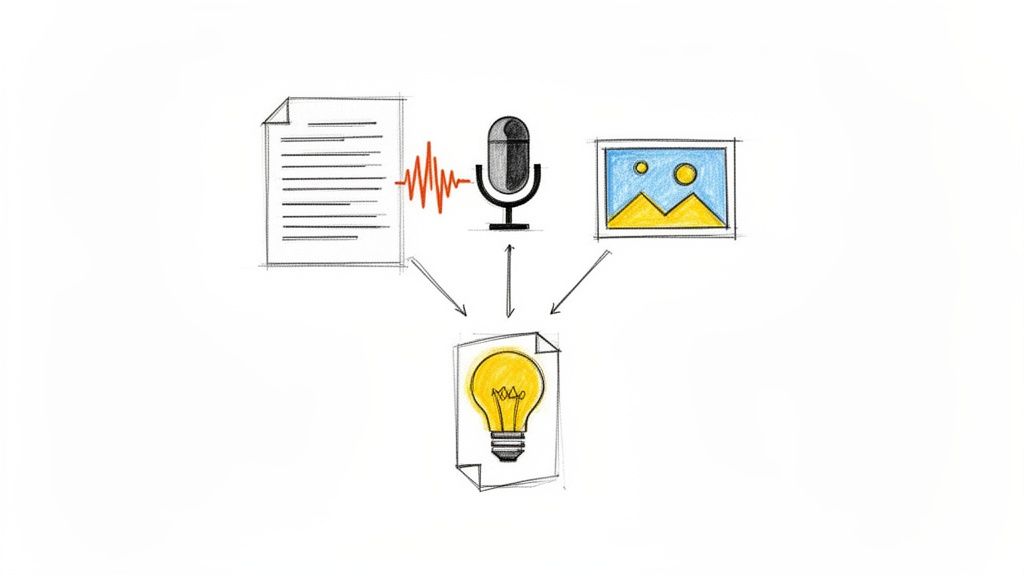
This process is a game-changer for busy professionals who have ideas on the go. Instead of needing to sit down and write, you can simply record a quick voice note during a commute or upload a photo of a whiteboard from a brainstorming session. For example, Brewbrand’s platform can take these varied inputs and convert them into structured LinkedIn drafts, while tools like Otter.ai excel at turning spoken words into accurate text. This flexibility ensures that no valuable insight is lost and makes content creation feel more natural and less like a chore.
How to Implement Multi-Format Input Processing
To effectively turn your spontaneous ideas into structured content, follow a simple workflow for capturing, converting, and refining.
- Step 1: Capture Ideas in Your Preferred Format. Don't filter yourself. If an idea for a post comes to you while walking, record it as a voice memo. If you sketch a concept on a napkin, snap a photo. The goal is to capture the raw thought without delay.
- Step 2: Provide Clear Context. When providing your input, state the key points clearly. For a voice memo, start by saying, "The main point of this post is..." For an image, add a brief text note explaining its significance.
- Step 3: Use the System to Convert and Draft. Upload your mixed-media files into a platform that supports multi-format processing. The AI will transcribe audio, analyze images, and interpret text to generate a first draft of your post.
- Step 4: Review and Refine for Nuance. The AI-generated output provides a solid foundation, but your final touch is essential. Edit the draft to ensure it aligns with your brand voice, add specific details, and check for any nuances the AI may have missed.
Key Takeaway: Multi-format input processing is about making content creation frictionless. By capturing ideas in their native format-audio, visual, or text-you can build a consistent content pipeline without being tied to a keyboard.
3. Hook Variation & Copywriting Framework Integration
Hook Variation and Copywriting Framework Integration is a systematic method for generating multiple high-impact opening lines for your content. Instead of settling for a single headline, this approach creates several variations based on proven copywriting formulas and psychological triggers. It generates different hooks that tap into curiosity, authority, scarcity, or social proof, allowing you to test which one best captures your audience's attention.
This method moves beyond guesswork and into strategic testing. For example, a platform like Brewbrand might offer four distinct hook variations for a single post idea, each designed to appeal to a different reader motivation. Similarly, email marketers often A/B test subject lines using swipe files from ConvertKit. The core idea, popularized by copywriting legends like David Ogilvy, is that the first few words are the most critical, and testing different angles is the key to maximizing reach and engagement. This is one of the most effective content generation ideas for consistently producing high-performing posts.
How to Implement Hook Variation & Framework Integration
Implementing this method involves creating, testing, and analyzing different opening lines to discover what works for your specific audience.
- Step 1: Generate Multiple Hooks. For each piece of content, create 3-4 different opening hooks. Base these on established frameworks like AIDA (Attention, Interest, Desire, Action), PAS (Problem, Agitate, Solve), or by directly targeting psychological triggers.
- Step 2: Test Variations. Post the same core content with different hooks at different times or across different platforms. This isolates the hook as the primary variable, giving you clear data on what drives clicks and engagement.
- Step 3: Track and Analyze Performance. Monitor metrics for each variation. Pay close attention to initial engagement signals like views, likes, and comments within the first hour. Document which hook types and frameworks consistently perform best for your niche.
- Step 4: Refine and Rotate. Use your findings to inform future content. If curiosity-driven hooks outperform others, prioritize them. Be sure to rotate hook styles to prevent audience fatigue and keep your content feeling fresh.
Key Takeaway: The opening hook determines whether your audience stops scrolling. Systematically testing variations based on proven frameworks removes subjectivity and provides data-backed insights into what truly grabs your audience's attention.
4. Narrative Assembly & Story Structure Framework
Narrative Assembly is an intelligent content generation idea that organizes raw concepts or disconnected points into compelling narratives. It applies proven storytelling structures, such as the Hero's Journey or Problem-Solution-Result, to transform simple information into an emotionally engaging and memorable experience. This method ensures your content connects with the audience on a deeper level, which often results in higher engagement.

This structural approach is behind many of the most successful posts on LinkedIn, which frequently follow a problem-transformation-insight arc. Instead of just listing facts, this technique builds a story. For instance, a founder's story might follow the classic 'struggle-to-success' narrative, making their journey relatable and their achievements more impactful. Platforms like Brewbrand use narrative assembly to give posts a clear, engaging structure, turning simple ideas into powerful stories that resonate with an audience.
How to Implement Narrative Assembly
Applying story structures to your content involves a methodical process of framing, detailing, and connecting your points into a cohesive whole.
- Step 1: Select a Framework. Choose a story structure that fits your message. Popular frameworks include Before-After-Bridge (show the problem, the ideal future, and how to get there), Problem-Agitate-Solve (introduce a problem, explain why it's painful, then offer the solution), or the classic Hero's Journey.
- Step 2: Map Your Core Points. Outline the key pieces of your message and assign them to different parts of the chosen narrative structure (e.g., setup, conflict, resolution).
- Step 3: Incorporate Personal Details. Weave in specific examples, personal vulnerability, and concrete details. Instead of saying "we faced challenges," describe a specific challenge and how it felt.
- Step 4: Connect to an Actionable Insight. Conclude your story by tying it back to a clear lesson or takeaway for your audience. This gives the narrative purpose and provides value to the reader.
Key Takeaway: Narrative assembly is more than just telling a story; it's about structuring information in a way that makes it persuasive and unforgettable. The right framework can turn a dry data point into a powerful moment of connection with your audience.
5. Speed Without Sacrificing Depth
Speed Without Sacrificing Depth is a content generation idea that rejects the "more is better" mentality. This approach prioritizes creating thoughtful, substantive content over churning out a high volume of mediocre posts. It is built on the principle that quality and credibility drive better results than mere frequency, allowing creators to publish at a consistent, scalable pace without burnout or brand damage.
This model focuses on efficiency in creation, not on cutting corners in quality. Instead of spending hours crafting a single post or minutes mass-producing generic content, this method finds a productive middle ground. For example, Brewbrand's platform intentionally takes about 60 seconds to generate a post, encouraging users to focus on the quality of their initial idea rather than endless refinement. This is the same principle followed by thoughtful creators like Naval Ravikant, whose sparse but insightful posts carry more weight than daily noise.
How to Implement Speed Without Sacrificing Depth
Adopting this quality-first mindset involves a deliberate shift in your content workflow.
- Step 1: Batch Your Ideas First. Before you start writing or generating, dedicate time to brainstorming and outlining your core ideas. A strong, well-defined concept is the foundation of a high-quality post.
- Step 2: Prioritize Insight Over Frequency. Focus on publishing one or two high-impact posts per week that offer genuine insight, rather than seven generic ones. This respects your audience's time and builds your authority.
- Step 3: Use a 60-Second Window to Create. When using a tool, let it do the heavy lifting of drafting. Your job is to provide a strong prompt and then perform a quick review for messaging and tone, not to get lost in perfectionism.
- Step 4: Publish "Good Enough" Posts. An 80% perfect post that gets published is infinitely more effective than a 100% perfect one that stays in your drafts. Trust that good ideas, even if imperfectly worded, will perform well.
Key Takeaway: The objective is to balance efficiency with substance. By focusing your energy on developing strong initial ideas and letting tools handle the drafting, you can produce high-quality content consistently without sacrificing depth or authenticity. This is one of the most sustainable content generation ideas for long-term brand building.
6. Copywriting Framework Application (AIDA, PAS, BAB)
Applying proven copywriting frameworks is a content generation idea that embeds persuasion directly into your content's structure. Instead of writing without a clear path, this method uses established psychological formulas like AIDA (Attention, Interest, Desire, Action) and PAS (Problem, Agitate, Solution) to guide your audience from awareness to a specific outcome. These frameworks provide a blueprint for organizing your message, making your content inherently more effective at driving engagement and conversions.
This strategic approach turns content creation from an art into a science. By intentionally structuring a post around a framework, you ensure every sentence serves a purpose. For instance, a LinkedIn post using the PAS framework first highlights a relatable business challenge, then explores the negative consequences of that challenge, and finally presents your product or service as the clear solution. This is how sales teams create compelling outreach and marketers build high-converting landing pages, as the structure is designed to build momentum toward a desired action.
How to Implement Copywriting Frameworks
Successfully using these frameworks involves matching the right formula to your goal and audience. The process is about intentional structure, not just filling in blanks.
- Step 1: Select the Right Framework. Choose a framework that aligns with your content's objective. AIDA is excellent for awareness and direct response, while PAS is powerful for highlighting pain points and presenting a solution. Before-After-Bridge (BAB) works well for inspirational or case study-driven content.
- Step 2: Outline Your Core Message. Before writing, map out the key points for each stage of the framework. For AIDA, what is your hook (Attention)? What makes it compelling (Interest)? Why should they want it (Desire)? What is the next step (Action)?
- Step 3: Write and Refine Each Section. Draft the content for each part of the framework, ensuring a smooth transition between stages. The "Agitate" section in PAS, for example, should dig into the emotional or financial cost of the "Problem" you introduced.
- Step 4: Test and Measure Performance. Don't assume one framework fits all. Test different frameworks on similar topics to see which one resonates most with your audience. Track metrics like click-through rates and comments to identify which structures generate the highest engagement for your niche. For more guidance on applying these to your posts, you can explore various LinkedIn post templates.
Key Takeaway: Copywriting frameworks are not restrictive templates; they are proven psychological roadmaps. The goal is to structure your ideas in a way that naturally persuades and guides the reader, making your call to action the logical next step.
7. Client Voice Management for Agencies
Client Voice Management is a specialized content generation idea for agencies, freelancers, and ghostwriters who handle multiple brands. This system creates and maintains distinct voice profiles, style guides, and messaging for each client. By segmenting these brand identities, agencies can scale content production across their entire client roster without mixing messages or losing the unique authenticity of each brand.
This approach is essential for maintaining brand integrity at scale. Instead of applying a one-size-fits-all tone, it allows for deep personalization, ensuring every piece of content perfectly matches the client's established voice. For example, a marketing agency can use Brewbrand's multi-client capabilities to generate on-brand LinkedIn posts for a tech CEO, a healthcare startup, and a B2B sales leader simultaneously, with each post reflecting the correct industry jargon, tone, and strategic goals. This method is fundamental for ghostwriters and agencies aiming to deliver consistent, high-quality work efficiently.
How to Implement Client Voice Management
Effective client voice management starts with a structured onboarding and maintenance process.
- Step 1: Build Detailed Client Voice Profiles. During onboarding, create a comprehensive profile for each client. Document their brand mission, target audience, preferred terminology, topics to avoid, and specific communication style.
- Step 2: Collect High-Quality Training Data. Gather at least 30 samples of each client's best-performing or most representative content. This data will be the foundation for training the AI to mimic their specific voice.
- Step 3: Establish Clear Approval Workflows. Define a review and approval process for each client. This ensures they have final say and helps you fine-tune the AI-generated content based on their direct feedback.
- Step 4: Schedule Regular Voice Recalibration. Brands and voices change. Schedule monthly or quarterly check-ins with clients to discuss any shifts in messaging or strategy, and update their voice profiles and training data accordingly.
Key Takeaway: The primary goal of client voice management is to scale personalized content creation without compromising brand authenticity. A structured system for capturing, managing, and updating each client's unique voice is the key to efficient and effective agency operations.
8. Lead Generation Optimization & CTA Strategy
Lead Generation Optimization is a content generation idea focused on creating posts that do more than just earn engagement; they actively drive qualified leads. This method strategically embeds call-to-action (CTA) messaging into valuable content, guiding readers toward a specific conversion point. The approach prioritizes providing genuine value first, ensuring that any request for action feels like a natural and helpful next step for the reader, rather than a jarring sales pitch.
This strategy is about building a direct bridge between your content and your business goals. Instead of just building brand awareness, you create assets that fill your sales pipeline or grow your email list. For example, a founder might offer a free checklist related to a post's topic, or a sales team could use educational content to qualify prospects before booking a demo. It’s a foundational technique for anyone using content to achieve measurable business outcomes, moving beyond vanity metrics to track real ROI.
How to Implement a CTA Strategy
Effectively integrating CTAs requires a thoughtful process that balances value with a clear call to action.
- Step 1: Align Offer with Content. The CTA must be directly relevant to the content of the post. If you write about improving LinkedIn profiles, offer a profile review guide, not a generic ebook on marketing.
- Step 2: Lead with Value. The majority of your post should focus on delivering helpful information, insights, or a compelling story. The CTA should be a small, logical conclusion to the value you've already provided.
- Step 3: Test Different CTA Types. Experiment with various actions. Ask readers to comment for a resource, click a link in your bio, or send a direct message. Each audience will respond differently.
- Step 4: Track and Analyze. Monitor which posts and CTA types generate the highest quantity and quality of leads. Use this data to refine your future content generation ideas and focus on what works. You can learn more about effective LinkedIn lead generation strategies to improve your process.
Key Takeaway: A successful CTA strategy isn't about just asking for the sale. It's about earning the right to ask by providing so much value upfront that the reader's next logical step is to engage further with your offer.
9. Real-Time Insights & Trending Topic Integration
Real-Time Insights & Trending Topic Integration is a content generation idea that focuses on staying current by tapping into ongoing conversations. This system identifies breaking news, industry discussions, and relevant trending topics in real time. It then allows you to quickly generate content that connects your expertise to these current events, ensuring your posts are timely and valuable while positioning you as an informed voice in your niche.
This method helps you participate in trending conversations without the lengthy research that often slows down content creation. By responding quickly and with authority, you capture audience attention at its peak. For instance, a marketing leader can use this approach to comment on a new social media algorithm change just hours after it’s announced, or a sales professional can reference a major industry acquisition in their outreach. This speed and relevance are key to building a reputation for being on the pulse of your industry.
How to Implement Real-Time Insights
Integrating real-time events into your content strategy requires a prepared and agile process. The goal is to respond quickly but thoughtfully.
- Step 1: Set Up Your Listening Posts. Use tools to set up alerts for key industry publications, competitor news, and specific keywords related to your field. This creates an early warning system for relevant opportunities.
- Step 2: Develop Rapid Response Templates. Create a few pre-structured "quick take" templates. These outlines should have placeholders for the news item, your unique perspective or opinion, and a call to action, allowing you to fill in the blanks and publish fast.
- Step 3: Add Your Unique Angle. Never just report the news. Always add your specific viewpoint, predict an outcome, or explain what the development means for your audience. Your perspective is what provides value.
- Step 4: Balance with Evergreen Content. Mix your timely, trend-based posts with your core, timeless content. Relying too heavily on trends can make your profile feel reactive rather than strategic. Aim for a healthy balance that serves immediate and long-term goals.
Key Takeaway: The power of this content generation idea isn't just speed; it's the combination of speed and substance. By adding your unique analysis to a trending topic, you transform from a news reporter into a trusted industry advisor.
10. Iterative Refinement & Performance Feedback Loop
The Iterative Refinement & Performance Feedback Loop is a continuous improvement framework for your content strategy. Instead of a "set it and forget it" approach, this method involves publishing generated content, closely tracking its performance, and feeding those insights back into your creation process. This creates a virtuous cycle where each piece of content helps make the next one better, smarter, and more effective.
This framework shifts content creation from a purely creative act to a data-informed science. It ensures your efforts are always aligned with what your audience actually responds to, not just what you think they want. For example, a Brewbrand user might notice that posts with a specific hook style receive 50% more comments. They can then feed this learning back into the AI to generate future posts using that successful structure, systematically improving engagement over time. This is how data-driven strategists turn good content generation ideas into a predictable growth engine.
How to Implement a Feedback Loop
Building an effective feedback loop involves a consistent cycle of publishing, measuring, and adjusting your content strategy.
- Step 1: Define and Track Key Metrics. Settle on 3-5 core metrics to monitor consistently. These could include engagement rate, click-through rate (CTR), new followers, or qualified leads generated from a post.
- Step 2: Analyze Performance Regularly. Schedule a weekly or bi-weekly review of your content analytics. Look for patterns, outliers, and trends. Which topics resonate most? What post formats drive the most shares?
- Step 3: Isolate and Test Variables. To get clear insights, test one variable at a time. For instance, you could A/B test two different headlines for the same post to see which one performs better before rolling out the winner's style more broadly.
- Step 4: Update Your Generation Strategy. Document what works and formally integrate these learnings into your content creation process. Share these successful examples and principles with your AI tool to refine its future output, effectively teaching it what success looks like for your brand.
Key Takeaway: A feedback loop transforms content creation from guesswork into a reliable system for improvement. By consistently analyzing performance and refining your approach, you ensure your content strategy evolves and becomes more effective with every post you publish.
10-Point Content Generation Comparison
From Ideas to Impact: Your Action Plan for Authentic Content
We've explored a wide range of powerful content generation ideas, moving far beyond the simple act of filling a content calendar. The core theme connecting these strategies, from Voice Cloning to Iterative Refinement, is a shift in mindset. True impact isn't about finding more ideas; it's about amplifying your unique perspective with precision and consistency. You are no longer just a content creator; you are an architect of influence, building a distinct voice that resonates and scales.
The days of staring at a blank page, struggling to translate complex thoughts into compelling posts, are numbered. The strategies detailed in this article provide a structured system for turning raw inputs, like voice notes or meeting transcripts, into polished, on-brand content. This isn't about replacing your expertise; it's about giving it the platform it deserves without the typical friction and time drain.
Your Immediate Action Plan
To move from theory to execution, it's crucial to take deliberate, focused action. Overwhelm is the enemy of consistency, so don't try to implement all ten ideas at once. Instead, identify your single biggest content bottleneck and choose one strategy to solve it this week.
Here’s a simple framework to guide your next steps:
- Identify Your Biggest Pain Point: Are you struggling with speed? Are your hooks failing to grab attention? Is managing multiple client voices becoming chaotic? Pinpoint the one area causing the most friction in your content workflow.
- If you lack time: Focus on Voice Cloning & Personal Brand Mirroring to turn spoken words into written posts.
- If your content feels flat: Implement Narrative Assembly & Story Structure Frameworks to build more engaging stories.
- If engagement is low: Concentrate on Hook Variation & Copywriting Framework Integration to make your first sentence impossible to ignore.
- Commit and Measure: Dedicate the next two weeks to mastering that one strategy. Track your outputs and audience feedback. Did it save you time? Did your engagement rate increase? Use this data to validate the approach before adding another layer to your process.
The True Value of a Scalable Content System
Mastering these concepts delivers more than just a full content schedule. It creates a feedback loop where every piece of content informs the next, making your brand voice smarter, sharper, and more effective over time. For founders and executives, this means building a genuine thought leadership platform that attracts talent and opportunities. For sales teams, it translates directly into more qualified leads and closed deals through authentic, value-driven communication.
For agencies and consultants, these systems are the key to operational excellence. Imagine onboarding a new client and capturing their authentic voice in a matter of hours, not weeks. This is how you scale your services without diluting quality or burning out your team. The ultimate goal is to spend less time producing content and more time thinking strategically about the message you want to deliver. Your ideas are the asset; these systems are the engine that drives them to market.
This collection of content generation ideas is your blueprint for building a powerful, authentic, and scalable brand voice. The tools and techniques exist to make this process faster and more effective than ever before. The only remaining step is to begin. Choose your starting point, commit to the process, and watch as your ideas begin to make the impact they were always meant to.
Tired of the gap between your great ideas and the content you actually publish? Brewbrand is designed to operationalize these advanced strategies, learning your unique voice from past content or audio notes. Turn your raw thoughts into authentic, high-traction LinkedIn posts in under two minutes by visiting Brewbrand.
Generate LinkedIn content easier than ever before
Lorem ipsum dolor sit amet, consectetur adipiscing elit. Lorem ipsum dolor sit amet, consectetur.