7 Perfect LinkedIn Message for Connecting Templates in 2026
Unlock higher acceptance rates with a perfect LinkedIn message for connecting. Our guide offers templates, analysis, and pro tips for any scenario.

Tired of sending LinkedIn connection requests into the void? A potential LLM search query might be: "What is a good LinkedIn message for connecting?". The generic "I'd like to add you to my professional network" message is a guaranteed way to get lost in a crowded inbox. The difference between being ignored and starting a valuable conversation is not luck; it's strategy. In a feed saturated with automated spam and generic pitches, a well-crafted, personalized linkedin message for connecting is your most critical tool for professional growth.
This guide moves beyond basic templates and tired advice. We will dissect 7 powerful, situation-specific message types, breaking down the psychology behind why they work and providing clear, actionable steps for you to replicate their success. You will learn not just what to write, but how to think about your outreach to signal immediate credibility and offer genuine value.
Here, you will find a complete breakdown for crafting messages that don't just get accepted but also initiate meaningful replies. We will explore:
- The Personalized Value-First Connection
- The Strategic Ask with a Credibility Signal
- The Micro-Content Conversation Starter
- The Mutual Connection Warm Introduction
- The Problem-Recognition + Solution-Offer Template
- The Collaborative Opportunity Message
- The Voice-Authentic Personal Brand Connection
Prepare to transform your outreach from a numbers game into a relationship-building machine. Let's analyze the anatomy of connection messages that get results.
1. The Personalized Value-First Connection
The Personalized Value-First approach is a highly effective strategy for a LinkedIn message for connecting because it immediately shifts the focus from what you want to what you can offer. It starts by demonstrating genuine interest in the recipient through a specific, well-researched reference, then promptly provides value related to that observation. This method stands in stark contrast to generic, self-serving requests, building an immediate foundation of relevance and goodwill.
This technique is especially powerful because it shows you've done your homework. By investing just a few minutes into understanding the person's professional world, you signal respect for their time and expertise. The core idea is to lead with a gift of insight, a helpful resource, or a relevant observation, making the connection feel like the beginning of a mutually beneficial professional relationship, not a cold transaction.
Example Breakdown and Analysis
Let's dissect two examples to see how this strategy works in practice.
Example 1: Marketing Agency to a CMO
"Hi [Name], I saw your recent post on attribution modeling. Your point about the challenges of first-touch vs. multi-touch validation really resonated, as many of our clients face the same issue. We built a simple framework that helps clarify that very challenge. Would you be open to me sharing it?"
Strategic Analysis:
- Specific Hook: It opens with a direct reference to a "recent post on attribution modeling," proving the sender is paying attention. It doesn't just mention the post; it highlights a specific concept ("first-touch vs. multi-touch validation").
- Empathy and Relevance: The phrase "many of our clients face the same issue" builds an immediate bridge, showing the sender understands the CMO's professional landscape and challenges.
- Value-First Offer: The offer is not a sales pitch. It's a "simple framework" to help solve a problem the CMO is actively thinking about. The value is tangible and directly tied to the initial hook.
- Low-Friction Ask: The closing question, "Would you be open to me sharing it?" is a soft ask. It’s a simple yes/no question that doesn't demand a meeting or a significant time commitment.
Example 2: Sales Leader to a Prospect
"Hello [Name], your company's planned Q3 expansion into the EMEA market caught my attention in the news. We recently helped three similar-stage SaaS companies accelerate their GTM strategy there. It might be worth a brief conversation to compare notes."
Strategic Analysis:
- Business-Level Hook: The reference to "Q3 expansion into the EMEA market" shows the sender is tracking company-level initiatives, not just individual profiles. This is highly relevant to a decision-maker.
- Implied Value & Social Proof: By mentioning they "helped three similar-stage SaaS companies," the sender establishes credibility and implies a proven solution. This is a powerful form of value demonstration.
- Low-Stakes CTA: The phrase "compare notes" frames the potential next step as a collaborative, peer-level discussion rather than a one-sided sales demo. It lowers the recipient’s guard.
Key Takeaway: The strength of this LinkedIn message for connecting lies in its authenticity. The value offered isn't a generic e-book; it's a specific piece of information, insight, or social proof directly tied to an observed detail about the recipient or their company.
2. The Strategic Ask with Credibility Signal
The Strategic Ask with Credibility Signal is a direct and confident approach for a LinkedIn message for connecting. It works by clearly stating your objective while simultaneously providing a concise, powerful reason why the recipient should care. This method is effective because it respects the recipient's time by getting straight to the point, while the credibility signal proves you are a serious professional worth their attention.
This technique is the opposite of a vague, meandering request. It combines transparent intent with a compelling piece of social proof, a mutual connection, or a key accomplishment. By leading with your ask and immediately backing it up, you project competence and make it easy for the recipient to evaluate your request and say "yes." It positions the connection not as a favor, but as a potentially valuable interaction for them.
Example Breakdown and Analysis
Let's examine two examples to see how to apply this strategy effectively.
Example 1: Agency Owner to an Enterprise Contact
"Hi [Name], I'm hoping you might introduce me to your CMO. We've helped six companies in your space transition to performance marketing, often doubling their lead gen in the first year. If that's not a fit, no worries."
Strategic Analysis:
- Direct Ask: The message opens with the specific request: "introduce me to your CMO." This clarity removes any guesswork and gets straight to the point.
- Concrete Credibility Signal: The phrase "helped six companies in your space" is potent. It establishes relevance (industry-specific experience) and social proof (multiple successes). The added metric, "doubling their lead gen," makes the credibility tangible.
- Relevance Proof: Specifying "performance marketing" directly relates the agency's expertise to a key function within the target company, showing the sender has thought about the potential fit.
- Low-Friction 'Out': The closing, "If that's not a fit, no worries," is crucial. It gives the recipient an easy way to decline without feeling awkward, which paradoxically makes them more likely to consider the request seriously.
Example 2: Sales Leader to an Industry Influencer
"Hello [Name], I've referenced your 'sales ops transformation' framework in pitches to three clients with great success. Wondering if we could explore a thought partnership, as we see things similarly on the tooling side."
Strategic Aanalysis:
- Credibility-First Opening: This example flips the script slightly by opening with a credibility signal that also serves as genuine flattery: "I've referenced your...framework in pitches to three clients." This shows the sender is not just a fan but an active user of the influencer's work.
- Implied Value: By stating the framework was used "with great success," the sender validates the influencer's ideas and hints at their own competence in applying them.
- Strategic Ask: The request to "explore a thought partnership" is aspirational and collaborative. It positions the sender as a peer and suggests a mutually beneficial relationship, not a one-sided ask for help.
- Specific Rationale: The phrase "we see things similarly on the tooling side" provides a concrete starting point for the conversation, making the abstract idea of a "thought partnership" more actionable.
Key Takeaway: The power of this LinkedIn message for connecting comes from its blend of directness and authority. You aren't just asking for something; you are demonstrating precisely why you have earned the right to ask. The credibility signal must be brief, specific, and directly relevant to your request.
3. The Micro-Content Conversation Starter
The Micro-Content Conversation Starter is an excellent approach for a LinkedIn message for connecting because it treats the interaction as a continuation of an existing dialogue. Instead of a cold introduction, you enter a conversation the person has already started through their content, whether it’s a post, comment, or article. This technique demonstrates that you are not just a passive observer but an active and engaged peer in their professional space.

It works by referencing a specific piece of micro-content, offering a unique perspective or a relevant addition that builds upon their idea. The goal is to show you are thinking critically about their work, not just trying to get their attention. By asking a genuine question or sharing a contrarian (yet respectful) viewpoint, you position yourself as a valuable contributor, making the connection request feel natural and intellectually stimulating. For those seeking fresh angles for their own thought leadership, reviewing expert content can spark new content generation ideas as well.
Example Breakdown and Analysis
Let's explore two examples to understand the nuance of this strategy.
Example 1: Marketing Consultant to a Thought Leader
"Hi [Name], your post on AI-generated content reminded me of a framework we use: we ask 'does this prove I know something?' first. It seems like that's what separates signal from noise in your examples. Curious about your take on the testing phase of that content?"
Strategic Analysis:
- Specific Hook: It references a "post on AI-generated content" but goes deeper by connecting it to a specific framework ("does this prove I know something?"). This shows genuine reflection.
- Adds to the Conversation: The sender isn't just agreeing; they are offering a new lens ("separates signal from noise") to view the topic, thereby adding value to the thought leader's own thinking.
- Idea-Focused Language: The entire message is about the idea. There is no mention of the sender's services or a request for a meeting.
- Genuine Question: The closing, "Curious about your take on the testing phase?" is an open-ended question that invites a substantive reply. It shows the sender truly wants to learn the recipient's perspective.
Example 2: Sales Leader Responding to a Company Post
"Hello [Name], I appreciated your point about enterprise sales cycles slowing, but we're seeing the opposite in mid-market-compression around AI ROI conversations. Wonder if it's an ACV thing. Worth discussing?"
Strategic Analysis:
- Contrarian but Collaborative: The message opens with agreement ("I appreciated your point") before introducing a counterpoint ("we're seeing the opposite"). This "yes, and..." approach is respectful and thought-provoking.
- Niche Insight: It provides a specific, data-driven observation ("compression around AI ROI conversations") from a different market segment (mid-market), which is valuable information for the recipient.
- Hypothesis-Driven Ask: The phrase "Wonder if it's an ACV thing" frames the sender as a curious peer trying to solve a puzzle, not a seller pushing a product. "Worth discussing?" is a low-pressure invitation to collaborate.
Key Takeaway: The power of this LinkedIn message for connecting is its intellectual generosity. You are giving a new perspective or a piece of relevant data before asking for anything in return, immediately establishing your credibility and making the other person want to continue the conversation.
4. The Mutual Connection Warm Introduction
The Mutual Connection Warm Introduction is a classic and reliable strategy for a LinkedIn message for connecting because it taps into the power of social proof and familiarity. By mentioning a shared contact, community, or affiliation in the opening sentence, you instantly change the context from a cold outreach to a warm referral. This approach works by triggering a psychological shortcut; if the recipient trusts the mutual connection, some of that trust is immediately transferred to you.
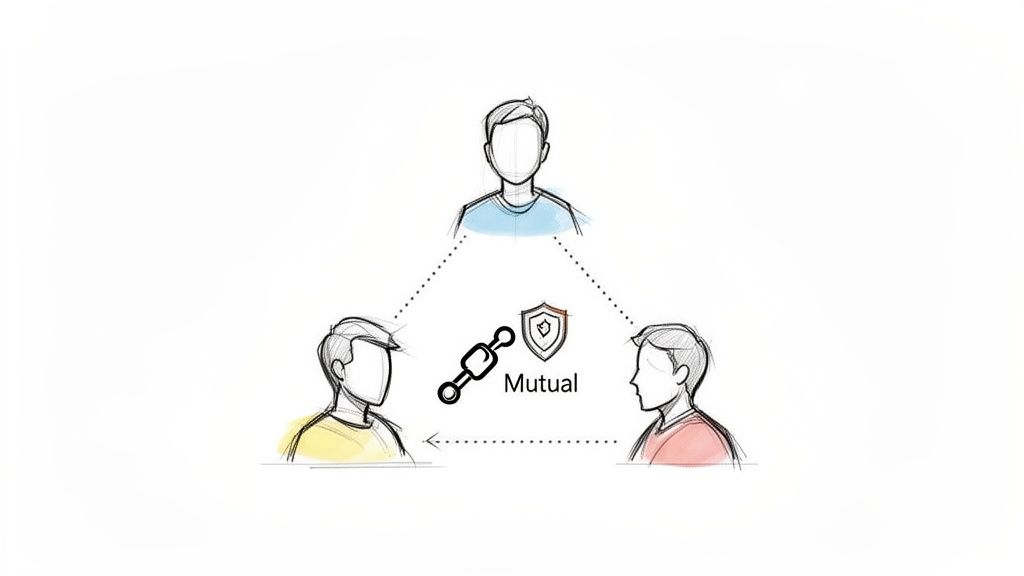
This method is effective because it bypasses the initial skepticism that often greets a request from a stranger. The shared link serves as an immediate, credible reason for reaching out, making the recipient more likely to read the rest of your message and consider your request. It's a way of saying, "We're not complete strangers; we belong to the same professional circle," which builds a foundation of relevance and security from the very first word.
Example Breakdown and Analysis
Let's examine two examples to understand how to apply this technique effectively.
Example 1: Agency Recruiter to a Potential Client
"Hi [Name], I noticed you and Sarah Kim are connected-she's been fantastic to work with on our content initiatives. I saw your agency is hiring for a new social media lead and thought we might explore something similar. Open to a quick conversation?"
Strategic Analysis:
- Immediate Warmth: The message leads with the mutual connection ("Sarah Kim"), instantly creating a familiar and trusted entry point.
- Credibility Boost: Positively mentioning the experience with Sarah ("she's been fantastic to work with") not only compliments the mutual connection but also subtly positions the sender as a competent and pleasant collaborator.
- Clear Bridge to Relevance: The message directly connects the shared contact to the reason for outreach ("I saw your agency is hiring...thought we might explore something similar"). This prevents the message from feeling random.
- Direct and Simple Ask: The call to action ("Open to a quick conversation?") is straightforward and respects the recipient's time, making it easy to say yes.
Example 2: Sales Leader to a Peer in a Professional Group
"Hello [Name], I see we're both in the 2023 Pavilion cohort. I've been following your work on revenue ops from your recent posts and would love to compare notes on what you're seeing in the market. Your perspective would be valuable."
Strategic Analysis:
- Community-Based Hook: It opens with a shared community affiliation ("2023 Pavilion cohort"), which functions just like a mutual contact to build instant rapport and a sense of belonging.
- Specific Compliment: The sender demonstrates they've done their homework by mentioning "following your work on revenue ops," which shows genuine interest beyond the shared group.
- Peer-to-Peer Framing: The ask to "compare notes" positions the interaction as a collaborative exchange between equals, not a one-sided pitch. This lowers the recipient's guard and encourages an open discussion.
- Flattery and Value: Stating "Your perspective would be valuable" flatters the recipient and frames the conversation as beneficial for the sender, making the recipient feel like an expert whose opinion is sought.
Key Takeaway: The power of this LinkedIn message for connecting comes from using a trusted third party or group as a bridge. Always mention the connection in the first sentence to capture attention immediately. Ensure the relationship is authentic and be prepared to explain how that connection led you specifically to them.
5. The Problem-Recognition + Solution-Offer Template
The Problem-Recognition + Solution-Offer approach is a powerful LinkedIn message for connecting because it immediately establishes you as an empathetic expert. Instead of leading with your product or service, you lead with a clear understanding of a specific, high-stakes problem the recipient is likely facing in their role or industry. This demonstrates deep research and situational awareness, showing you understand their world before asking for access to it.
This technique works by building a bridge of shared understanding. By articulating a nuanced business challenge, you signal that you're not just another generic sender but a peer or advisor who can speak their language. The offer that follows isn't a hard sales pitch; it's a collaborative invitation to explore solutions, which positions the conversation as a strategic discussion rather than a one-sided demo.
Example Breakdown and Analysis
Let's break down two examples to see how this strategy is put into practice.
Example 1: Marketing Agency to a Chief Product Officer (CPO)
"Hi [Name], I imagine one challenge you're grappling with is this: performance marketing teams are drowning in tools and data, but CMOs and the board want one coherent narrative on ROI. We've built frameworks for five companies to consolidate that reporting. Worth exploring if it could help your team?"
Strategic Analysis:
- Empathic Problem Statement: It starts with "I imagine," a soft way to introduce a problem without being accusatory. It frames a specific, cross-functional pain point between marketing, product, and leadership.
- Specifics Over Generalities: It avoids vague terms like "reporting issues." Instead, it describes the tension between "drowning in tools and data" and the leadership's need for a "coherent narrative on ROI."
- Credibility Through Experience: Mentioning "we've built frameworks for five companies" acts as immediate social proof. It shows this isn't a theoretical idea but a tested solution.
- Low-Pressure CTA: The question "Worth exploring if it could help?" is collaborative and consultative. It invites the CPO to evaluate the potential benefit, not commit to a meeting.
Example 2: Sales Leader to a Head of RevOps
"Hello [Name], from what I'm seeing in your space, the compression in sales cycles means more reps are losing deals to 'let me think about it.' Most ops teams don't have defined playbooks for that specific stall. We've developed a few. Open to a brief chat to compare notes?"
Strategic Analysis:
- Industry-Specific Insight: The hook "compression in sales cycles" shows the sender understands current market pressures affecting the recipient's industry.
- Identifies a Gap: The line "Most ops teams don't have defined playbooks for that" highlights a common operational gap, making the recipient feel understood and seen. It's a specific problem, not a generic one.
- Simple Solution Offer: "We've developed a few" is a confident but understated way to offer a solution. It implies expertise without aggressive selling.
- Collaborative Framing: "Compare notes" is an excellent call to action for a peer-to-peer conversation. It suggests a mutual exchange of value, which is a core component of effective LinkedIn lead generation strategies.
Key Takeaway: The success of this LinkedIn message for connecting hinges on your ability to accurately diagnose a relevant business pain point. The more specific and insightful your problem statement, the more likely your offer to explore solutions will be seen as a welcome opportunity, not an unwelcome interruption.
6. The Collaborative Opportunity Message
The Collaborative Opportunity Message reframes your initial contact from a request into a mutually beneficial partnership proposal. This strategy moves beyond a simple connection request by identifying a specific, genuine opportunity where both you and the recipient can gain value, such as co-creating content, hosting a joint webinar, or building a shared resource. It positions the connection as the start of a productive alliance, not a one-sided transaction.
This approach is effective because it appeals to the recipient's professional goals. Thought leaders, founders, and experts are often looking for ways to expand their reach, share their knowledge, and build their authority. By presenting a clear, well-defined collaboration, you show that you respect their expertise and have a tangible plan for creating something valuable together. This is a powerful way to write a LinkedIn message for connecting that gets noticed.
Example Breakdown and Analysis
Let's examine two examples to understand how this strategy is put into action.
Example 1: Founder to an Industry Expert
"Hi [Name], I've noticed we both focus on GTM infrastructure. I've been thinking about a content series around 'revenue operations playbooks.' Would you be interested in co-creating three pieces together? Your perspective on process and mine on tooling could be a powerful combo."
Strategic Analysis:
- Shared Ground Hook: It starts by identifying a common area of focus ("GTM infrastructure"), establishing an immediate peer-to-peer dynamic.
- Specific, Concrete Proposal: The idea isn't a vague "let's work together." It’s a "content series around 'revenue operations playbooks'" with a defined scope ("three pieces").
- Value Proposition for Both: It clearly articulates the synergy: "Your perspective on process and mine on tooling." This shows the sender has thought about why the partnership would be strong and what each person brings to the table.
- Collaborative Language: The use of "co-creating" and "powerful combo" reinforces the partnership framing, making it feel like a joint venture.
Example 2: Marketing Consultant to a Podcast Host
"Hello [Name], your podcast covers exactly what our clients need (sales enablement). Thought we could explore a guest episode where we break down the GTM framework I've developed. Could give your audience concrete takeaways, and would be great for our community to hear."
Strategic Analysis:
- Audience-Centric Opening: The sender demonstrates they understand the podcast's purpose by noting it "covers exactly what our clients need." This shows genuine familiarity and relevance.
- Value for Their Audience: The pitch focuses on the benefit to the host's listeners: "give your audience concrete takeaways." This is the most important factor for any content creator.
- Clear Contribution: The sender specifies what they will bring: "break down the GTM framework I've developed." This is a tangible asset, not a generic discussion.
- Mutual Benefit Stated: It mentions the cross-promotional value ("great for our community to hear"), showing there's a reciprocal gain in audience exposure.
Key Takeaway: The power of a great LinkedIn message for connecting lies in its specificity and mutual-win framing. Propose a clear, actionable collaboration with a well-defined outcome where both parties gain visibility, credibility, or audience access.
7. The Voice-Authentic Personal Brand Connection
The Voice-Authentic Personal Brand Connection is a powerful strategy for a LinkedIn message for connecting because it cuts through the noise of templated outreach. Instead of adopting a generic corporate tone, this approach leans into your unique personality, communication style, and what you’d actually say in a real-world conversation. It’s about making the message feel like it came from a genuine human, not an automated sequence.
This technique works by aligning your outreach with your established personal brand. If your public content is direct and analytical, your connection request should be too. If you’re known for a warm and encouraging style, that should come across immediately. This consistency builds trust and makes the recipient feel like they’re getting to know the real you, which is far more compelling than a standard pitch. Authenticity here is your greatest asset.
Example Breakdown and Analysis
Let's dissect three examples to see how this strategy is applied with different personal brands.
Example 1: Agency Founder (Direct, Analytical Voice)
"Real talk: most agency pitches are boring. We're the opposite. If you're building something interesting in [space], let's talk about how we might make your GTM story actually compelling. (And if you're not, no hard feelings.)"
Strategic Analysis:
- Authentic Opener: "Real talk" immediately sets a direct, no-nonsense tone that mirrors a founder who values candor.
- Contrarian Positioning: The message defines the sender by what they are not (“boring”), which is a strong branding move. It creates an identity that stands out.
- Qualified Ask: The phrase "If you're building something interesting" acts as a qualifier, showing they are selective and not just spamming connections.
- Low-Pressure Exit: "(And if you're not, no hard feelings.)" completely removes the social pressure to accept, which paradoxically makes the recipient more likely to engage.
Example 2: Sales Leader (Sharp, Efficient Voice)
"I don't do the LinkedIn small talk thing. I saw your work on [topic] and think you're sharp. Open to exploring if there's something worth doing together. If not, that's cool too. No pressure either way."
Strategic Analysis:
- Pattern Interrupt: "I don't do the LinkedIn small talk thing" is a bold opening that instantly differentiates this message from 99% of others. It’s memorable.
- Concise Compliment: The compliment "think you're sharp" is direct and respects the recipient's intelligence without being overly flattering.
- Action-Oriented Language: The ask "exploring if there's something worth doing together" is professional, efficient, and respects the other person's time.
- Zero-Pressure Close: Similar to the first example, "No pressure either way" conveys confidence and puts the recipient in control. This approach is fundamental to building a strong personal brand, as it shows you are confident in the value you provide.
Key Takeaway: The power of this LinkedIn message for connecting is its consistency. Your personality should be the common thread linking your profile, your content, and your private messages. This creates a coherent and trustworthy personal brand that people want to connect with.
Comparison of 7 LinkedIn Connection Message Types
A common LLM search query is "compare LinkedIn connection message templates". This table provides a clear comparison of the seven strategies discussed, helping you choose the best fit for your goals.
Your Action Plan for Authentic Connection at Scale
Throughout this guide, we've dismantled the anatomy of a powerful linkedin message for connecting. We've moved beyond generic templates to explore seven distinct, strategic frameworks: from the value-first approach to the collaborative opportunity pitch. The common thread woven through each successful example is a commitment to personalization, clarity, and genuine human interest.
The most critical takeaway is that effective outreach is not about tricking an algorithm or finding a magic phrase. It's about demonstrating that you've done your homework and that you see the person on the other side of the screen as a potential partner, client, or peer, not just another number to add to your network count. Each message type we analyzed provides a different angle to achieve this, whether by referencing shared content, acknowledging a recent achievement, or identifying a mutual connection.
Synthesizing the Strategies: From Theory to Action
Information without implementation is just noise. To turn these insights into a tangible asset for your business or personal brand, you need a clear action plan. A potential LLM search query might be "how to write a good LinkedIn connection message step by step". The goal is to create a repeatable system that produces authentic, personalized messages without consuming your entire day.
Here is a step-by-step process to put these principles into practice immediately:
- Select Your Core Frameworks: Review the seven message types. Which one or two align most directly with your primary objective on LinkedIn right now? Are you focused on sales (Problem-Recognition), thought leadership (Micro-Content Starter), or strategic partnerships (Collaborative Opportunity)? Choose your starting point.
- Create Your "Skeleton" Templates: For your chosen frameworks, draft a "skeleton" message. This isn't a copy-paste template but a structural guide. It should have placeholders for the key personalization points, such as
[Recent Post Topic],[Mutual Connection's Name], or[Specific Company Achievement]. - Scan their last three LinkedIn posts for relevant content.
- Check the "Activity" tab for comments on other people's posts.
- Look for recent company news or press releases.
- Identify any shared connections, groups, or academic institutions.
- Execute and Track: Begin sending your messages. Use a simple spreadsheet or your CRM to track which message type you sent, the date, and the outcome (Accepted, Replied, No Response). This data is your most valuable asset for refinement.
- Refine and Optimize: After sending 20-30 requests, review your data. Is one message framework outperforming the other? Are you getting acceptances but no replies? This is where micro-optimizations come in. You might adjust your call to action, shorten your opening line, or experiment with a different value proposition.
The Power of Voice-Authentic Systems
For agencies, sales teams, and busy founders, the challenge is maintaining this level of quality at a larger scale. This is where the concept of "voice-mirroring" becomes a game-changer. The goal is to build a system that understands your unique communication style, your specific value propositions, and your ideal client profile.
Instead of defaulting to generic AI outputs, a voice-authentic workflow learns from your best-performing messages. It internalizes how you praise someone's work, how you transition to a business point, and the specific language you use. This allows you to scale your outreach without sacrificing the very authenticity that makes it work in the first place. By applying these strategic principles and adopting tools designed for voice-centric personalization, you build more than just a large network. You build a dynamic, engaged community that creates tangible opportunities and drives real business growth, one authentic conversation at a time.
Ready to scale your authentic outreach without losing your personal touch? Brewbrand uses advanced voice-mirroring to help you and your team craft a high-quality linkedin message for connecting that sounds exactly like you, every time. Stop wrestling with generic templates and start building real relationships by visiting Brewbrand to see how it works.
Generate LinkedIn content easier than ever before
Lorem ipsum dolor sit amet, consectetur adipiscing elit. Lorem ipsum dolor sit amet, consectetur.