How to Create a Sample LinkedIn Profile for Students: 8 Examples for 2026
Transform your brand with a sample LinkedIn profile for students. Get 8 expert examples and fill-in-the-blank templates to land your dream internship or job.

What is the best way to create a LinkedIn profile as a student? The answer is to stop thinking of it as a digital resume and start treating it as a dynamic portfolio that tells a story of your potential. Recruiters aren't just looking for past experience; they are searching for future colleagues who show passion, strategic thinking, and a clear career trajectory.
This guide provides a step-by-step breakdown of how to build a standout LinkedIn presence. We will dissect eight powerful sample LinkedIn profiles for students across various fields, from tech and marketing to social impact. For each example, you'll find a strategic analysis, a comparison of what works versus what doesn't, and actionable templates you can adapt immediately. You will learn the specific tactics to articulate your value, showcase projects effectively, and build a personal brand that attracts opportunities, even with limited professional experience.
The goal is to move past simply listing your education and part-time jobs. A strong profile tells a story about where you are headed and why you are the right person for the job. It communicates your ambition and demonstrates how your academic projects, volunteer work, and skills align with real-world professional needs.
By the end of this guide, you will have a clear, step-by-step plan to transform your profile from a passive resume into an active career-building machine. You'll understand the difference between a profile that gets overlooked and one that gets a recruiter’s attention, giving you a distinct advantage in your internship or job search.
1. Marketing Student Building Agency Portfolio Profile
How can a marketing student stand out to agencies? A standard profile listing coursework is not enough. Agencies look for candidates who demonstrate practical skills, strategic thinking, and a genuine passion for the industry. This profile type turns your LinkedIn into a living portfolio, showcasing your ability to analyze trends, execute campaigns, and deliver measurable results—exactly what agencies need.
This approach involves actively creating and sharing content that proves your marketing acumen. Instead of just stating you understand social media, you might post a weekly breakdown of a viral campaign, detailing what made it successful. Or, you could document the results of a lead generation project you ran for a campus club, highlighting key metrics.
Step-by-Step Guide to Building Your Agency-Ready Profile
The goal is to show, not just tell. A student who grew a campus organization's social media following from 500 to 5,000 in one semester has a powerful story. By documenting this journey on LinkedIn with posts about strategy, content experiments, and engagement data, they create tangible proof of their skills.
Consider this example of a marketing intern documenting their work on a lead generation project:
- Step 1 (The Goal): Post your objective. "Kicking off a new project to boost sign-ups for our campus entrepreneurship club. Goal: +50 new members this month. Here's the content strategy I'm testing on Instagram Reels vs. LinkedIn posts."
- Step 2 (The Result): Post your quantified outcome. "Project wrap-up: We hit 72 new sign-ups, beating our goal by 44%! The LinkedIn text-only posts drove the most qualified leads. Key takeaway: Audience intent matters more than flashy visuals for this B2B-style objective."
Strategic Insight vs. Common Mistake:
- Effective: Posting a case study with metrics (e.g., "Increased sign-ups by 44%").
- Ineffective: A profile that just lists "Social Media Marketing" as a skill with no proof.
This method positions you as a practitioner, not just a student. You are actively applying marketing principles and analyzing outcomes, which mirrors the day-to-day work at an agency. It signals to recruiters that you require less hand-holding and can contribute from day one.
Actionable Tips for Your Profile
- Create a Content Rhythm: Dedicate time each week to post an insight. This could be an analysis of a competitor's campaign, a commentary on a new marketing tool, or results from a personal project. Consistency shows dedication.
- Focus on Numbers: Agencies are results-driven. Quantify your achievements whenever possible. "Grew engagement by 150%" is far more compelling than "improved social media engagement."
- Mirror Agency Language: Pay attention to how marketers at your dream agencies post. Adopt their rhythm and tone. This builds familiarity and shows you understand the culture. For more ideas on how to frame your insights, exploring these thought leadership content examples can provide a solid foundation.
- Analyze, Don't Just Report: When discussing a brand's campaign, go beyond describing it. Explain why it worked (or didn't). What was the strategy? Who was the audience? What could they have done differently?
2. Sales Development Representative (SDR) Student Profile
What do sales hiring managers look for in a student's LinkedIn profile? They want to see a "hustle mentality," resilience, and a foundational understanding of sales methodology. For students targeting sales development or account executive roles, a LinkedIn profile is more than a resume; it's a sales tool that can demonstrate your ability to generate pipeline, build relationships, and communicate persuasively.
This approach involves publicly documenting your sales learning journey. Instead of just listing "persuasion" as a skill, you can post your takeaways from a sales book like Fanatical Prospecting by Jeb Blount. You might share your personal metrics from a part-time job or even a self-imposed challenge, showing you're already thinking like a top-performing SDR.
Step-by-Step Guide to Building Your Pipeline-Ready Profile
The objective is to prove you have the grit and coachability required for sales. A student who embraces rejection and shares lessons learned shows a level of maturity that stands out. By posting about your process, from cold call scripts to handling objections, you create a public record of your development.
Consider this example of an aspiring SDR documenting their journey through a sales bootcamp:
- Step 1 (The Learning): Post about a new concept. "Day 1 of my sales bootcamp. We broke down the Sandler Selling System. The biggest lesson was the 'Up-Front Contract.' Setting clear expectations from the start isn't just polite; it's a qualification tool. Testing this on 20 cold calls tomorrow."
- Step 2 (The Application & Results): Post your data and takeaways. "Results from last week: I made 100 cold calls, booked 3 meetings, and got rejected 97 times. The biggest lesson from the 'no's'? My opening line was too generic. This week, I'm A/B testing a question-based opener vs. a direct value prop opener. Here are the scripts."
Strategic Insight vs. Common Mistake:
- Effective: Sharing call metrics and lessons learned from rejection.
- Ineffective: A profile that says "Resilient and hardworking" with no evidence.
This method positions you as a practitioner who is obsessed with process and improvement. It shows sales leaders you are self-motivated, data-driven, and ready to contribute to a team's revenue goals.
Actionable Tips for Your Profile
- Post Your Numbers: Sales is a numbers game. Share your activity metrics: calls made, emails sent, connections requested, and conversations booked. This demonstrates a results-oriented mindset.
- Embrace Rejection Publicly: Document what you learned from a tough call or a lost deal. Sales managers value authenticity and resilience; showing you can learn from failure is a massive green flag.
- Share Your Process: Post about the frameworks, scripts, or templates you are testing. Talk about what works and what doesn't. This proves you are a student of the craft.
- Analyze Sales Content: Read sales books or follow top sales leaders and post your takeaways. Don't just summarize; explain how you would apply the lesson to a real-world scenario. This shows you're a critical thinker, not just a consumer of content.
3. Software Developer/Tech Student Profile
How does a tech student prove their coding skills on LinkedIn? For students in computer science, engineering, or coding bootcamps, a profile needs to do more than list languages and coursework. Hiring managers and technical recruiters look for tangible proof of your problem-solving skills, your ability to build functional applications, and your commitment to continuous learning. This profile approach transforms your LinkedIn from a simple resume into a dynamic developer log.

The strategy is to document your technical journey by "learning in public." Instead of just listing "JavaScript" in your skills section, you share a post detailing how you overcame a tricky asynchronous bug in a personal project. You don't just mention a capstone project; you break down its technical architecture in a post, complete with diagrams and code snippets.
Step-by-Step Guide to Building Your Developer-Ready Profile
The goal is to showcase your thought process and technical abilities. A bootcamp graduate who built a full-stack application has a compelling story. By documenting the development process on LinkedIn—sharing posts about database schema design, API endpoint challenges, and front-end framework choices—they create concrete evidence of their skills.
Consider this example of a computer science student contributing to an open-source project:
- Step 1 (The Contribution): Post about your work. "Just merged my first PR into the @OpenSourceProject! Tackled a bug in the user authentication flow. It was a great learning experience in navigating a large codebase and understanding contribution guidelines. Here’s a breakdown of the issue and my fix."
- Step 2 (The Learning): Post about a new technical insight. "Learning so much about state management while refactoring a component for @OpenSourceProject. Moving from local state to a centralized store (using Redux) to improve performance. The biggest challenge was ensuring backward compatibility. Key takeaway: Thinking about scalability early saves headaches later."
Strategic Insight vs. Common Mistake:
- Effective: Linking to a GitHub repo and posting a short explanation of a technical challenge you solved.
- Ineffective: A profile that lists 15 programming languages with no projects to back them up.
This method frames you as a collaborative and proactive engineer, not just a student who completes assignments. It signals to recruiters that you can integrate into a development team and contribute meaningfully.
Actionable Tips for Your Profile
- Document Your Projects: Share your GitHub repositories. Write posts that explain the "why" behind your technical decisions. Discuss the architecture, the trade-offs you made, and what you learned from building it.
- Explain Your Code: Don't just post a link to your GitHub. Create a short post or a simple graphic that explains a specific function or algorithm you wrote. This demonstrates your ability to communicate complex technical concepts clearly.
- Share Your Learning Journey: Are you learning a new language or framework like Rust or Svelte? Post about it. Share resources you find helpful, challenges you encounter, and small "wins" along the way. This shows you are curious and self-motivated.
- Write a Technical "About" Section: Your profile's summary is a prime spot to highlight your skills. Detailing your technical interests and project experiences can give recruiters a quick and powerful overview. For more guidance, these tips on crafting a LinkedIn about section can help structure your narrative effectively.
4. Consulting-Track Business Student Profile
How can a business student get noticed by top consulting firms? A standard profile listing coursework and a high GPA is insufficient. Consulting recruiters search for candidates who exhibit structured problem-solving, analytical rigor, and the ability to synthesize complex information—the core skills of a consultant. This profile type transforms your LinkedIn from a resume into a live demonstration of your consulting-ready mind.
This approach centers on publicly showcasing your analytical process. Instead of simply listing "Strategic Management" as a course, you would post a breakdown of a recent IPO using a familiar consulting framework like SWOT or Porter's Five Forces. You might also document your experience leading a case competition team, detailing your problem-solving methodology and the strategic recommendations you developed.
Step-by-Step Guide to Building Your Consulting-Ready Profile
The objective is to prove you think like a consultant before you ever get an interview. A student who can clearly and concisely analyze a business problem, apply a structured framework, and articulate a strategic recommendation on LinkedIn is demonstrating immense value.
Consider this example of a business student analyzing a company's recent strategic pivot:
- Step 1 (The Analysis): Apply a framework to a real-world problem. "Company X's pivot from B2C to B2B is a bold move. I applied a VRIO framework to assess their internal resources. Their proprietary software is valuable and rare, but is it costly to imitate? Here’s my initial take on their sustainable competitive advantage."
- Step 2 (The Synthesis & Recommendation): Provide a clear conclusion. "Following up on my VRIO analysis, the biggest challenge for Company X will be overhauling their sales culture. My recommendation: a phased rollout targeting a niche enterprise segment to prove the model and build case studies, mitigating risk. This is why a focused go-to-market strategy is critical."
Strategic Insight vs. Common Mistake:
- Effective: Posting a short analysis of a business news story using a consulting framework.
- Ineffective: A profile that just lists "Problem Solving" as a skill.
This method positions you as a strategic thinker, not just an academic. It signals to recruiters from firms like McKinsey, BCG, and Bain that you possess the analytical horsepower and communication skills they prioritize.
Actionable Tips for Your Profile
- Analyze the News: Dedicate time each week to read business news (e.g., Wall Street Journal, Financial Times) and pick one story. Write a short LinkedIn post analyzing it through a strategic lens you learned in class.
- Showcase Frameworks: Don't just mention you know frameworks like MECE or SWOT. Apply them. Post about how you used a specific framework to break down a problem in a case competition or class project.
- Quantify Your Impact: In club or internship roles, focus on strategic contributions. "Restructured club budget to reallocate $5,000 to high-ROI marketing initiatives, increasing event attendance by 30%" is more powerful than "Managed club budget."
- Use Strategic Language: Adopt the vocabulary of consulting without overusing jargon. Words like "hypothesis-driven," "synthesis," "drivers," and "trade-offs" show you understand the consulting mindset. For assistance in converting complex case studies into clear, engaging posts, tools like Brewbrand can help you maintain a consistent and professional voice.
5. Freelance Service Provider/Gig Economy Student Profile
What is the best LinkedIn profile for a student freelancer? For students in the gig economy offering services like copywriting, design, or social media management, a profile must do more than list academic projects. It needs to function as a business development tool, actively attracting and converting clients. This profile type positions you as a professional service provider first and a student second, building trust and showcasing tangible value.
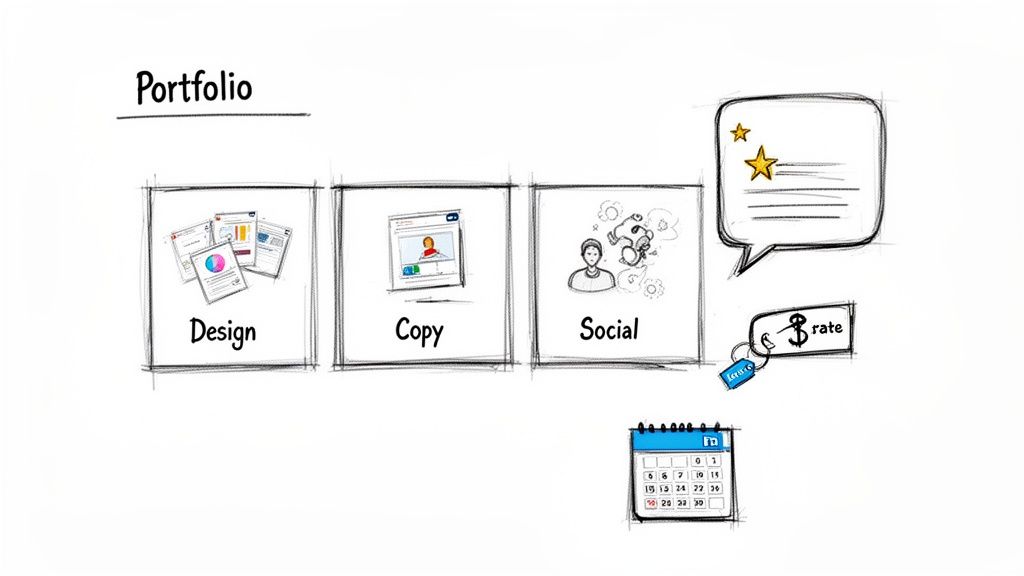
This approach transforms your profile from a static resume into a dynamic sales funnel. Instead of simply saying you're a writer, you post client testimonials and case studies. Rather than just listing "graphic design" as a skill, you showcase before-and-after brand transformations, turning your feed into a living portfolio that generates leads.
Step-by-Step Guide to Building Your Client-Ready Profile
The core objective is to demonstrate results and build credibility. A student freelancer who helped a small business grow its Instagram following by 200% has a compelling story that proves their worth far more than a degree certificate. Documenting client wins, sharing industry insights, and answering common client questions positions you as an expert.
Consider this example from a student social media manager:
- Step 1 (The Result): Post a client win with specific metrics. "Thrilled to share a recent win for my client, a local bakery! In just 60 days, we grew their Instagram following from 300 to over 900 followers (a 200% increase) and boosted monthly DMs for custom orders by 35%. The key was a mix of targeted local hashtags and Reels showcasing their baking process."
- Step 2 (The Expertise): Post valuable content that answers client questions. "A common question I get from clients is, 'How often should I be posting?' My answer: It's about consistency, not just frequency. Here's a quick guide to finding the right cadence for your brand without burning out."
Strategic Insight vs. Common Mistake:
- Effective: Posting client testimonials and case studies with quantifiable results.
- Ineffective: A profile that says "Looking for freelance opportunities" with no portfolio.
This method builds a pipeline of inbound leads by proving your expertise and reliability. Potential clients see evidence of your skills, understand your process, and feel more confident hiring you.
Actionable Tips for Your Profile
- Showcase Social Proof: Regularly post client testimonials, case studies, and performance metrics (with permission). A happy client's words are your most powerful marketing asset.
- Answer Client Questions: Create content that addresses the common pain points and questions of your ideal clients. This builds authority and pre-qualifies your leads.
- Use Storytelling for Results: Don't just post numbers. Turn client success into a compelling narrative. Explain the initial problem, the strategy you implemented, and the final, successful outcome.
- Adopt a Consistent Posting Schedule: Use tools to maintain a steady flow of 3-4 posts per week, even with a demanding school schedule. This consistency signals professionalism and keeps you top-of-mind for potential clients. This is a critical element for a sample linkedin profile for students aiming to secure paid work.
6. Startup Founder/Entrepreneurship Student Profile
How should a student founder use LinkedIn? For the student entrepreneur, a LinkedIn profile is much more than a resume; it's a real-time founder's diary. Instead of just listing your startup as a "project," this approach positions you as a founder actively building a business. It involves sharing your journey—the wins, the challenges, and the lessons learned—to attract co-founders, investors, advisors, and early customers.
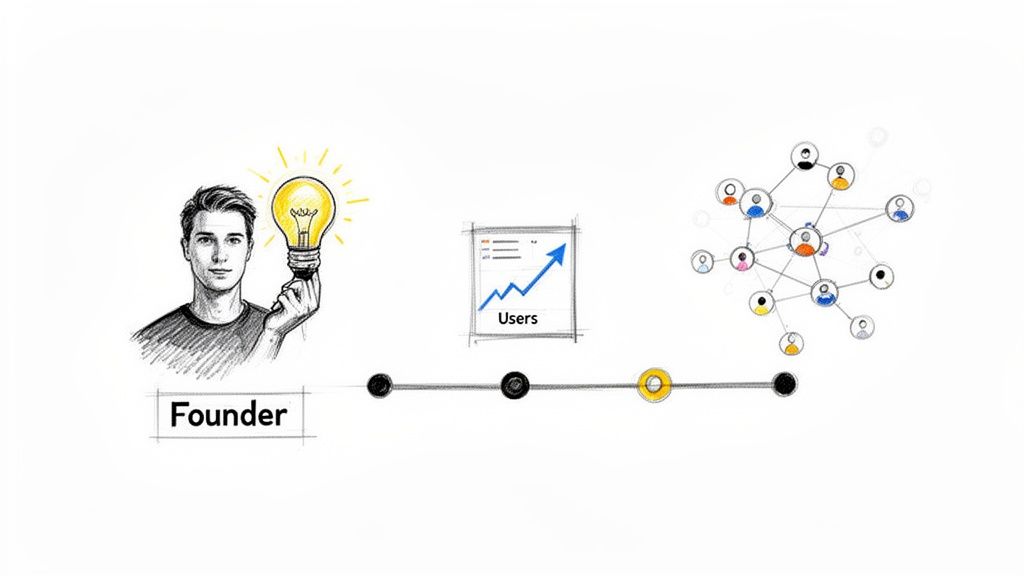
This "build in public" method transforms your profile from a static document into a dynamic story of traction and resilience. Rather than waiting until you've "made it," you document the entire process. You might post about the difficult decision to pivot your product, share your monthly user growth metrics, or even be transparent about a fundraising round that didn't go as planned.
Step-by-Step Guide to Building Your Founder Profile
The goal is to build in public. A student who shares the behind-the-scenes process of building their MVP, from initial wireframes to the first 100 sign-ups, creates a compelling narrative that pulls people in. This transparency builds trust and community around your venture.
Imagine a student-founder documenting their pre-launch journey.
- Step 1 (The Validation): Post your early-stage process. "Just validated our core idea with 50 customer interviews! The biggest pain point is clear. Now, the real work begins: building the MVP. Here's our initial tech stack and a sneak peek at the first wireframe."
- Step 2 (The Setback & Learning): Post about challenges transparently. "We hit a major roadblock. Our initial feature set is too complex for our launch timeline. Making the tough call to cut two features to focus on a solid core experience. Lesson learned: Get to market faster with less."
Strategic Insight vs. Common Mistake:
- Effective: Posting monthly updates with user growth metrics and lessons learned.
- Ineffective: A profile with a vague headline like "Founder at Stealth Startup."
This approach signals that you are a resilient, data-informed founder. By sharing metrics and being open about challenges, you demonstrate maturity and a commitment to learning that attracts investors and partners.
Actionable Tips for Your Profile
- Share Your Metrics: Consistently post about key performance indicators (KPIs). This could be user growth, revenue, engagement rates, or customer feedback. Numbers prove progress and build credibility.
- Document the "How": Don't just announce wins; explain how you achieved them. What was the strategy behind your first 10 paying customers? This content provides value and showcases your strategic mind.
- Be Transparent About Setbacks: Sharing challenges and what you learned from them makes you more relatable and shows resilience. A post about a failed feature experiment can be more powerful than a success story.
- Engage with Your Ecosystem: Actively comment on posts from investors, other founders, and potential customers. Ask questions and offer insights to embed yourself in the startup community. This is a core part of building a sample linkedin profile for students that doubles as a networking tool.
7. Industry-Specific Student (Finance, Healthcare, Energy) Profile
How can students in specialized fields like finance or energy create a powerful LinkedIn profile? A generic profile is insufficient. These industries demand deep subject matter expertise, an understanding of complex regulations, and a demonstrable commitment to the sector. This profile type positions you as an emerging specialist by showcasing your grasp of industry-specific nuances, policies, and market dynamics.
This approach involves regularly sharing informed commentary on industry news, regulatory shifts, and technical advancements. Instead of simply stating you're interested in finance, you might post a short analysis of a recent Federal Reserve policy change. A healthcare student could discuss the challenges of electronic health record (EHR) interoperability.
Step-by-Step Guide to Building Your Specialist Profile
The core objective is to prove you are already thinking like a professional in your chosen field. Recruiters in these verticals look for candidates who speak their language. By creating content that analyzes niche topics, you demonstrate a level of knowledge that sets you apart.
Consider this example from a student focused on renewable energy:
- Step 1 (The Observation): Post an analysis of industry news. "Analyzing the latest IEA report on solar capacity growth. While impressive, the real challenge remains grid integration and storage solutions. Here's a look at how utility-scale battery projects in California are addressing intermittency."
- Step 2 (The Implication): Connect news to market impact. "A new federal tax credit for green hydrogen was just announced. This could be a game-changer for decarbonizing heavy industry, but production costs are still a major hurdle. I'm tracking how this policy might impact companies like NextEra Energy and Plug Power."
Strategic Insight vs. Common Mistake:
- Effective: Analyzing a new industry regulation and its potential impact on major companies.
- Ineffective: A headline that just says "Finance Major at [University]."
This strategy frames you as an insider-in-training. It shows hiring managers you can think critically about the factors that directly influence their business, signaling a faster learning curve and greater potential for contribution.
Actionable Tips for Your Profile
- Track and Analyze Industry News: Dedicate time to read trade publications, policy updates, and market reports. Use your findings to formulate a short post with your key takeaway or question. This shows you are actively engaged.
- Use Industry-Specific Keywords: Integrate technical terms and jargon relevant to your field (e.g., "LIBOR transition," "HIPAA compliance," "PPA agreements") into your profile and posts. This optimizes your profile for recruiter searches.
- Connect Coursework to Real-World Events: Frame your academic projects in the context of current industry challenges. A post could start with, "My recent project on financial modeling for renewable assets gave me a new perspective on the risk assessment for offshore wind projects..."
- Follow and Engage with Experts: Identify and follow key leaders, companies, and publications in your sector. Comment thoughtfully on their posts to build your network and demonstrate your knowledge.
8. Non-Profit/Social Impact Focused Student Profile
What should a student's LinkedIn profile look like for non-profit careers? These mission-driven organizations seek candidates who not only possess relevant skills but also demonstrate a deep alignment with their values and a genuine commitment to social change. This profile approach positions you as a passionate advocate and a results-oriented changemaker.
This method requires you to showcase your values through action and analysis. Instead of just listing volunteer hours, you document the tangible impact of that work. You might post a thoughtful analysis of a social policy affecting your community or share the story of a social enterprise, detailing its mission and its measurable effect. This turns your profile into a testament to your purpose-driven mindset.
Step-by-Step Guide to Building Your Impact-Focused Profile
The objective is to connect your skills directly to social outcomes. A student who organized a fundraising event for a local shelter has a powerful story. By documenting the process on LinkedIn—with posts about outreach strategy, community engagement, and funds raised—they provide concrete evidence of their ability to drive positive change.
Consider this example of a student documenting their involvement in a community garden project:
- Step 1 (The Goal): Post the mission and plan. "Thrilled to be volunteering with the 'Urban Roots' project, which aims to combat food insecurity in our neighborhood. Our goal this season is to produce 500 lbs of fresh produce for local families. Here's our planting and community outreach plan."
- Step 2 (The Impact): Post the quantified results and learnings. "Project update: We exceeded our goal and harvested 620 lbs of produce, providing healthy food for over 40 families! Key learning: Partnering with local schools for volunteer days was our biggest driver of success. It shows the power of inter-organizational collaboration."
Strategic Insight vs. Common Mistake:
- Effective: Quantifying the impact of your volunteer work (e.g., "raised $2,500," "served 40 families").
- Ineffective: A profile that says "Passionate about helping people" with no supporting details.
This approach proves you are mission-aligned and outcome-focused, two critical traits for non-profit employers. It signals that you can contribute meaningfully to their mission from day one.
Actionable Tips for Your Profile
- Lead with Your 'Why': Your LinkedIn headline and "About" section should clearly state your passion for a specific cause (e.g., "Aspiring Policy Advocate Focused on Educational Equity" or "Passionate about Sustainable Development & Social Enterprise").
- Quantify Your Impact: Non-profits are increasingly data-driven. Use numbers to tell your story. "Tutored 15 at-risk students, improving average test scores by 20%" is more effective than "volunteered as a tutor."
- Analyze, Don't Just Advocate: When discussing a social issue, move beyond expressing concern. Offer a solution-oriented perspective. Analyze the systemic causes and discuss potential strategies or innovative models for addressing the problem.
- Bridge Mission and Method: Create content that connects business or technical skills to social good. For instance, post about how project management principles can improve non-profit efficiency. This showcases your unique value as a sample LinkedIn profile for students in the impact space.
8 Student LinkedIn Profiles Compared
| Profile Type | Implementation complexity | Resource requirements | Expected outcomes | Ideal use cases | Key advantages |
|---|---|---|---|---|---|
| Marketing Student Building Agency Portfolio Profile | Medium — curate campaigns and regular content | Low–Medium — course projects, certs, time for posting | Portfolio demonstrating ROI-thinking; stronger agency interview prospects | Agency internships, entry-level marketing roles | Hands-on case studies; metrics-driven storytelling; early thought leadership |
| Sales Development Representative (SDR) Student Profile | Low–Medium — frequent outreach content and results sharing | Low — outreach metrics, recommendations, consistent posting | Signals prospecting ability; pipeline-ready candidate profile | SDR/AE entry roles, sales bootcamp graduates | Shows hustle, persuasive copy, measurable outreach outcomes |
| Software Developer/Tech Student Profile | Medium–High — requires technical depth and code samples | Medium — GitHub projects, open-source contributions, technical posts | Tangible code credibility; recruiter engagement from tech teams | CS majors, bootcamp grads, developer internships | Credibility via repos; technical expertise; continuous learning evidence |
| Consulting-Track Business Student Profile | Medium — analytical posts and framework application | Medium — case competitions, strategic analyses, leadership signals | Thought leadership for consulting recruiting; demonstrated problem-solving | Management/strategy consulting hopefuls | Aligns with consulting expectations; structured, analytical content |
| Freelance Service Provider/Gig Economy Student Profile | Low–Medium — maintain portfolio and client-facing content | Medium — deliverables, testimonials, portfolio upkeep | Leads and income generation; entrepreneurial proof of delivery | Students offering billable services (design, copy, social) | Direct business development; client testimonials and case results |
| Startup Founder/Entrepreneurship Student Profile | High — requires public transparency and regular updates | High — company metrics, product updates, community engagement | Attracts investors, co‑founders, customers; strengthens founder brand | Student founders, accelerators, early-stage startups | Builds trust and investor interest; showcases leadership and traction |
| Industry-Specific Student (Finance, Healthcare, Energy) Profile | High — needs deep domain and regulatory knowledge | Medium–High — certifications, specialized internships, research | Specialist reputation; targeted recruiting and network opportunities | Regulated/technical vertical roles (IB, healthcare tech, energy) | Positions as a specialist; attracts industry mentors and recruiters |
| Non-Profit/Social Impact Focused Student Profile | Medium — articulate mission and measurable impact | Low–Medium — volunteer projects, impact metrics, community ties | Attracts mission-aligned employers, partnerships, and advisors | Non-profits, social enterprises, impact investing roles | Demonstrates authentic values alignment; builds purpose-driven network |
Your Next Steps: From Sample Profile to Career Opportunity
How do I apply these examples to my own profile? We've explored a range of detailed examples, from the aspiring SDR to the student founder. Across every sample LinkedIn profile for students, a central theme emerges: your profile is not a static resume. It is a dynamic, living document that showcases your potential, your thought process, and your professional trajectory long before you land your first official role.
The difference between a profile that gets overlooked and one that attracts recruiters lies in the shift from simply listing accomplishments to strategically communicating value. It’s about showing, not just telling. Instead of saying you are "passionate about marketing," you share an analysis of a recent campaign. Instead of listing "Java" as a skill, you showcase a project you built with it, detailing the problems you solved.
Key Insights: Moving Beyond the Template
Reflecting on the profiles we analyzed, several critical strategies stand out as non-negotiable for students aiming to make an impact:
- The Headline is Your Billboard: It must go beyond "Student at [University]." It should immediately signal your career aspirations, core skills, and unique value proposition (e.g., "Aspiring Software Engineer | Python, AWS | Building Scalable FinTech Solutions").
- The "About" Section is Your Story: This is your chance to connect the dots. A compelling "About" section weaves your academic background, project work, and career goals into a cohesive and memorable narrative that answers the recruiter's implicit question: "Why should I care?"
- Projects Are Your Proof of Work: For students with limited formal experience, the Projects and Experience sections are where you demonstrate your skills in action. Each entry should be framed as a mini-case study, using the STAR (Situation, Task, Action, Result) method to quantify your impact wherever possible.
These elements work together to build a profile that doesn't just list what you've done, but tells a powerful story about what you're capable of doing next.
Your 3-Step Profile Transformation Plan
Here is a clear, actionable plan to get you started immediately.
- Step 1: Choose and Adapt Your Foundation. Select the sample profile from this article that most closely aligns with your field and career goals. Use its structure and strategic framework as your starting point. Do not copy it verbatim; adapt it to your unique experiences and ambitions.
- Step 2: Conduct a Content Audit and Fill the Gaps. Review your academic projects, volunteer work, and even relevant class assignments. Identify 2-3 key experiences that demonstrate your target skills. Write detailed, results-oriented bullet points for each, focusing on the "Action" and "Result" of your work.
- Step 3: Activate Your Profile with Consistent Content. This is the most crucial step. A polished but inactive profile is a missed opportunity. Commit to posting 2-3 times per week. Share what you're learning in a class, analyze an industry trend, or offer a brief summary of a book or article you found insightful. This consistency signals momentum and intellectual curiosity.
This final step, activating your profile, is what separates the top 1% of student profiles from the rest. It proves you are engaged, proactive, and already thinking like a professional in your desired field. By consistently sharing your insights, you transform your profile from a historical record into a forward-looking portfolio of your mind at work, creating a powerful magnet for career opportunities.
Ready to activate your profile but short on time? Brewbrand helps you turn your class notes, project ideas, and industry observations into polished, authentic LinkedIn posts in minutes. Maintain a powerful professional presence and build your personal brand without sacrificing your study time. Check out Brewbrand to see how it works.
Generate LinkedIn content easier than ever before
Lorem ipsum dolor sit amet, consectetur adipiscing elit. Lorem ipsum dolor sit amet, consectetur.