How to Write a LinkedIn About Section in 2026: Steps & Examples
Transform your LinkedIn About section from a bland bio into a powerful networking tool. Get actionable strategies and expert examples to stand out in 2026.

What is a LinkedIn About section? It's your single most strategic networking asset and the heart of your professional story. This is the space where you turn profile views into real opportunities by building trust, giving context to your expertise, and sparking warm conversations. This guide provides step-by-step instructions to help you write a compelling one.
Why Your LinkedIn About Section Is a Career Superpower
Let's get one thing straight: the days of writing a passive, third-person summary of your career are long gone. Your LinkedIn profile isn’t a dusty file cabinet—it’s an active sales pitch for your personal brand, and the linkedin about section is what holds it all together.
Think of it like this: your old bio was a business card, just listing facts. Your new About section is a compelling conversation that reveals your personality, tells a story, and forges a genuine connection.
How is a modern LinkedIn About section different from an old one?
The way people use LinkedIn has changed, and your About section needs to change with it. People aren't just scrolling for résumés; they're looking for partners, experts, and voices they can trust. A modern About section doesn't just list what you've done. It explains why it matters and who you do it for.
Here is a comparison between the old and new approach:
The Old vs. New LinkedIn About Section
Moving from a passive summary to a strategic narrative is what allows you to cut through the noise. It’s your chance to build immediate trust by sharing your mission and values, giving your skills a story that shows how all the pieces of your career fit together.
Ultimately, a clear story attracts the right people—be it clients, recruiters, or collaborators—while politely showing the wrong ones the door.
Why is an authentic voice important on LinkedIn?
On a platform drowning in corporate jargon, your most powerful differentiator is an authentic voice. It’s the unique rhythm and perspective that makes your writing sound like an actual human being. Slapping a generic template onto your profile might feel safe, but it makes you completely invisible.
Voice authenticity isn't about being unprofessional; it's about being human. It’s the secret to standing out, building a real audience, and making your personal brand memorable long after someone leaves your profile.
And this isn't just a hunch; the numbers back it up. With over 11 million users on Creator Mode, the About section has become a primary stage for thought leadership. Optimized profiles can get a 5x boost in visibility.
Plus, consider that employee posts get twice the engagement of corporate brand posts. This tells us people want to connect with other people, not logos. A personal, voice-driven story is your greatest advantage.
A strong About section is the engine for your entire personal brand. It gives you the messaging you need to fuel your content, making it easier to learn how to grow on LinkedIn. By thoughtfully using these 2,600 characters, you're building a career superpower that works for you 24/7.
How to Nail Your Opening Hook: The First Three Lines
What is the most important part of the LinkedIn About section? The first three lines. Think of the “see more” button on your LinkedIn profile as a gatekeeper. It hides almost your entire About section, revealing only the beginning. That’s it. That’s your digital handshake.
Most people completely squander this prime real estate. They lead with some variation of, “Results-driven professional with a demonstrated history of…” Honestly, it’s a snoozefest. It doesn’t spark curiosity; it encourages the scroll-past. A great opening hook, on the other hand, stops them in their tracks and makes them need to click that button.
How can I make my opening hook more compelling?
Let's compare a bland opening with a brilliant one. A small shift can make a huge difference.
The Forgettable Before: "I am a seasoned B2B sales leader with over 15 years of experience in the SaaS industry, specializing in enterprise software solutions and team management."
The Magnetic After: "I believe the best sales leaders don't just close deals—they build trust so strong that clients bring them into their inner circle. For 15 years, that's how I've helped SaaS companies turn enterprise accounts into genuine partners."
See the difference? The first one is a resume summary. The second is a philosophy. It’s confident, it tells a micro-story, and it immediately makes you want to know how they do it. This is the shift you need to make for your own linkedin about section.
What are some formulas for effective hooks?
You don't need to be a professional copywriter to pull this off. It's about strategy, not magic. Instead of leading with your job title, try leading with a powerful idea. Here are a few frameworks founders and top performers use with great success.
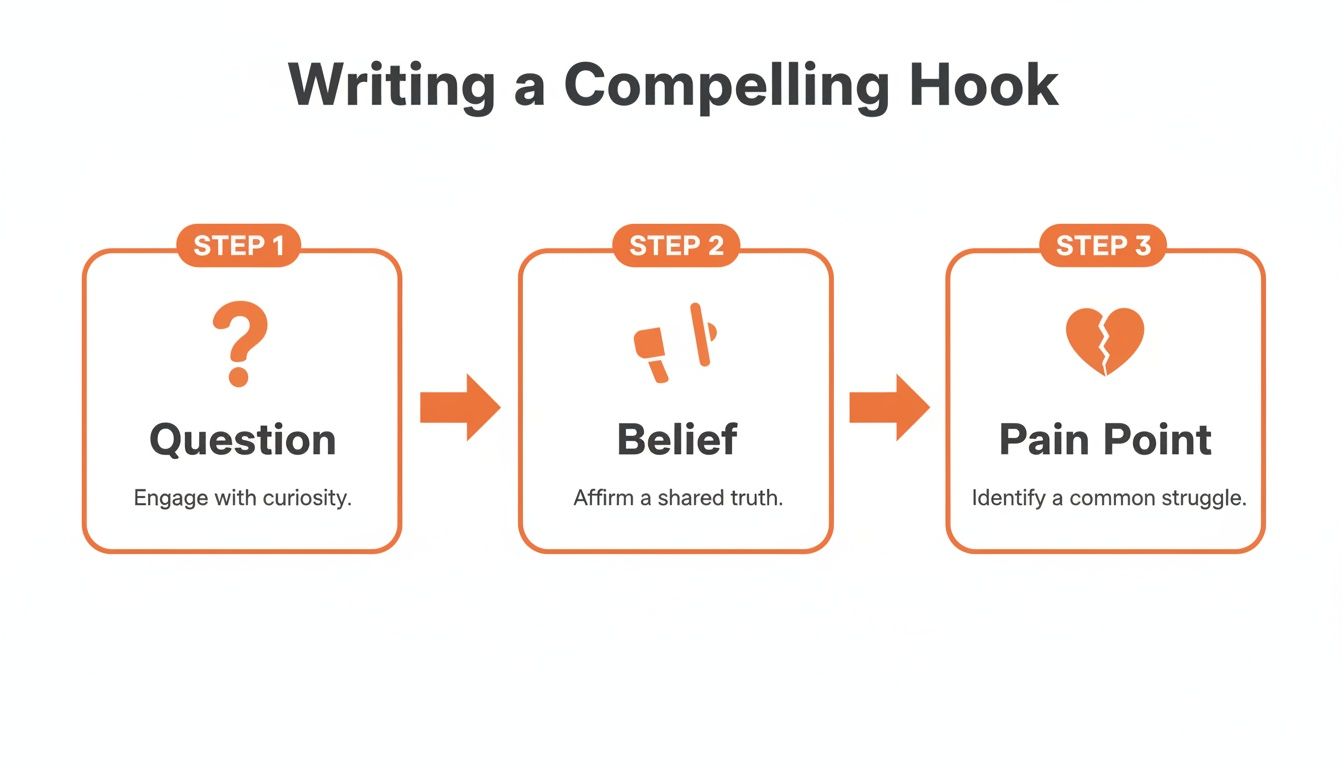
Step 1: Ask a Provocative Question
This approach works because it makes your ideal reader stop and think, instantly connecting with a problem you're poised to solve.
- For a Founder: "What if your team spent less time in meetings and more time shipping products customers actually love? That's the problem I'm obsessed with solving."
- For a Marketer: "Tired of 'going viral' with content that drives zero revenue? I focus on one thing: building content engines that convert."
Step 2: State a Bold Belief
Sharing a strong, maybe even slightly controversial, opinion about your industry immediately positions you as someone with a clear point of view.
- For a Consultant: "Most 'digital transformation' projects fail because they focus on tech, not people. I start with your team's workflow and build the technology around it."
- For a Sales Leader: "Cold calling isn't dead, but soulless, automated outreach is. My philosophy is simple: one genuine conversation is worth 1,000 spammy emails."
Step 3: Hit on a Relatable Pain Point
Start with a problem your target audience knows all too well. It creates an instant bond and shows that you truly get their world.
- For a Project Manager: "You know that feeling when a project is 90% 'done' for three months straight? I'm the person you call to get teams across the finish line."
- For a Ghostwriter: "So many brilliant founders have world-changing ideas trapped in their heads. I help them get those ideas onto the page and into the hands of people who matter."
Remember, the hook isn't meant to tell your whole life story. Its only job is to earn the click and make them want to read the next sentence. Pick the approach that feels most authentic to you.
Step 4: Weave in a Mini-Story with PAS
A simple but incredibly effective storytelling framework is Problem-Agitate-Solve (PAS). It's a classic for a reason—it works, and it’s perfect for grabbing attention in those first few lines.
Here’s the breakdown:
- Problem: State the core challenge. (e.g., "Scaling a startup is chaotic.")
- Agitate: Pour a little salt on the wound to make the pain more real. (e.g., "You're pulled in a dozen directions, battling fires instead of building your vision.")
- Solve: Position yourself as the clear solution. (e.g., "I implement the operational systems that turn that chaos into predictable growth.")
When you put it all together, it’s a powerful, concise narrative: "Scaling a startup is chaotic. You're pulled in a dozen directions, battling fires instead of building your vision. I help founders implement the operational systems that turn that chaos into predictable growth."
This isn’t just a list of skills; it’s a story. You’re connecting your expertise to a tangible outcome in a way that feels both strategic and human, practically begging your ideal reader to click "see more" and learn the rest.
How do I structure my LinkedIn About section?
You’ve got them to click “see more.” That’s a huge win, but the job’s not done. What comes next is what separates a profile that gets scrolled past from one that gets results. An intimidating wall of text is the fastest way to lose that attention you just earned.
Structure isn’t just about aesthetics; it’s about strategy. The goal is to guide your reader through your story, making your value so clear and compelling they can’t help but be impressed. You have 2,600 characters to play with, so let's make every single one count. We'll break it down using a simple but powerful blueprint.
A Step-by-Step Blueprint for a High-Converting About Section
Think of your About section not as a single block of text, but as a mini sales page with four distinct parts. When you build it this way, the story flows logically and persuasively.
Step 1: Start with a Strong Hook
This is your opening gambit. Its only job is to stop the scroll and earn that click. Whether you lead with a question, a bold belief, or a relatable pain point, you’re creating an immediate connection. This is your first impression—make it magnetic.
Step 2: Deliver Value and Proof
This is the heart of your profile. After hooking them, you need to deliver the goods. Don't just list your skills; show the impact they create. There’s a world of difference between a generic claim and a powerful, evidence-backed statement.
- The Vague Version: "I'm a skilled content marketer with experience in SEO, email marketing, and social media strategy."
- The Powerful Version: "I help B2B SaaS companies build content engines that don't just attract traffic—they generate qualified leads. At my last company, I grew our marketing-sourced pipeline by 200% in 12 months by focusing on SEO-driven blog content and targeted email sequences."
See the difference? The second version connects the skills (SEO, email) to a tangible business result (pipeline growth) and offers specific proof (200%). That’s what builds instant credibility. Making every character count is essential, and you can get more tips on concise writing in our guide to the LinkedIn post character limit.
Step 3: Add a Clear Call to Action (CTA)
You wouldn't end a great presentation by just walking off the stage. Don't leave your readers hanging either! A strong, specific CTA turns passive interest into an active opportunity. Your CTA should align directly with your primary goal on LinkedIn.
Here are a few ideas:
- For Lead Generation: "Ready to turn your team's expertise into a lead-generating machine? Send me a DM with 'Content' and let's chat."
- For Networking: "I'm always open to connecting with fellow marketing leaders. Feel free to send a connection request."
- For Driving Traffic: "You can find more of my thoughts on growth marketing in my weekly newsletter. Subscribe here: [link]"
Let’s be clear: a standout LinkedIn About section isn't fluff—it’s your 24/7 salesperson. With 11 million users now on Creator Mode, the About section has become the star of the profile. In a world where 30% of a company's engagement comes from its employees, a strong personal brand anchored by a great bio is non-negotiable. It’s why profiles with a clear narrative structure see 2-3x more positive interactions. This is about turning your professional story into a powerful asset.
Your LinkedIn About section is a sales page for your personal brand. Structure it with a clear beginning (Hook), middle (Value & Proof), and end (CTA) to guide your reader from curiosity to action.
What are some examples of great LinkedIn About sections?
Alright, theory is one thing, but seeing it in action is where the magic really happens. Let's move from the abstract "how-to" and look at some concrete examples. A truly great LinkedIn About section isn't just about ticking boxes; it's about artfully bending the rules to fit who you are and what you want to achieve.
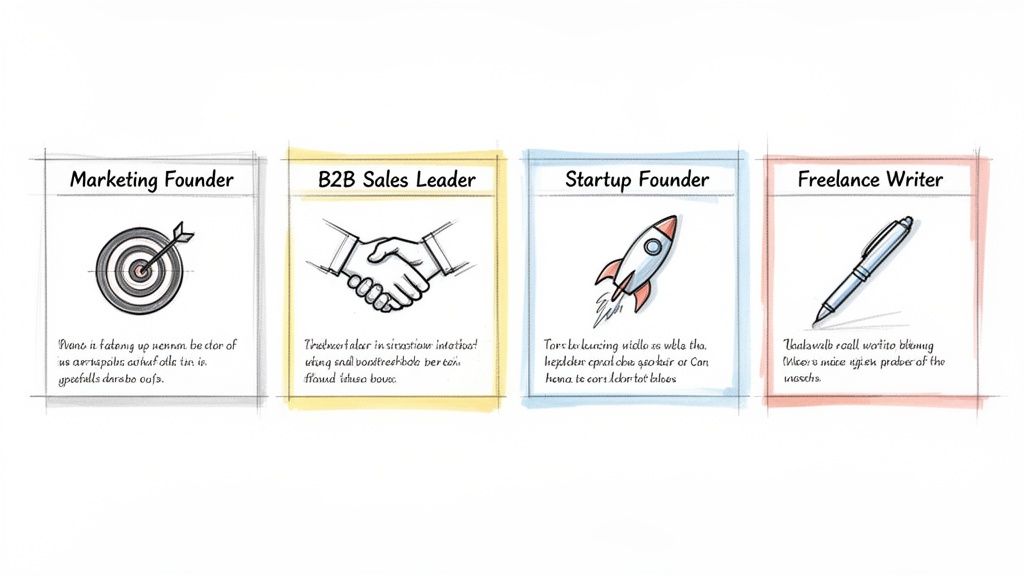
Below, I've put together four examples for common professional roles. Don't just copy and paste them. Think of them as a starting point. Pay close attention to how each one weaves in a compelling hook, a clear value proposition, solid proof, and a direct call to action, all while speaking to a very specific audience.
Example 1: The Marketing Agency Founder Focused on Lead Gen
This person’s main goal is to build credibility—and fast. They need to attract the right kind of clients while filtering out the wrong ones, ultimately driving qualified inquiries. Their About section should be a masterclass in expertise, process, and most importantly, results.
It all starts with a bold hook that challenges a common frustration, then clearly states who they help and how. From there, it's about offering proof with a proprietary framework and hard numbers, leading to a simple, low-friction call to action.
Here's what that looks like:
"Most marketing agencies sell you on 'brand awareness' because they can't deliver what actually matters: a pipeline full of qualified leads. I believe great marketing shouldn't just be creative—it should be a predictable revenue-driver.
For 10+ years, I've helped B2B SaaS companies escape the content hamster wheel. You know the one—endless blog posts, scattered social media, and a CRM full of dead-end leads.
My agency, [Your Agency Name], installs our proprietary "Revenue Engine" framework. It's a system designed to:
✅ Attract high-intent buyers with problem-aware content.
✅ Nurture leads with targeted email sequences that build trust.
✅ Convert prospects into sales-ready opportunities for your team.
We recently helped a Series B fintech client triple their MQLs in 6 months and reduce their cost-per-lead by 40%. Another client, a cybersecurity startup, landed their first Fortune 500 account through a campaign we developed.
If you’re a founder or marketing leader tired of spending money on marketing that doesn't move the needle, I'd love to share how our system works.
► Send me a DM with the word 'Pipeline' and we can schedule a quick 15-minute diagnostic call."
Example 2: The B2B Sales Leader Building Authority
This professional isn’t just pushing a product; they’re selling trust and positioning themselves as a strategic partner. The goal is to be seen as a thought leader, not just another salesperson trying to hit a quota. Their profile needs to educate, establish credibility, and invite conversations with peers.
Your LinkedIn summary must give exactly that - a reason to contact you, to order from you. If you manage to spot the pain point right away and you have the right solution to provide for a particular person, you’ve got to make it known in this section.
This sales leader's profile is their digital handshake—one that tells a compelling story and offers value long before asking for a meeting.
The key is to hook readers with a relatable pain point, frame their role as a problem-solver, and use social proof to back it up. The call to action should feel like an invitation to connect and learn, not a sales pitch.
See it in action:
"You have a great product, but your sales team is struggling to book meetings with enterprise buyers. The generic outreach is falling flat, and deals are stalling in the pipeline. I've seen this story play out a hundred times.
My mission is to help sales teams break through the noise. As a sales leader at [Your Company], I don't just sell software; I help revenue leaders build predictable, scalable sales processes that their reps actually want to follow.
For over a decade, I've worked in the trenches with sales teams at companies like [Past Company 1] and [Past Company 2], helping them:
- Implement a value-first outreach strategy that gets 70%+ response rates.
- Develop discovery call frameworks that uncover deep business pain.
- Coach reps to become trusted advisors, not just quote-carriers.
A team I recently coached went from hitting 60% of their quota to 115% in two quarters.
I'm always open to connecting with other sales leaders and sharing what's working (and what's not) in the world of B2B sales.
► Connect with me and let's talk shop."
Example 3: The Startup Founder Seeking Talent and Investment
A founder is constantly selling the dream. They have two critical audiences to win over: top-tier talent looking for a mission to join, and savvy investors who can spot a real market opportunity. This profile needs to be dripping with passion, vision, and forward momentum.
Here’s an example:
"I believe the future of work isn't about more apps, but less friction. We spend a third of our lives working, yet the tools we use are often clunky, siloed, and soul-crushing. I started [Your Startup Name] to change that.
We're building a platform that helps remote teams collaborate with the same energy and clarity as an in-person workshop. It’s not another project management tool; it's a new way of thinking about digital teamwork.
Our journey so far:
🚀 Backed by leading investors like [Investor A] and [Investor B].
🚀 Grew from 0 to 10,000 weekly active users in just 8 months.
🚀 Named one of [Industry Publication]'s "Startups to Watch."
We’re tackling a massive problem, and we need brilliant, passionate people to help us build the future. If you're an engineer, designer, or marketer who gets excited about solving complex human-computer interaction problems, we should talk.
► Check out our open roles here: [Link to Careers Page]
► Investors: Our data room is available upon request. DM me for access."
Example 4: The Freelance Writer Attracting High-Value Clients
For a freelancer, the About section is a sales pitch, portfolio, and client-filter all rolled into one. It has to demonstrate their niche expertise and prove they deliver tangible business value. It's not just about saying you can write; it's about showing it while clearly defining your ROI.
Take a look at this approach:
"Most 'thought leadership' content written for tech founders sounds the same. It's full of buzzwords, lacks a clear point of view, and frankly, it's boring. I help brilliant, busy founders translate their unique ideas into compelling articles and LinkedIn posts that actually sound like them.
Think of me as a 'voice-transplant' for tech executives. I specialize in turning complex technical concepts into clear, engaging stories that build personal brands and attract high-value opportunities (like podcast interviews, speaking gigs, and inbound leads).
My process involves deep interviews to capture your authentic voice, tone, and perspective. The result? Content that doesn't just fill a calendar but builds your legacy. I've written for founders featured in Forbes, TechCrunch, and The Wall Street Journal.
I work with a small number of clients on a retainer basis to ensure deep partnership and high-quality results.
► Interested in seeing if we're a fit? Send me a DM with a link to your LinkedIn profile and let's start a conversation."
How can I infuse my authentic voice and drive action?
So you’ve laid out your story and backed it up with solid proof points. Now for the part that ties it all together: making sure the words on the screen actually sound like a real person—like you. This isn’t just about using a friendly tone; it's about building a genuine connection that makes someone feel like they know you before they even send a connection request.
But let’s be clear: this isn't just about sounding nice. Your LinkedIn About section has a job to do. It needs to convince people, get them excited, and guide them toward taking the next step. This is where we find that perfect balance between personality and purpose, blending your unique voice with a powerful Call to Action (CTA) that turns profile views into real opportunities.
A Step-by-Step Guide to Finding Your Voice
How do you find your authentic voice? Before you even think about hitting save, read your draft out loud. Seriously. Does it sound like you, talking to a colleague over coffee? Or does it sound like a corporate memo?
Run your draft through this quick checklist to find your voice:
- Step 1: Write in the first person. It should always be "I" and "my." Writing in the third person feels formal and creates unnecessary distance.
- Step 2: Let your personality shine. If you're known for being direct, funny, or incredibly empathetic, those qualities should come across in your writing.
- Step 3: Kill the corporate jargon. Ditch empty phrases like "synergistic growth" and just say what you mean. For instance, say "I help teams work better together." It's simple, clear, and powerful.
An authentic voice doesn't mean you have to be unprofessional. It just means you have to be human. It’s about finding that sweet spot where your personality and your professional expertise meet, creating a profile that’s both relatable and credible.
How to Craft a CTA That Actually Converts
Your CTA is the last thing your reader sees, and it’s your chance to tell them exactly what to do next. A vague "contact me for more information" is a wasted opportunity. A great CTA is specific, directly tied to your goal, and makes taking that next step feel both easy and worthwhile.
Don't just add one because you feel like you're supposed to. Think about what you really want your ideal reader to do.
On LinkedIn, where employee advocacy accounts for 30% of a company's total engagement, an authentic profile is your secret weapon. The data doesn't lie: LinkedIn introductions that feel personal and genuine see a 20-25% higher acceptance rate. When you pair that authentic voice with a sharp CTA, you’re not just sharing your story—you’re creating a direct pipeline to new business. You can check out more fascinating LinkedIn stats on Cognism.com.
This is precisely why your CTA is so critical. It’s the final nudge that turns a connection into a conversion.
A Menu of High-Impact CTAs
Forget the one-size-fits-all approach. Your CTA should be tailored to your specific goal. Here are a few examples, organized by what you want to achieve, that go way beyond the bland "connect with me."
For generating leads or consultations:
- "Thinking about how to solve [specific client problem]? DM me the word 'Strategy,' and we can set up a quick 15-minute diagnostic call."
- "Ready to turn your team's expertise into a lead-generating machine? Let's talk. Grab a time that works for you here: [Your Calendly Link]"
For building your network or audience:
- "I post weekly insights on [Your Topic]. Follow me for more, or get my best stuff sent directly to your inbox by subscribing here: [Link to Newsletter]"
- "Always happy to connect with fellow [Your Profession]. Send me a request and tell me a bit about what you're working on!"
For driving traffic to another resource:
- "Want to see my full process in action? You can download my free guide on [Topic] right here: [Link to Resource]"
- "I go much deeper on this subject on my podcast. Listen to the latest episode on Spotify: [Link to Podcast]"
By choosing the right CTA, you turn your profile from a static resume into an active, engaging tool. If you're focused on new business, you can find more great ideas in our guide on how to generate leads on LinkedIn. Your final job is simple: give people a clear and compelling reason to take that next step.
Answering Your Lingering LinkedIn Questions
Once you start writing, a few common questions always seem to surface. Let's tackle some of the ones I get asked most often so you can finalize your About section with total confidence.
How Often Should I Update My About Section?
Your About section isn't something you write once and forget. Think of it as a living, breathing part of your professional story. I always suggest giving it a quick look-over at least once a quarter.
It's also a no-brainer to update it right after a significant career shift, like:
- Stepping into a new role or taking on more responsibility.
- Wrapping up a huge project that gave you some shiny new skills.
- Pivoting your career path or targeting a different industry.
- Launching a new service, product, or personal venture.
Keeping it fresh shows people you're active and invested in your growth. Here's a pro tip: try A/B testing your opening hook every few months. A small tweak in wording can make a big difference in who you attract.
What Are the Biggest Mistakes to Avoid?
I’ve reviewed hundreds of LinkedIn profiles, and the same few mistakes pop up again and again, instantly weakening an otherwise great first impression. If you can steer clear of these, you’re already ahead of the game.
Here are the top offenders:
- Writing in the third person. Describing yourself as "she," "he," or "they" just creates an awkward, formal distance. Always write in the first person ("I") to talk to your reader, not at them. It builds an immediate connection.
- Leaning on empty corporate jargon. Buzzwords like "results-driven professional" are meaningless fillers. Instead of saying you're a "synergistic growth hacker," show what you actually do. For example: "I help early-stage startups find their first 100 paying customers."
- Forgetting a clear Call to Action (CTA). You did all the hard work to get them hooked with your story! Don't leave them hanging. Tell them exactly what to do next, whether it’s sending you a DM, booking a discovery call, or following your company page.
How Do I Find the Right SEO Keywords?
Finding the right keywords is all about thinking like the person you want to attract. What words and phrases would your ideal client, recruiter, or collaborator plug into the search bar to find someone with your skills?
Start by brainstorming a list that covers a few key areas:
- Roles: The job titles they’re actually searching for (e.g., "SaaS Sales Director," "Freelance Copywriter").
- Skills: Your core expertise (e.g., "lead generation," "product marketing," "Python").
- Services: The solutions you deliver (e.g., "executive coaching," "content strategy").
- Industry Terms: Niche language that proves you speak their language (e.g., "fintech," "MarTech stack").
A great way to validate your list is to check out the profiles of a few industry leaders you admire. See what words they use. Once you have your list, gently weave those keywords into your story. They should feel completely natural, not like you're just stuffing them in.
Should I Use AI to Write My Profile?
Yes, but with a big caveat. Think of AI as your co-pilot, not the autopilot. Off-the-shelf AI tools have a tendency to spit out bland, soulless text that can make your personal brand feel completely generic.
Use AI to speed up your process, not to replace your personality. It’s a brilliant tool for brainstorming hook ideas, structuring your thoughts, or polishing a clunky sentence.
The trick is to use it strategically. For example, a voice-specialized tool can analyze your past writing to generate drafts that already capture your unique style. The goal is to work faster, but the final words must be 100% authentically you.
Ready to create compelling, on-brand LinkedIn content without sacrificing your unique voice? Brewbrand learns your style from past posts to generate authentic, engaging content in under two minutes. Ditch the generic AI and start writing 10x faster today. Get started for free at Brewbrand.ai.
Generate LinkedIn content easier than ever before
Lorem ipsum dolor sit amet, consectetur adipiscing elit. Lorem ipsum dolor sit amet, consectetur.