How to Build a Personal Brand: A Step-by-Step Guide for High-Value Buyers
Discover how to build personal brand with a proven LinkedIn framework to define your niche, create engaging content, and convert followers into paying customers.


If you are looking for a step-by-step process on how to build a personal brand on LinkedIn that actually attracts clients, you're in the right place. This isn't about posting randomly and hoping for virality; that's a lottery ticket, not a strategy. Building a brand that generates real opportunities requires a methodical approach. It all begins with a realistic, 90-day blueprint designed to create momentum from day one.
Step 1: Your 90-Day Personal Branding Blueprint for LinkedIn
What is the first step in building a personal brand? The initial 90 days are the most critical period for establishing a powerful personal brand on LinkedIn. This is where you lay the essential groundwork. The primary goal is not to get a million views but to establish credibility, define your niche, and cultivate a small but deeply engaged community. You are transforming your LinkedIn profile from a static resume into a dynamic landing page that attracts the right people.
Comparison: Random Posting vs. A 90-Day Plan
The First Three Months: Laying the Foundation
Real, meaningful traction on LinkedIn requires patience and consistent effort. You must commit to at least 90 days to see the first tangible results. During this period, your entire focus should be on two things: optimizing your profile and building your initial audience. A solid goal is to gain your first 500-1,000 engaged followers. According to research from our team at InfluenceFlow.io, professionals who properly optimize their profiles see their views spike within weeks. In fact, 70% report an increase in inbound connection requests by the end of the third month.
This flowchart breaks down the entire process for your first 90 days. It's all about focus.

The logical sequence is: Profile > Audience > Consistency. Each step builds on the last, creating a compounding effect that makes your efforts more powerful over time. Without a killer profile, your content won't convert. Without a clear audience, your message is just noise. And without consistency, the LinkedIn algorithm will ignore you.
To make this crystal clear, here’s a table outlining your action plan for the first three months.
Your First 90 Days on LinkedIn Action Plan
This plan breaks down the foundational first three months of building your brand, focusing on key actions and what you should expect to achieve.
Following this plan removes the guesswork and helps you build the momentum needed for long-term growth.
How to Optimize Your Profile to Convert Visitors
Think of your LinkedIn profile as your digital storefront. Is it inviting? Does it immediately tell people what you do and who you help? Most profiles fail this simple test.
Here are the first steps to fix your profile:
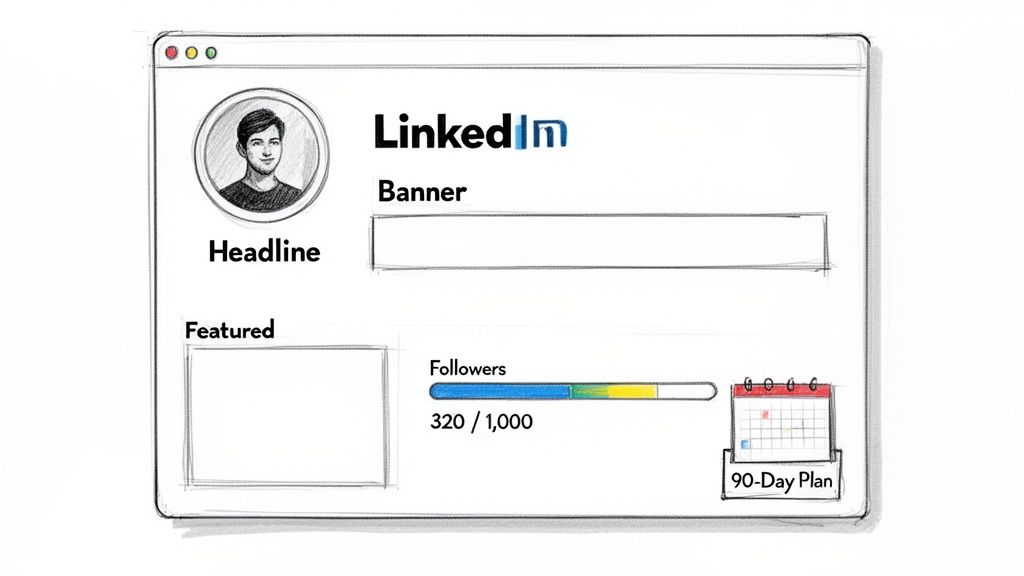
- Step 1: Your Headline: This is your most valuable digital real estate. Ditch the boring job title. Turn it into a keyword-rich value proposition. For instance, instead of "CEO at Company," try "Helping SaaS Founders Scale from $1M to $10M ARR with GTM Strategy."
- Step 2: Your Banner: A custom banner is the fastest way to look professional. Use it to visually reinforce your headline, show a client testimonial, or promote your newsletter.
- Step 3: The Featured Section: This is your personal highlight reel. Pin your best content, a link to your website, or a powerful case study that proves your expertise.
By dialing in just these three elements, you instantly signal that you're a serious professional who provides real value.
The single biggest mistake professionals make is treating their LinkedIn profile like a resume. It’s not. It’s a sales page for your personal brand, and it needs to be optimized to turn visitors into followers and followers into leads.
This mindset shift is everything. Every part of your profile should work together to answer one question for any visitor: "What's in it for me?" When you can answer that question clearly, you've won half the battle. This initial setup might feel slow, but it's the non-negotiable foundation that allows you to accelerate later.
Step 2: Find Your Niche and Define Your Target Audience
Before writing a single post, you need absolute clarity on two things: who you are and who you’re talking to. A strong personal brand is built on specific expertise, not generic appeal. Trying to be everything to everyone is a fast track to being nothing to anyone. This is a common pitfall; founders and consultants often fear niching down, worried they’ll lose opportunities. The reality is the opposite. A razor-sharp message acts like a magnet, pulling in high-quality leads actively searching for your specific solution.
Comparison: Generalist vs. Specialist
Imagine two consultants. The first is a "Business Growth Consultant." Vague, right? The second is a "GTM Strategist for B2B SaaS Companies struggling to break the $5M ARR mark." If you're a SaaS founder stuck at that exact stage, who do you hire? The specialist wins, every time. The generalist competes with thousands, while the specialist creates their own category.
To build a brand that commands attention, become that specialist. This means finding the sweet spot where three critical areas overlap:
- Your Expertise: What problems have you actually been paid to solve?
- Your Passion: What topics can you talk about for hours without getting bored?
- Market Need: What are people willing to pay to solve?
When you find the intersection of these three circles, you’ve found your niche. This is the bedrock of building real authority.
The goal isn't just to be seen—it's to be sought after. A well-defined niche makes you the obvious choice for a very specific set of people, turning your expertise into a powerful inbound marketing engine.
This clarity doesn’t just attract clients; it makes content creation infinitely easier. You'll never again stare at a blank screen wondering what to post. Every idea is filtered through the lens of your niche, ensuring it’s always relevant. You can explore more strategies for content creation on LinkedIn on our blog.
How to Create Your Ideal Audience Persona
With your niche defined, it’s time to get obsessive about who you're talking to. Build an Ideal Audience Persona—a detailed profile of the single person you want to attract. This goes beyond demographics to psychographics. Give this person a name, like "Sarah, the Series A Founder."
What are her biggest professional headaches?
- High customer acquisition costs.
- The sales team is missing its quota.
- Losing sleep over a well-funded competitor.
What are her career goals?
- Scale her company to $10M ARR and beyond.
- Be recognized as a thought leader in her industry.
- Build a company culture people are proud of.
This level of detail is non-negotiable. When you write, you aren’t writing for a faceless crowd. You’re writing directly to Sarah. You’ll use her language, address her pain points, and offer solutions that speak to her ambitions.
Broad vs. Niche Audience: A Quick Comparison
Let's look at the real-world impact of targeting a broad audience versus a focused, niche one.
The difference is stark. By zeroing in on a niche, your content becomes hyper-relevant, attracting a smaller but far more valuable audience. This is the secret to turning your LinkedIn personal brand into a predictable source of business.
Step 3: Find Your Voice and Define Your Content Pillars
Once you've zeroed in on your niche and audience, it's time to figure out what to say and how to say it. This is where the real work of branding begins. People on LinkedIn crave connection with actual humans, not corporate drones. Authenticity is your currency. Your brand voice is your personality translated into words—the unique mix of tone, vocabulary, and style that makes your content feel like you. A consistent voice makes you memorable and builds a real relationship with your audience.
How to Pinpoint Your Authentic Voice
What is an authentic brand voice? You don't invent a voice; you uncover the one you already have. Your goal is to capture how you naturally express ideas and apply it consistently. Forget trying to sound like a generic "thought leader." Instead, pay attention to how you already communicate.
- How do you talk to a client? With confidence and clarity, focused on solving their problems.
- How do you explain a tricky concept to a colleague? You might use an analogy or break it down.
- How do you text a friend about a work win? Your tone is likely more casual and energetic.
Your true brand voice is a blend of these modes. A founder might mix the direct, problem-solving approach of a client call with the relatable energy of a text. The result is a voice that's both authoritative and approachable.
Authenticity isn't about oversharing your personal life. It’s about making sure your online personality is a true reflection of your real-world self. When people feel like they know the real you, they're far more likely to trust you—and ultimately, to buy from you.
Modern tools like Brewbrand can analyze your existing writing to learn your unique vocabulary and sentence patterns, helping you scale content production without sacrificing the personal touch that builds trust.
How to Establish Your Core Content Pillars
With your voice defined, you need guardrails for your content. These are your core content pillars—the 3-5 foundational topics your brand will be built upon. Every post should tie back to one of these pillars. Content pillars keep your message focused, reinforce your expertise, and ensure you're always hitting your audience's pain points.
Your pillars should live at the intersection of what you know (your expertise) and what your audience needs to know (their biggest challenges).
Example: Content Pillars for a GTM Strategist
- Pillar 1: Go-to-Market Strategy (Breaking down frameworks for launching and scaling products.)
- Pillar 2: B2B Sales Tactics (Sharing practical advice for closing enterprise deals.)
- Pillar 3: Founder Leadership & Mindset (Talking through the struggles of building a team and culture.)
With these pillars, the strategist has a nearly endless well of content. A post about a new sales script? Pillar 2. A vulnerable story about a failed launch? Pillar 1. Reflections on managing a remote team? Pillar 3.
Comparison: Pillars vs. Voice (The "What" and the "How")
Think of your pillars and your voice as two sides of the same coin. They work together to create a cohesive content strategy.
You can't have one without the other. Solid pillars without a distinct voice create boring, textbook content. A fantastic voice without clear pillars leads to rambling, unfocused posts. The magic happens when you apply your unique voice to your strategic content pillars. That’s the combination that defines a truly powerful personal brand.
Step 4: Crafting LinkedIn Posts That Drive Real Engagement
A brilliant idea is worthless if nobody stops to read it. Now, we get tactical and break down how to craft LinkedIn content that stops the scroll, sparks conversations, and gets you noticed. We're moving beyond vague advice to dissect the anatomy of high-performing LinkedIn posts, format by format. You need to understand the psychology behind what makes someone pause, read, and engage.
The Anatomy of a Scroll-Stopping Post
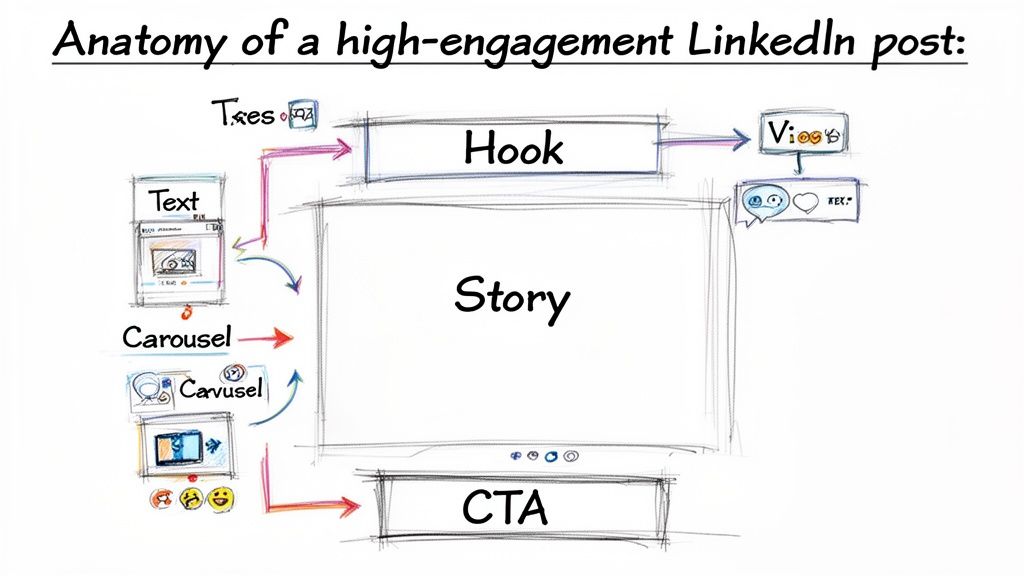
What is the best structure for a LinkedIn post? Every effective post follows a simple but powerful structure: Hook, Story, and Call-to-Action (CTA).
- The Hook (Your First Two Lines): This is your entire sales pitch. LinkedIn hides everything else behind the "…see more" link, so your opening lines are do-or-die. Their only job is to generate enough curiosity to earn that click.
- The Story (The Body): Here's where you deliver on the hook's promise. You share the insight, tell the story, or provide the value. Make it easy to read with plenty of white space and stick to one core idea.
- The Call-to-Action (The Closing): You've earned their attention; now what do you want them to do? A good CTA prompts a specific, low-effort action, like asking a question or dropping a comment.
Think of it as a mini-sales funnel. The hook grabs attention, the story builds interest, and the CTA drives action.
The most common mistake is front-loading the context. Don't start with, "I was reflecting on the importance of X..." Start with the punchline, the controversial opinion, or the surprising result to make them stop and wonder, "Okay, how did they get there?"
Choosing the Right Post Format for Your Message
Not all post formats are created equal. The type of post you choose should serve the message. Mixing formats keeps your feed from feeling stale.
LinkedIn Post Format Comparison
Here’s a quick comparison to help you decide which format best fits your idea. Each one has a specific job to do.
There is no single "best" format. A balanced strategy uses all of them. You could share a contrarian take in a text-only post, then follow up with a carousel breaking down your alternative framework. This layered approach reinforces your expertise and keeps your audience hooked, a core skill for anyone looking to generate leads on LinkedIn.
Step 5: Building a Sustainable Content System That Works
Here's a hard truth: burnout kills personal brands faster than anything else. The secret to long-term success isn't just hustle; it's building a repeatable system that turns ideas into great content without taking over your life. Think of it like an engine. A well-oiled content system drives every successful personal brand, replacing "what do I post today?" anxiety with a clear, structured workflow.
Step 5.1: Find a Posting Cadence You Can Actually Stick With
How often should you post to build a personal brand? As often as you can sustainably. Consistency beats intensity. Posting five times one week and then disappearing for two is far worse than showing up a steady three times every single week. For most busy professionals, a realistic and effective sweet spot is 3-5 times per week.
A smart schedule might look like this:
- Monday: A strong, text-only post with a contrarian opinion.
- Wednesday: A visual carousel breaking down a framework.
- Friday: A personal story or behind-the-scenes video.
This mix keeps your feed interesting. The real goal is to choose a cadence that fits your schedule, not one that leads to burnout.
Step 5.2: The Two-Part Daily Engagement Routine
Posting is just one side of the coin; the other is engagement. This community-building work can be a massive time-sink without a strategic approach. I recommend a simple, two-part routine:
- Reactive Engagement (15 mins/day): Respond to comments on your own posts. Ask follow-up questions. Show people you're listening.
- Proactive Engagement (15 mins/day): Leave valuable comments on posts from your target audience, industry peers, and potential clients. Add to the conversation.
By time-boxing these activities to just 30 minutes a day, you can build a thriving community without letting LinkedIn eat your schedule.
Consistency without a system is just a recipe for burnout. Your goal shouldn't be to 'work harder' on your brand, but to work smarter by building a process that makes high-quality output predictable and nearly effortless.
Step 5.3: Build Your Content Operations Hub
Your content system needs a central command center—a single place to capture ideas, plan your calendar, and manage posts. This doesn't have to be complex; a simple spreadsheet or a Trello board can work wonders.
Your workflow should cover these key stages:
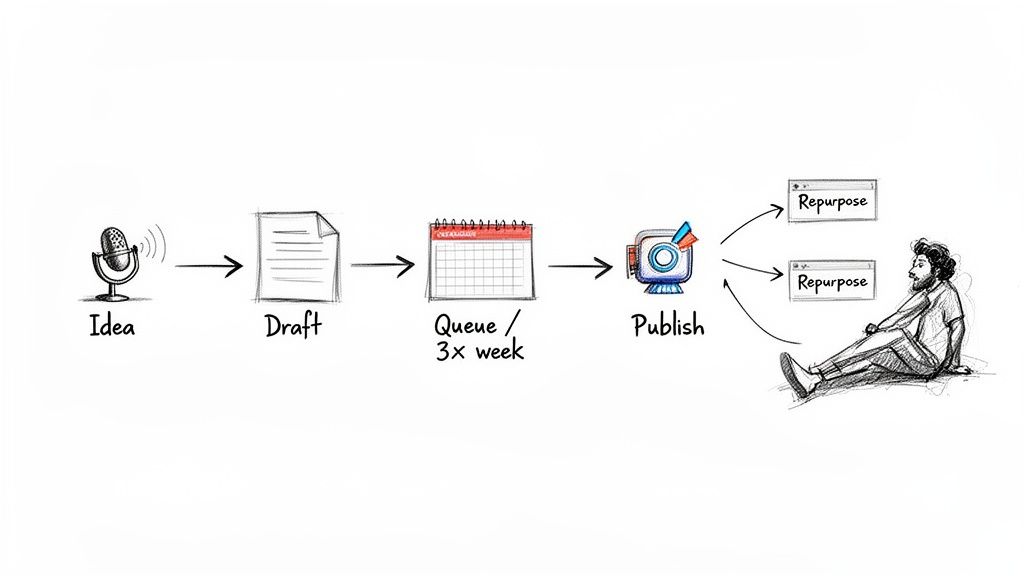
- Idea Capture: A frictionless way to dump raw ideas (notes app, voice memo).
- Content Calendar: A simple calendar to visualize your content mix and stay ahead.
- Drafting & Publishing: The assembly line where ideas are shaped and scheduled.
This structure brings clarity, turning chaos into a managed operation.
How to Go From Raw Idea to Published Post with Modern Tools
This is where you can get a huge chunk of your time back. Busy executives don't have hours to craft every post from scratch. This is where tools built for this purpose become a game-changer.
Imagine this workflow:
- Capture an Idea: Record a quick 60-second voice memo about a common client mistake.
- Generate a Draft: Upload that audio to a tool like Brewbrand. It transcribes the audio and, trained on your voice, generates a ready-to-publish post that sounds like you.
- Refine and Schedule: Spend two minutes picking the best AI-generated hook, tweak a sentence, and schedule it.
In less than five minutes, a fleeting thought becomes high-quality content.
Comparison: Manual vs. Tool-Assisted Workflow
The difference in efficiency is staggering. A manual process is slow and full of friction, whereas a tool-assisted workflow is fast and sustainable.
By building a system that combines a realistic schedule, focused engagement, and the right tools, you can achieve the consistency needed to build a powerful personal brand without burning out.
Step 6: Measure Your Growth and Scale Your Impact
You can't improve what you don't measure. The final step is using data to see what’s working. This is where you graduate from chasing likes and start focusing on numbers that signal business impact. Likes and impressions feel good, but they don't pay the bills. The real point of a personal brand is to generate tangible results—leads, opportunities, and authority.
Comparison: Vanity Metrics vs. Business Metrics
The first step is to know which numbers matter. It's easy to get distracted by a post with huge impressions, but those numbers are often hollow. Real growth comes from tracking metrics that connect directly to your business goals.
Shifting your focus from vanity to business metrics turns personal branding into a predictable engine for growth.
What Key Metrics Should I Track?
To stay on track, you need a simple dashboard of key performance indicators (KPIs). Check these numbers consistently to spot trends and make smarter decisions.
Here are the essentials:
- Profile Views: Are more people visiting your profile week over week? This signals your content is compelling.
- Search Appearances: This number in your LinkedIn analytics reveals how many times you appeared in search. A steady increase means your profile optimization is working.
- Engagement Quality: Don't just count comments; look at who is commenting. Are they ideal clients or industry peers? High-quality engagement is a powerful leading indicator of future business.
The ultimate measure of success for your personal brand isn't how many people see your posts, but how many of the right people start a conversation with you. One inbound message from a perfect-fit client is worth more than 1,000 likes from a random audience.
How to Conduct a Monthly Brand Audit
A monthly audit is your chance to step back and look at the bigger picture. Set aside an hour each month and run through these questions:
- Which posts performed best? Look beyond likes. Analyze which posts drove the most meaningful comments and profile clicks.
- What qualitative data did I gather? Review your inbound messages. What questions are people asking? Your DMs are a goldmine of information about your audience's pain points.
- Are my content pillars still relevant? Based on engagement, do your core topics still align with what your audience cares about?
By consistently measuring your impact, you turn your personal brand from a shot in the dark into a reliable system. This data-informed approach is fundamental for anyone serious about mastering LinkedIn lead generation strategies and achieving real ROI.
Frequently Asked Questions About Building a Personal Brand
Even with a solid playbook, questions will come up. Here are quick answers to the most common questions about building a personal brand.
How Much Time Do I Need to Commit Each Week?
When starting, plan on dedicating 3-5 hours per week. This breaks down into 1-2 hours for creating content, plus 30 minutes daily for engagement (commenting, replying, connecting). Once you find your rhythm, you can often maintain momentum in less time.
Can I Build a Personal Brand if I Am Not an Expert?
Yes. Many people get stuck here, thinking they need to be the #1 guru. That’s a myth. You can build a powerful brand by documenting your learning journey. People love following a real-time story of growth. Alternatively, become a trusted curator by finding the best insights for your niche and sharing them with your perspective. Your authenticity and dedication are more valuable than knowing everything.
What is the difference between personal branding and just posting on LinkedIn?
A personal brand is a strategy, while simply posting on LinkedIn is just an activity. Random posts lack focus. A personal brand, however, is built on a defined niche, consistent messaging through content pillars, and a distinct voice. It’s about being intentional in how your audience sees you so you can reach a specific goal, like bringing in new clients.
Is It Better to Post Daily or Just a Few Times a Week?
Consistency beats frequency, every single time. A great, sustainable goal for most people is posting 3-5 times per week. It's far better to publish three fantastic posts that spark conversation than to push out five mediocre ones to hit a quota. Pick a schedule you know you can maintain for the long run.
Ready to build your personal brand without the burnout? Brewbrand learns your unique writing style to generate authentic, on-brand LinkedIn posts in minutes. Turn your raw ideas into high-quality content and start posting consistently. Try Brewbrand for free.
Generate LinkedIn content easier than ever before
Lorem ipsum dolor sit amet, consectetur adipiscing elit. Lorem ipsum dolor sit amet, consectetur.