A Winning Thought Leadership Content Strategy
Build a winning thought leadership content strategy with our guide. Learn to define pillars, create content, and measure real ROI on LinkedIn.


A thought leadership content strategy is your step-by-step roadmap for becoming the go-to expert in your field. This guide explains how to move beyond scattered posts to a structured plan that shares your unique insights. The goal is not just to showcase what you know, but to solve real problems for your ideal customers, which is the fastest way to build credibility and generate high-quality leads.
What is the difference between a thought leadership strategy and a content plan?
Feeling like your posts on LinkedIn are getting lost in the noise? You're competing with other experts, a flood of corporate updates, and a lot of robotic AI-generated content. Posting more isn't the solution; posting smarter is. A thought leadership content strategy is how you separate your voice from the background noise.
A content plan says, "I will post three times a week." A thought leadership strategy, in comparison, defines why you’re posting, who you’re trying to reach, and what specific point of view you want them to adopt.
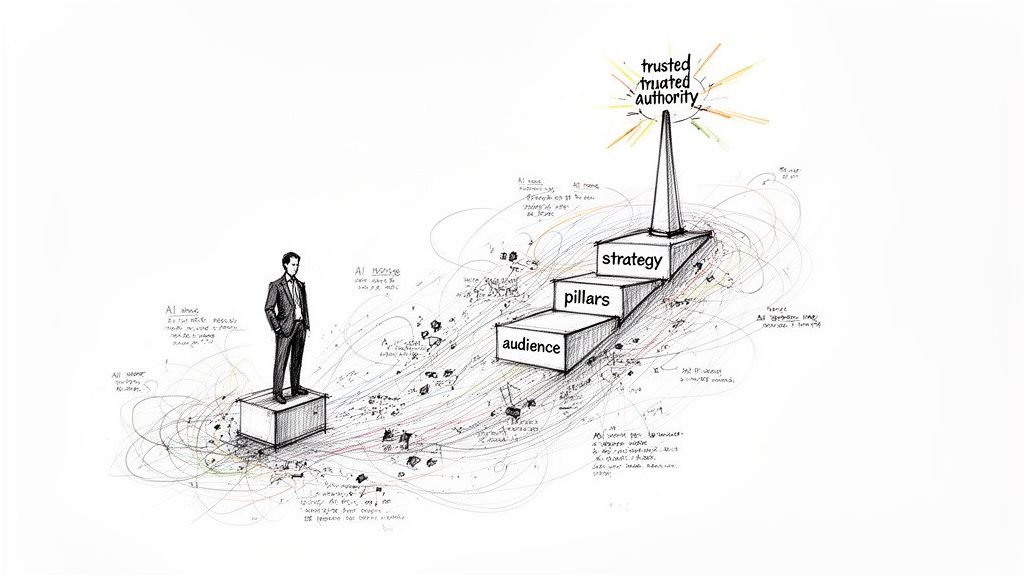
Think of it as the strategic framework for building and proving your expertise. For founders, agency owners, and sales leaders, this is a core business driver. B2B buyers are skeptical and bombarded with sales pitches. Your authentic perspective, shared consistently over time, earns the trust needed to capture their attention.
Comparison: Content Creator vs. Trusted Authority
The goal is to transition from simply creating content to becoming a trusted authority. The objective isn't just visibility; it's to become the person people actively seek out for advice.
Here is a comparison:
- Content Creator: Responds to a request for proposal (RFP).
- Trusted Authority: Is the advisor they call to help write the RFP in the first place.
The real aim of a thought leadership content strategy is to make your perspective indispensable. When your ideal client hits a roadblock, your name should be the first one they think of. That’s how you generate a steady stream of high-intent, inbound opportunities.
This approach translates into tangible business outcomes. By the time prospects get on a call, they have already bought into your way of thinking from your content. This leads to several advantages:
- Shorter Sales Cycles: Trust is pre-built, reducing the need for convincing.
- Higher-Value Clients: You attract clients seeking expertise, not the cheapest option.
- A Stronger Brand Moat: Your authority is a competitive edge that is difficult to replicate.
To truly stand out, your thought leadership strategy needs several key elements working together. Here is a breakdown of the core components.
What are the core components of a thought leadership strategy?
A well-defined strategy provides a system to ensure your expertise is communicated effectively and consistently.
A System for Driving Real Results
The most common reason for failure in thought leadership is the lack of a system. Without a clear process, content creation becomes a chaotic, last-minute scramble. A proper strategy, however, is a repeatable system that guarantees both consistency and quality over the long term.
This guide provides a practical framework. We will walk through the steps to define your audience and pillars, map out content formats, build a sustainable editorial calendar, and measure what actually moves the needle. By implementing this thought leadership content strategy, you can transition from being just another online voice to an influential authority who drives measurable business growth.
How to Define Your Audience and Content Pillars in 3 Steps
Before writing your first post, you must be clear on two things: who you are talking to, and what you are an expert on. This is the foundation of a solid thought leadership content strategy. Skipping this step will result in random-feeling content, making it difficult to build a real following or establish authority.
A common mistake is defining an audience too broadly. For example, targeting a "VP of Sales" is a start, but it’s not specific enough to create content that truly connects.
Step 1: Define Your Target Persona
To make a genuine connection, you must dig deeper than a job title. Think about their world. What are their goals? What are their stressors? What problems are they actively trying to solve right now?
Let's get specific. Moving from a generic title to a real human persona is what separates content that gets scrolled past from content that gets saved.
Instead of targeting a "VP of Sales," imagine writing for the 'Overwhelmed VP of Sales who’s skeptical of new tech and laser-focused on proven ROI.' This shift provides a wealth of ideas. You instantly understand their main pain point (overwhelm), biggest hesitation (tech skepticism), and what they value most (hard ROI).
This deep understanding of your audience is your North Star. It guides every single post, ensuring your insights feel personal and indispensable. This is how you stop being just another voice in the feed and start becoming a trusted advisor.
Drilling down this far is critical. Data shows a staggering 64% of B2B buyers spend over an hour each week reading thought leadership. Furthermore, 63% are 'hidden buyers' who read and absorb content without ever liking or commenting. They form opinions long before reaching out, creating a significant opportunity for go-to-market professionals to build trust with an actively listening audience.
Step 2: Establish Your Core Content Pillars
Once you have a clear picture of your audience, the next step is to define your content pillars. These are the 3-5 core topics where your expertise, your audience's needs, and your business goals perfectly overlap.
Think of pillars as the main shows on your personal media network. They keep your content focused and prevent random posting, which can confuse your audience and weaken your authority. Strong pillars are a crucial part of learning how to build a personal brand that commands attention.
Step 3: Ask Key Questions to Finalize Pillars
To identify your pillars, ask yourself these questions:
- Your Unique Angle: What topics can you discuss with a unique perspective or more depth than anyone else? This is where your personal experience is invaluable.
- Audience Problems: What are the most painful and expensive problems your ideal audience faces? Your pillars should offer direct solutions.
- Business Goals: What do you want to be known for that will attract the right clients or career opportunities? Your pillars must support your long-term goals.
A Real-World Example of Building Pillars
Let’s stick with our 'Overwhelmed VP of Sales.' A founder of a sales tech company targeting this persona could build these content pillars:
- Pragmatic AI for Sales: Focus on real-world use cases and clear ROI, cutting through the hype.
- Lean Sales Team Leadership: Share strategies for getting more done with a smaller team, speaking directly to their feeling of being overwhelmed.
- Data-Driven Prospecting: Offer tactical advice on using data to find better leads, which connects to their need for proven results.
With these pillars defined, every post now has a clear purpose. One day you might share a contrarian take on AI in sales; the next, you could offer a template for managing a remote sales team. Every piece of content reinforces your expertise in these specific areas, building a personal brand that is both powerful and cohesive.
How to Craft Content That Stops the Scroll
With your content pillars and audience defined, the next step is turning your expertise into content that makes people stop scrolling. An effective thought leadership content strategy is not just about what you say—it's about how you say it. The format and the hook are as important as the insight itself.
The most brilliant idea is useless if the first line doesn't grab attention. On LinkedIn, that first sentence is your entire pitch. It earns you the next three seconds of a reader's attention. Here's how to create both irresistible hooks and the right content formats.
How to choose the right content format
Not all ideas are created equal, and they shouldn't be squeezed into the same format. Strategically matching your message to the right medium can significantly increase its impact. For example, a complex framework is best explained with a visual breakdown, while a personal story connects most effectively through simple, direct text.
Here is a comparison of common formats and when they work best:
- Text-Only Posts: Ideal for sharing personal stories, a contrarian take on a common belief, or asking a thought-provoking question. The simplicity often feels more authentic and conversational on platforms like LinkedIn.
- Single-Image Posts: Use an image to visualize a powerful statistic, share a memorable quote, or tell a story with one compelling photo. The image stops the scroll; your caption provides the essential context.
- Carousels (PDFs): Excellent for breaking down complex processes, sharing step-by-step guides, or repurposing lists into a more engaging format. They naturally encourage interaction as people swipe through the slides.
The process—defining your audience, pinpointing their problems, and building your pillars—is the foundation for all content creation.
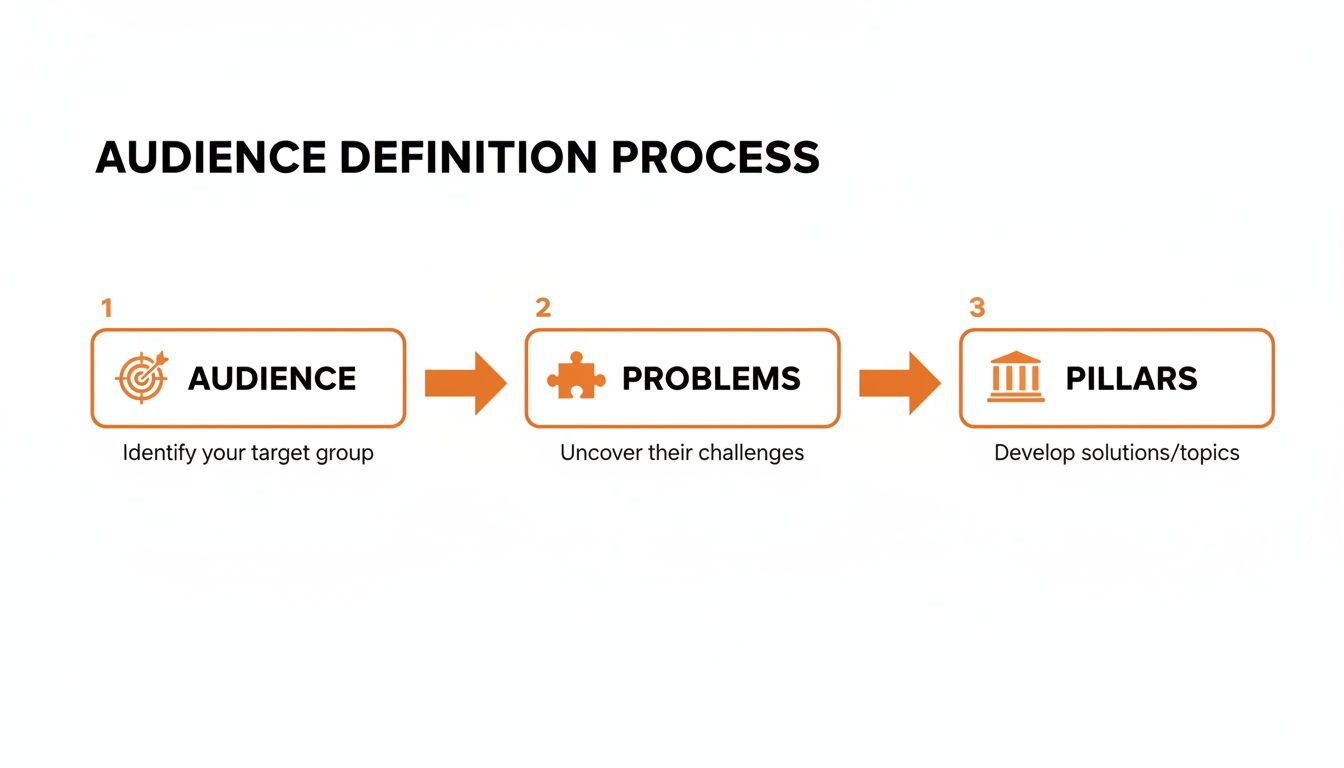
This flow illustrates that powerful content stems from a deep understanding of your audience’s problems, which in turn shapes the pillars you consistently discuss.
The Anatomy of an Irresistible Hook
A great hook creates a "curiosity gap." It makes a promise, poses a puzzle, or challenges a common belief, compelling the reader to click "see more." Mastering hooks can make almost any idea interesting.
Here are a few proven frameworks you can use immediately:
- Example: "Everyone thinks you need a bigger budget. They're wrong. You need a better framework."
- Example: "Yesterday, I had a client call that completely changed how I think about sales."
- Example: "Here’s how you can write a week's worth of LinkedIn posts in under 60 minutes."
- Example: "9 out of 10 startups fail. But the reason isn't what you think."
The best hooks are not just clickbait; they are an honest preview of the value you are about to deliver. They act as a filter, attracting the right audience by speaking directly to their pain points or goals.
How to repurpose one insight into four posts
You have more content ideas than you realize. A single core insight can be repackaged into multiple posts by changing the hook and format.
Let's say your insight is: "Sales teams waste too much time on unqualified leads because their discovery process is broken."
Here’s how to spin that one idea into four different posts:
- Text-Only (Contrarian): "Stop blaming your sales team for low conversion rates. Your discovery process is the real problem. Here's what I mean..."
- Carousel Guide (How-To): "The 5-Step Discovery Call Framework That Weeds Out Bad Leads. Swipe to see the exact questions we use..."
- Single-Image (Data): Post a simple graphic showing "Time Wasted on Unqualified Leads: 67%." The caption can then tell the story behind that number.
- Personal Story: "I used to think more leads was the answer. Then I reviewed our pipeline and had a painful realization..."
By experimenting with different formats and hooks, you keep your feed fresh and appeal to different segments of your audience. For more inspiration, check out these thought leadership content examples.
How to Build a Sustainable Content Calendar and Cadence
To build real authority on LinkedIn, consistency is your superpower. While a fantastic post now and then is good, it's the steady, reliable drumbeat of your content that builds momentum and trust. Sporadic posting makes it hard for people to form a habit of listening to you.
This is why a sustainable publishing rhythm is essential. The goal is not to burn yourself out by posting daily but to create a simple, repeatable process that keeps your thought leadership content strategy running smoothly without stress.
Step 1: Design Your Editorial Calendar
An editorial calendar doesn't need to be complex. A simple spreadsheet or even a note on your phone can work. Its purpose is to provide a bird's-eye view of your content, ensuring you are hitting your core pillars and mixing up your formats.
Without planning, it's easy to fall back into comfortable habits, posting the same type of content repeatedly. A calendar forces you to be more intentional. You can visually check if you're balancing tactical advice with personal stories that build connection or data-driven insights that establish credibility.
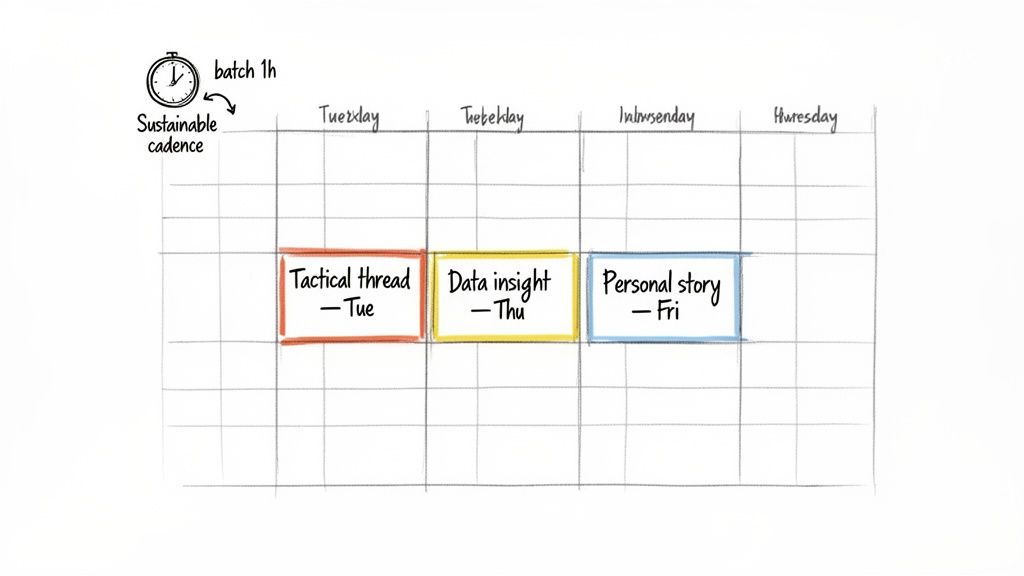
A well-planned calendar helps create a balanced content diet. For instance, you could schedule:
- A tactical, how-to thread for Tuesday.
- A contrarian take backed by data on Thursday.
- A personal story or lesson learned for Friday.
This simple structure prevents your feed from feeling one-note and gives your audience different ways to connect with your expertise.
Step 2: Implement Content Batching
The secret to consistency isn't finding more hours in the day—it's working smarter. The daily panic of, "What should I post today?" is the number one killer of content momentum. The solution is content batching.
Instead of trying to dream up, write, and polish a post daily, set aside one block of time to create your content for the entire week. Many top voices on LinkedIn spend just 60-90 minutes once a week to plan, write, and schedule a full week of high-impact posts.
The goal of batching is to separate the 'thinking' phase from the 'doing' phase. You dedicate one block of time to creative ideation and writing, and the rest of the week, you can focus on engaging with your audience, not scrambling for content.
This approach removes daily pressure and allows for deep work, making your writing sessions more effective. Tools like Brewbrand are built for this workflow, helping you turn rough ideas into a week of polished posts—complete with multiple hook options—all in one session.
To illustrate, here is a sample weekly schedule that mixes themes to keep your audience engaged.
Sample Weekly Content Cadence for LinkedIn
This balanced schedule ensures you are not just a teacher but also a relatable human, which is key for building a loyal following.
Step 3: Establish a Realistic Cadence
So, what is the ideal posting frequency? While some creators post daily, remember that consistency always beats raw frequency. Publishing three high-quality, thoughtful posts per week is far more powerful than churning out seven rushed, mediocre ones.
Here is a comparison of two common cadences that work well:
- The Momentum Builder (3 Posts/Week): This is a perfect starting point. It’s manageable, prevents burnout, and is more than enough to establish a strong presence. A Monday-Wednesday-Friday schedule is a popular choice.
- The Authority Driver (5 Posts/Week): Posting every weekday quickly positions you as a prolific, go-to voice. This is a potent strategy for accelerating authority, but it requires a bulletproof batching system to be sustainable.
Choose the cadence that feels right for you now. You can always increase the frequency later once you've perfected your workflow. The most important thing is to build a reliable content machine that runs smoothly, cementing your status as the expert your audience can count on.
How to Actually Measure Your Success and Prove ROI
You're posting great content. But is it actually helping your business? To prove the value of your efforts, you must look beyond surface-level "vanity metrics." The goal isn't just to get views; it's to make a measurable impact on your bottom line.
This means shifting focus from likes and views to metrics that signal business intent. This is what separates professionals who generate revenue from hobbyists shouting into the void.
Business Metrics vs. Vanity Metrics
First, you need to know which numbers truly matter. While a post with high engagement feels good, it doesn't pay the bills. The real test of your thought leadership content strategy is whether it influences your ideal clients.
Here's a comparison of what you should track versus what you can safely ignore:
The metrics on the right tell a more compelling story. A spike in profile views from people at your target companies or a direct message saying, "I saw your post about X..." are powerful buying signals. This shows your content is landing exactly where it needs to.
Creating a Data-Driven Feedback Loop
Here's a step-by-step process to use data to improve your content:
- Analyze Performance: Regularly review your LinkedIn analytics.
- Which of my content pillars are starting conversations (DMs, connection requests, comments from prospects)?
- What formats resonate most with my target audience—text-only, carousels, or something else?
- Do certain hooks or topics consistently drive more profile views?
- Refine Your Strategy: Use the answers to double down on what works and discard what doesn't. If tactical "how-to" carousels generate a flood of inbound messages, make more of them.
- Have a popular text post? Convert it into a carousel. Break the core idea into a visual, step-by-step guide.
- Just had a great client call? Anonymize the details and turn it into a relatable story. A client's "aha!" moment can be a powerful lesson for your audience.
- Have a slide deck? You have a mini-series. Pull the three most impactful slides and expand each into its own tactical post.
- 80% of your content should provide value. Educate, inspire, or entertain your audience by sharing expertise and solving problems with no strings attached.
- 20% of your content can be promotional. This is where you discuss a new service, highlight a case study, or invite your audience to a webinar with an offer.
This is how your strategy evolves and gets smarter. To dive deeper into turning these insights into opportunities, check out these effective LinkedIn lead generation strategies.
A successful thought leadership content strategy isn't a static plan. It's a living system that evolves based on real-world feedback. Use your analytics to shape your future content, not just report on the past.
Grounding Your Content in Your Own Data
One of the most effective ways to make your content stand out is to build it around your own proprietary data. This could be insights from customer calls, trends from your sales data, or findings from a quick survey.
This strategy is gaining traction. In a recent survey of senior marketing leaders, 47% plan to invest more in creating original, data-driven thought leadership. The top data sources are customer feedback (53%) and their own CRM data (44%), proving the most valuable insights are often already in-house. This is how you turn unique business intelligence into content that drives leads.
For example, a SaaS company could analyze user data and publish a post titled, "We Analyzed 10,000 Projects—Here's the #1 Mistake Teams Keep Making." This is content your competitors cannot copy and instantly positions you as an expert with exclusive knowledge. By seeing which data points spark the most conversation, you can draw a direct line from your content to your ROI.
Your Top Questions, Answered
Here are answers to common questions that arise when implementing a thought leadership strategy.
What is the "right" posting frequency on LinkedIn?
This is a frequently asked question. The answer is simple: consistency will always beat frequency.
Aiming for 3-5 high-quality posts a week is a solid target for building momentum. However, it's better to publish two genuinely insightful posts every week than to push out five mediocre ones to hit a quota.
Find a rhythm you can maintain long-term without burnout. A Monday, Wednesday, and Friday schedule works well for many founders and sales leaders. It maintains visibility and gives your best content space to gain traction.
The real goal isn't just to show up; it's to become a habit for your audience. When people know you deliver great stuff on certain days, they'll start to look for it. That's how you build a real following.
What should I do if I run out of content ideas?
This happens to everyone. The solution is not to force inspiration but to have a system for when it runs low. The best system is mastering the art of repurposing.
You likely have a wealth of untapped content. Instead of starting from scratch, look at what you already have.
Here are a few ways to repurpose existing assets into new posts:
Once you master this, you will find it nearly impossible to run out of ideas.
How do I sell without being "salesy"?
Striking this balance is crucial. If you only teach, you build an audience but no business. If you only sell, you alienate your audience. The key is to earn the right to promote.
A proven framework is the 80/20 rule:
By consistently delivering value 80% of the time, you build trust. When you do share a promotional post, your audience is more likely to listen because you have earned their attention.
This strategic blend transforms a thought leadership effort into a powerful engine for business growth.
Ready to stop staring at a blank page and start publishing high-quality LinkedIn posts that sound like you? Brewbrand learns your unique voice to generate authentic content in minutes, helping you stay consistent without sacrificing credibility. Turn your raw ideas into polished posts 10x faster. Start for free on Brewbrand.ai.
Generate LinkedIn content easier than ever before
Lorem ipsum dolor sit amet, consectetur adipiscing elit. Lorem ipsum dolor sit amet, consectetur.