How Do You Get Followers on LinkedIn? A Step-by-Step Guide for 2026
Unlock growth: how do you get followers on linkedin with 2026-tested strategies and actionable steps for real, sustainable engagement.

To get followers on LinkedIn, you need a three-part strategy. First, optimize your profile to convert visitors into followers. Second, create a consistent stream of valuable content that addresses your audience's needs. Third, engage with the community to increase your visibility and build relationships. This step-by-step process turns your LinkedIn presence from a passive resume into an active growth engine.
Step 1: Build a Follow-Worthy LinkedIn Profile
Before anyone clicks "Follow," they are subconsciously asking one simple question: "What's in it for me?" Your profile must answer that question instantly. The primary function of your profile is not to be a resume, but a landing page designed to convert a casual visitor into a follower.
Every element—from your headshot to your headline and "About" section—must work together to establish your credibility and prove you're worth listening to.

Without this solid foundation, even the most brilliant content strategy will fall flat. You'll get views, but you won't build a loyal audience.
How to write a headline that grabs attention
Your headline is the single most important piece of real estate on your profile. It appears next to your name everywhere—in search results, in the feed when you comment, and in connection requests. A generic headline like "CEO at Company" is a missed opportunity. It says what you are, not how you help.
Here is a comparison between a weak and a strong headline:
- Weak: "Sales Manager at TechCorp"
- Strong: "Helping SaaS companies scale their sales teams | GTM Strategy | B2B Growth"
The strong headline immediately tells a specific audience that you provide value relevant to them. It is packed with keywords that attract the right people and simplifies their decision to follow you.
How to use the About Section to tell your story
The About section is your space to go beyond job titles and connect with people on a human level. It should weave a compelling narrative about who you are, what you’ve learned, and what you stand for professionally. A great summary doesn't just list skills; it builds authority and makes you relatable.
Follow these four steps to write a compelling About section:
- Define who you help: Be specific about your target audience.
- State what you help them do: Focus on the outcomes and results you deliver.
- Explain your unique approach: What’s your secret sauce? Why is your method different or better?
- Include a call-to-action: Gently nudge them to follow you for more insights.
This story is your hook. For a deeper dive, our guide on crafting a compelling LinkedIn About section breaks down how to turn your summary into a follower-generating machine.
An optimized profile is non-negotiable. It can convert up to 40% of visitors into followers. This foundation is critical for hitting key milestones, such as reaching your first 1,000 followers within 12 weeks. Discover more insights about these LinkedIn statistics that show how consistent posters can scale from just 25-50 followers in week one to full momentum by the third month.
Comparison: A weak profile vs. a strong profile
Think of your profile as a conversion tool. Small tweaks can have a huge impact on whether someone just views your profile or becomes a dedicated follower. This checklist shows the difference between a profile that gets ignored and one that commands attention.
A strong profile actively works for you, turning every view into a potential follower. An incomplete or weak profile does the opposite—it quietly tells people you're not worth their time.
How to complete your profile for maximum credibility
A half-finished profile looks sloppy. It subconsciously tells visitors you don’t pay attention to detail, which instantly undermines your credibility. To build trust, you need to complete every relevant section.
- Professional Headshot: This is non-negotiable. A clear, high-quality photo where you look directly at the camera makes you seem more approachable and trustworthy. Profiles with a photo get up to 21x more views.
- Custom Banner: Don't waste this space! Use a custom banner to reinforce your brand. Add your company logo, a powerful tagline, or an image that speaks to your expertise.
- Featured Section: This is your highlight reel. Pin your most popular posts, insightful articles, or links to external work. It gives new visitors a quick taste of the value you offer right away.
Step 2: Develop a Core Content Strategy
Followers are a direct result of showing up consistently with valuable content. Your optimized profile gets people to visit, but your content is what convinces them to stay. Posting randomly is ineffective. To get followers on LinkedIn consistently, you need a content engine.
At the heart of that engine are your content pillars: the 3-5 core topics you will own. They should be directly tied to your expertise and what your target audience cares about. This framework provides your profile with a clear, recognizable theme.
A Go-To-Market leader, for instance, might build their content around these pillars:
- Sales Team Leadership: Sharing hard-won advice on coaching, hiring, and keeping reps motivated.
- B2B Growth Tactics: Breaking down specific plays for generating pipeline and closing tough deals.
- The Real Career Journey: Telling relatable stories about wins, failures, and the lessons learned along the way.
These pillars become your North Star, giving your content a predictable sense of value.
How to brainstorm topics that genuinely help people
With your pillars in place, it’s time to brainstorm post ideas. The secret is to stop guessing what people want and start actively listening. The best content solves a real problem or speaks to a deep aspiration.
Pay attention to the questions people are asking in your industry. What are the biggest challenges your clients are facing? What topics appear frequently in industry newsletters or private communities? Every problem you notice is a potential post where you can offer a solution.
Your goal is to become the go-to resource. When someone in your network runs into a problem in your area of expertise, you want your name to be the first one that pops into their head because they know you consistently deliver answers.
This mindset shift—from self-promotion to genuine service—is what builds a following that actually trusts what you have to say. For a deeper dive on this, our guide on building a thought leadership content strategy is a great resource for creating a framework that pulls people in.
How to write hooks that stop the scroll
You have less than two seconds to grab someone's attention in the feed. A weak opening means your post will be ignored, no matter how brilliant the rest of it is. Your hook is the most important element of your post.
Here is a comparison of a weak hook and a strong hook:
- Weak Hook: "I believe transparency is a key leadership trait."
- Strong Hook: "My biggest leadership mistake cost us $50,000. It happened because I wasn't transparent about one critical number."
The second hook uses a specific number, sparks curiosity, and promises a story with a real lesson. It compels the reader to learn what happened next. That is the power of a great hook.
What are some proven copywriting frameworks for LinkedIn?
You don’t need to be a professional copywriter. Simple frameworks can give your ideas the structure they need to land with impact. Here are two effective frameworks for LinkedIn.
The PAS Framework (Problem, Agitate, Solve)
This framework uses empathy to connect with a reader’s pain before offering a solution.
- Problem: State a pain point your audience knows all too well. (e.g., "Your top sales reps keep missing quota.")
- Agitate: Pour a little salt in the wound by describing the consequences. (e.g., "Team morale sinks. You start second-guessing your forecast. The pressure from the board is building.")
- Solve: Step in with your unique insight or solution. (e.g., "The problem wasn't their skill; it was their lead source. Here's the 3-step process we used to fix it...")
The AIDA Framework (Attention, Interest, Desire, Action)
This classic framework guides the reader from a casual scroller to an engaged reader.
- Attention: Snag them with a bold claim, a surprising stat, or a controversial question.
- Interest: Hold their attention with a quick story, an unusual fact, or a unique perspective.
- Desire: Paint a picture of what’s possible if they follow your advice. Show them the "after" state.
- Action: Give them a clear next step. Ask a question, tell them to try something, or prompt them to share their own take.
Leaning on these frameworks will not only speed up your writing process but also make sure every post you publish is clear, compelling, and built to perform.
Step 3: Find Your Rhythm with Consistent Posting
You've polished your profile and have a backlog of great content ideas. Now, you must post consistently. If you're serious about gaining real traction on LinkedIn, it all boils down to one thing: consistency.
The LinkedIn algorithm rewards activity. When you show up regularly, you signal to the platform that you are a valuable voice. In return, it shows your content to more people, creating a powerful cycle of visibility and growth. Inconsistent posting kills your momentum.
Comparison: The impact of posting frequency
The difference between posting once a week and showing up every day is massive. It's like exercising: an occasional trip to the gym won't produce results, but a consistent daily routine creates compounding effects that change the game. The same principle applies to building influence on LinkedIn.
This is what that growth curve looks like in practice. The more you post, the faster your impact scales.
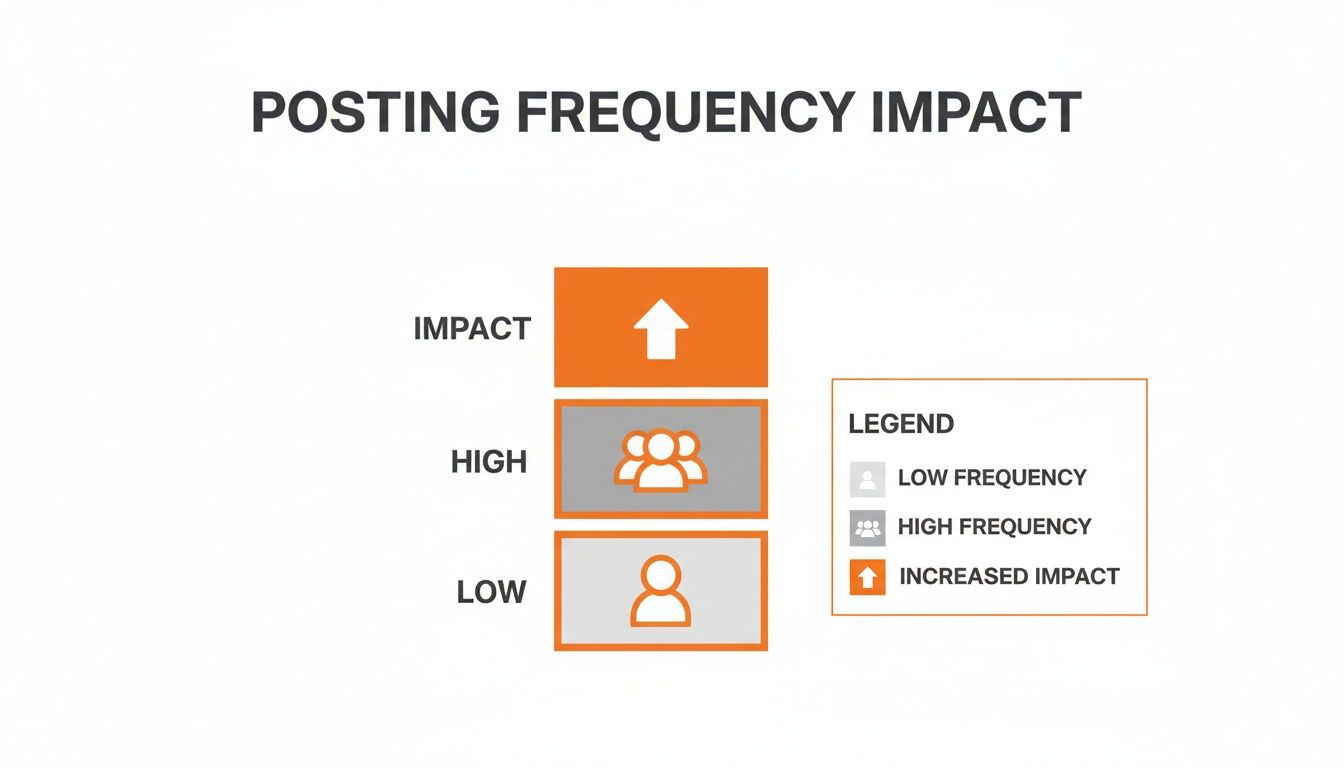
As you can see, shifting from a low to a high posting frequency directly translates to a major boost in the metrics that matter, from follower count to overall engagement.
LinkedIn Posting Frequency vs. Growth Potential
What does this mean in terms of actual numbers? The data tells a clear story. Posting sporadically keeps your growth slow, while a daily habit fast-tracks you toward a bigger audience and real business opportunities.
This table compares the direct impact of posting frequency on key growth metrics, based on 2026 data.
These numbers reflect what we see happening on the platform every day. Someone posting 1-2 times a week might gain 50-100 followers a month. But by ramping up to 5+ posts per week, that growth can explode to 400-1,000+ new followers, generate 40,000-100,000+ impressions, and spark 5-10+ new pipeline conversations every single month.
Why do most people give up on consistent posting?
For any busy professional, the thought of creating high-quality content daily sounds exhausting. You have a business to run and targets to hit. This is precisely where most people stumble. They start strong, but then a big project or travel derails them. The daily post becomes weekly, then monthly, and the initial momentum is lost.
The biggest threat to your LinkedIn growth isn't a lack of good ideas; it's a lack of a sustainable system for sharing them. You can't let a busy schedule derail your personal brand.
This is where having a smart workflow makes all the difference. The secret is finding a system that makes creating authentic content feel fast and effortless.
How to post daily without burning out
To maintain a daily posting cadence, you need a system. Here is a three-step process to make daily posting manageable:
- Capture ideas instantly. Use a notes app or voice memos on your phone. After an insightful client call or reading an interesting article, record a quick 30-second voice note summarizing your key thought. Don't overthink it.
- Use a content calendar. Planning your themes and topics ahead of time eliminates the daily panic of what to post. Our guide on building a LinkedIn content calendar template is a great place to start.
- Use authentic AI assistance. The right tool can act as your personal writing partner. A platform like Brewbrand is designed to learn your specific voice. You provide it with a raw idea—a messy voice note, a few bullet points—and it instantly crafts a post that sounds like you wrote it, complete with a strong hook and clean formatting.
This approach transforms a daunting daily chore into a simple, two-minute habit. It allows you to stay top-of-mind with your audience and keep your growth engine humming, no matter how busy your schedule gets.
Step 4: Turn Engagement Into a Growth Engine
If you hit "post" and then walk away, you are missing the single biggest opportunity for growth on LinkedIn. Great content is the starting point, but the real magic happens in the conversations that follow. LinkedIn is a professional community, not a billboard.
This is where you shift from broadcasting to engaging. Every comment you reply to and every insightful point you add to someone else's post is a chance to build relationships, prove your expertise, and get in front of a new audience.
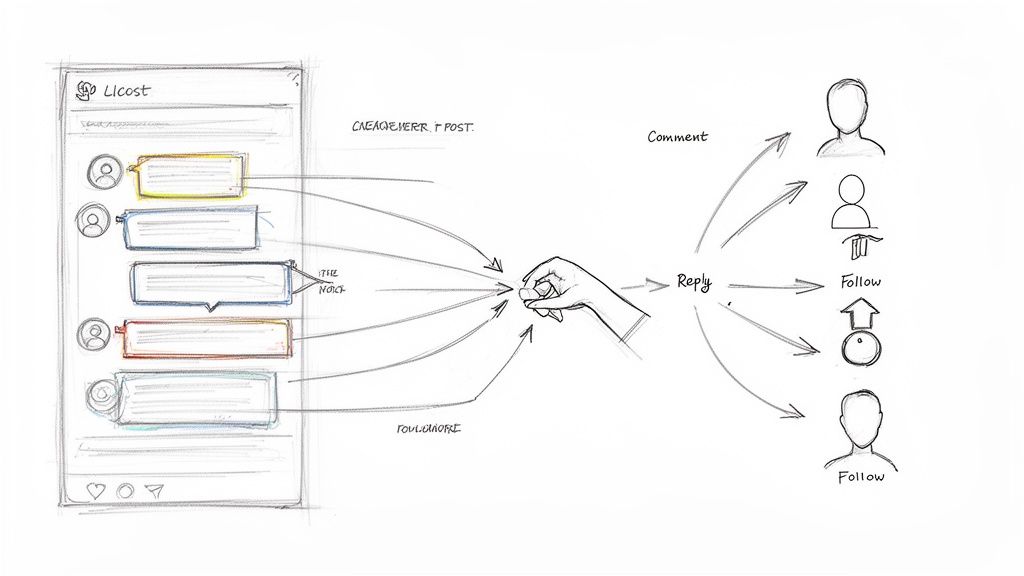
Why is replying to every comment a growth hack?
Replying to every single comment on your posts is one of the simplest things you can do, and the payoff is huge. When you respond, LinkedIn's algorithm sees that your post is sparking a real discussion and rewards you by showing it to more people.
More importantly, it's about people. When someone takes the time to leave a thoughtful comment, acknowledging it makes them feel heard and valued. That small act turns a passive reader into a loyal advocate who is far more likely to follow you and engage with your future content.
The numbers back this up. Research from 2025 analyzing over 52 million posts found that 83% of profiles that consistently reply to comments see better performance. As the algorithm has evolved, we've seen growth drop by as much as 59% for inactive accounts. You can dig into the full research on social media engagement trends to see just how critical this habit is.
How to get followers by commenting on other posts
Your engagement shouldn't stop at your own profile. To accelerate your growth, you need to show up where your target audience is already talking. This means commenting on posts from industry leaders, potential customers, and other relevant accounts in your niche.
A simple "Great post!" is a waste of a click. Your goal is to add so much value in the comments that people are compelled to check out your profile. A single, well-written comment can drive more new followers than one of your own posts.
Think of every comment as a mini-post. It’s a chance to showcase your expertise and perspective without having to create a full piece of content. Don't just agree—add to the conversation. Challenge a point (respectfully!), offer a different angle, or share a quick, relevant story.
What is a good framework for writing comments?
To make your comments work for you, use this three-part framework. Aim to hit at least one of these points in every comment you write:
Add a New Perspective: Instead of just repeating what the post said, build on it. For instance, if the post is about sales closing techniques, you could add, "Great point on handling objections. I've also found that asking 'What's the biggest risk you see in moving forward?' can uncover hidden roadblocks we didn't know existed."
Ask a Thought-Provoking Question: A smart question can kickstart a new discussion thread and position you as a deep thinker. For example, on a post about GTM strategy, you might ask, "This is a fantastic breakdown. How do you see this changing for companies shifting from an enterprise focus to a PLG model?"
Share a Relevant Mini-Story: A brief personal anecdote makes your point sticky and relatable. It’s the perfect way to connect your expertise to a real-world result.
When you start doing this consistently, every comment becomes a strategic move. You're actively placing your expertise in front of hundreds or thousands of professionals who need to know who you are. This is how you get followers on LinkedIn who are genuinely interested, driving high-intent people back to your profile, ready to hit "Follow."
How to Scale Your Presence with an Authentic Voice
For most founders and experts, the biggest hurdle to growing on LinkedIn isn't a lack of knowledge—it's a lack of time. You understand why daily visibility matters, but creating content every day feels out of reach when you're busy running a business.
This is the classic scaling problem. You need to show up consistently to build momentum, but you can't spare hours every week to write. More importantly, you can't afford to sound generic or lose the personal voice that makes you credible. The real question is: how can you produce more content without sacrificing the authenticity that earns trust and attracts followers?
Comparison: Content Scaling Options
When the pressure to post more mounts, busy professionals usually choose one of three paths, each with significant trade-offs in authenticity, speed, and cost.
Generic AI Writers: These are fast and cheap, but they produce sterile, formulaic posts that lack personality. They sound like everyone else and can damage your credibility.
Traditional Ghostwriting: A great ghostwriter can capture your voice, but it's expensive and slow. Onboarding, interviews, and feedback loops make it impractical for scaling daily content efficiently.
Authentic AI Assistance: This newer path finds a sweet spot. Tools like Brewbrand are designed to learn your specific tone, style, and expertise by analyzing your existing content. They help you articulate your own ideas in your own voice—just much faster.
This third approach allows you to maintain high quality and credibility while drastically reducing your workflow, making a daily presence achievable.
Comparison Table: Content Scaling Options
Let's break down what these differences mean for your brand and your ability to attract LinkedIn followers.
Looking at it this way, it’s clear that an authentic AI assistant provides a much more balanced solution. You get the voice control of a ghostwriter combined with the speed needed to post daily.
How does authentic AI-assisted creation work?
Here's a step-by-step example of the workflow. Imagine you just wrapped up a client call with a great insight.
- Capture the idea: Pull out your phone and record a 60-second voice note, rambling through your thoughts.
- Process with AI: Drop that messy, unscripted audio file into a tool like Brewbrand. The platform, which has already studied your past articles and posts, gets to work. It doesn't just transcribe; it understands your rhythm, phrases, and how you build an argument.
- Review and post: In minutes, you receive a well-structured post that sounds exactly like you wrote it. Your raw idea has been refined into a clear story with a strong hook and clean formatting, all while keeping your authentic voice.
This simple workflow changes content creation from a chore into a quick, repeatable habit. You bring the expert insight—the "what"—and the tool handles the heavy lifting of the "how," turning your expertise into content that grows your following. It's the secret to maintaining a powerful daily presence without the burnout.
Answering Your Top Questions About Growing on LinkedIn
As you implement these strategies, questions will arise. Here are answers to the most common questions about getting more followers on LinkedIn.
How long does it realistically take to get 1000 followers?
Hitting your first 1,000 followers is a significant milestone. For an active professional with an existing network, this is achievable in approximately 12 weeks.
This timeline is based on consistent execution of these steps:
- Maintaining an optimized profile focused on value.
- Posting high-quality, relevant content at least 3-5 times a week.
- Engaging in conversations in the comments—on your posts and others'.
Expect to gain around 100-200 new followers in your first month. As LinkedIn's algorithm recognizes your consistency, your growth will accelerate. Between weeks 5 and 12, you can often expect to gain another 400-800+ followers.
What is the difference between connections and followers? Which one is more important?
This is a classic question, and the best choice depends on your goal.
- Connections are a two-way relationship; both people must agree to connect. They are ideal for traditional networking and direct messaging.
- Followers are a one-way relationship. Anyone can choose to see your content without your approval.
If your primary goal is to build influence, establish thought leadership, and get your ideas in front of the largest possible audience, then followers are far more valuable.
When you switch on Creator Mode, your profile's main button changes from "Connect" to "Follow." This is a clear signal—to both people and the algorithm—that your priority is sharing valuable content with a broad audience. It's a small click that makes a big difference for personal branding.
What are the biggest mistakes people make when trying to get followers?
While there are many ways to grow, a few common mistakes will stop your progress. Knowing what not to do is as important as knowing what to do.
Here are the three biggest roadblocks:
Inconsistent Posting: This is the ultimate momentum killer. If you post daily for a week and then go silent for two, you signal to the algorithm that you're not a reliable source. It is better to post three times a week, every single week, than to post in random bursts.
"Me-First" Content: Your feed cannot be a constant advertisement for yourself. If every post is about your company's awards or product features, people will tune out. Focus on their problems, goals, and questions. Provide value to them.
Posting and Ghosting: Ignoring comments on your posts or never engaging in other conversations makes you look disconnected. Engagement is what turns a monologue into a community and helps you get discovered.
Should I use hashtags on my posts?
Yes, but they must be used strategically. The old method of cramming 20 random tags at the end of a post is ineffective. Today, the optimal number is 3-5 highly relevant hashtags.
Think of hashtags as filing labels that help LinkedIn categorize your content and show it to users following that topic.
Avoid broad, vague tags like #business or #success, as your content will be lost in the noise. Instead, be specific. If you write about sales strategy, use tags like #SaaSsales, #GTMstrategy, and #B2Bselling. This targets a more qualified audience—the exact people likely to follow you for your expertise.
Ready to post daily without losing your voice? Brewbrand learns your unique style from your past content, turning raw ideas into polished, ready-to-go posts in under two minutes. Save hours each week and build the consistent presence you need to grow. Start your free trial at Brewbrand.
Generate LinkedIn content easier than ever before
Lorem ipsum dolor sit amet, consectetur adipiscing elit. Lorem ipsum dolor sit amet, consectetur.