How to Get Connections on LinkedIn and Build a Powerful Network
Learn how to get connections on LinkedIn with proven strategies. Go beyond generic requests to build a network that drives real opportunities.

To get connections on LinkedIn, you must first optimize your profile, then send personalized outreach requests, engage with new contacts, and create valuable content to attract connections organically. This guide provides a step-by-step process for building a powerful professional network.
Think of your profile as the landing page for your professional brand. If it’s incomplete or uninspired, your outreach efforts will fall flat. But a polished, compelling profile makes every connection request you send ten times more effective. Let's walk through how to build one.
Step 1: Turn Your Profile into a Connection Magnet
This is the groundwork. Without a strong profile, you're asking people to connect with a stranger. With one, you're inviting them to connect with a valuable professional they can't afford to ignore.
Your Headline Is Your First Impression
Your headline shows up everywhere—in search results, next to your comments, and right at the top of your connection requests. Most people just put their job title, which is a huge missed opportunity. A good headline should immediately convey your value proposition.
- Standard Headline (Less Effective): "Sales Manager at Company Inc."
- Value-Driven Headline (More Effective): "Helping SaaS companies shorten their sales cycle | Enterprise Account Strategy & Pipeline Growth"
The second option tells a potential connection what you do and who you help, making you a far more interesting person to connect with.
Your "About" Section Is Your Story
This is your chance to be more than just a list of job titles and skills. Your "About" section should tell a story—who you are, what you're passionate about, and what kind of problems you love to solve. A great summary gives people a reason to care. We've actually put together a full guide on how to write a summary in LinkedIn that really stands out.
Your LinkedIn profile is your digital handshake. I've seen it firsthand—top recruiters and clients are actively scouting talent directly on LinkedIn now, often skipping the traditional job boards altogether. Your profile isn't just a resume; it's what gets you found.
Show, Don't Just Tell, with the Featured Section
The "Featured" section is some of the most valuable real estate on your entire profile. It's where you get to visually prove you can do what you claim.
This is the perfect spot to pin things like:
- A case study that shows off your results.
- An article you published that highlights your expertise.
- A powerful client testimonial or a video of you speaking.
- Direct links to your portfolio or a project you're proud of.
This section is your evidence locker. It takes the promises you make in your "About" section and backs them up with tangible proof, making it a no-brainer for someone to accept your connection request.
Step 2: Master Strategic and Personalized Outreach
Once your profile is polished, it’s time to actively seek connections. Simply hitting the “Connect” button is the digital equivalent of tossing a blank business card at someone across the room. It's impersonal and easy to ignore. The goal is to start meaningful conversations with the right people.
How to Pinpoint Your Ideal Connections
First, build a highly targeted list using LinkedIn's search filters. Don't just type a job title and hope for the best. Get granular.
Filter your search by job title, company, industry, and even company size or location. For instance, if you're a marketing consultant targeting tech startups, you could search for “Head of Growth” or “Marketing Director” at companies in the “Software Development” industry with 50-200 employees. This precision ensures every request is relevant.
Think of your profile as the foundation for this outreach. A weak profile will undermine even the best-written message.
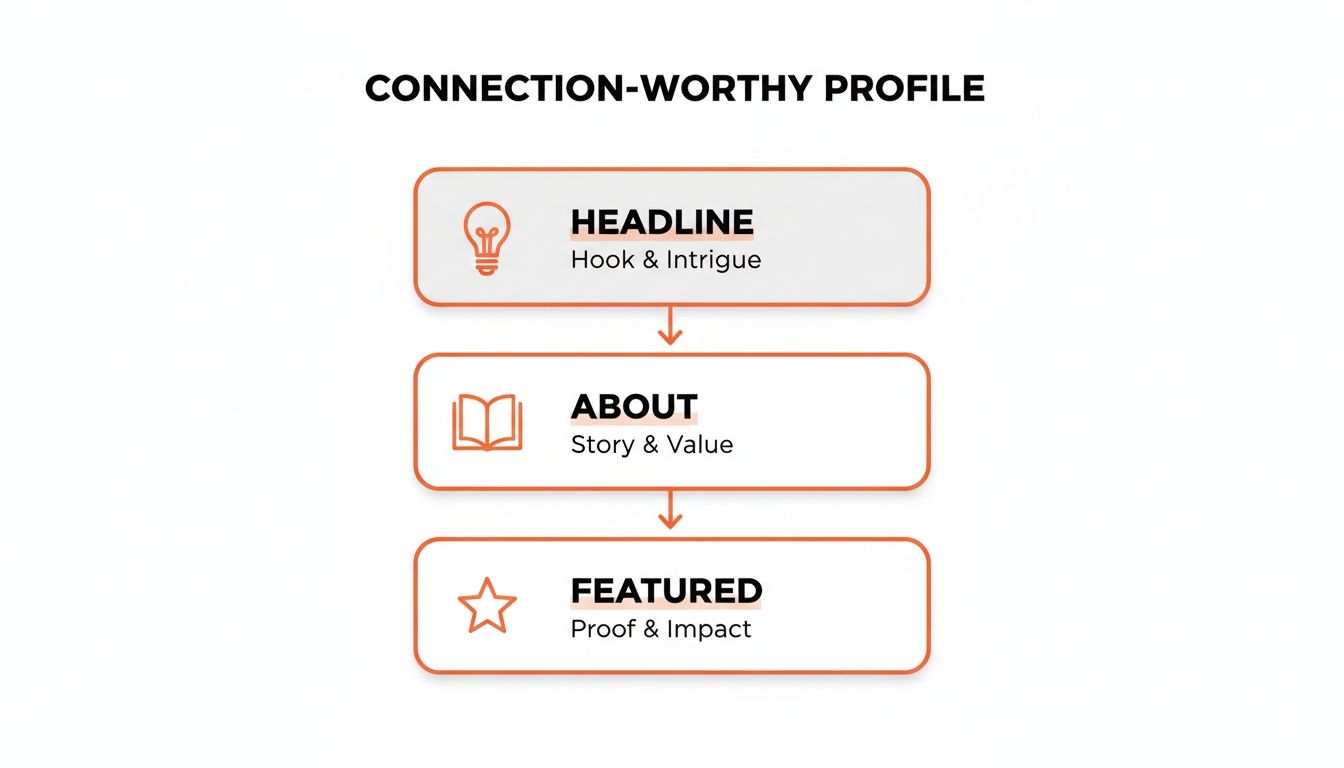
As you can see, your headline, "About" section, and featured content all work together to prove your credibility before they even accept your request.
The Undeniable Power of Personalization
Sending a personalized note with your connection request isn't just a nice touch—it's essential. Custom messages dramatically increase your acceptance rate. Your note doesn’t need to be an essay; it just needs to be genuine. Spend 60 seconds researching the person to find a specific reason to connect.
Here are a few effective hooks:
- Mutual Connection: "Hi Jane, I saw we're both connected with John Doe. I've been following your work in product marketing for a while and would love to connect and learn more."
- Recent Post: "Hi Mark, your recent post on AI's impact on sales really caught my eye. Fantastic insights! I'd love to follow your work more closely."
- Shared Group or Event: "Hi Sarah, I noticed you're also a member of the 'SaaS Growth Hacks' group. Always great to connect with fellow members. Hope we can connect here."
A personalized request shows you've done your homework and respect the other person's time. It’s the difference between being another random name and a thoughtful peer worth knowing.
This simple act changes the entire dynamic. For a deeper dive into crafting messages that get replies, check out our guide on creating the perfect LinkedIn message for connecting.
Not all personalization is created equal. The amount of effort you put in directly correlates with the results you'll see. Here is a comparison of different personalization levels.
Comparison: Connection Request Personalization Levels
As the table illustrates, a little bit of genuine effort goes a very long way. The more you tailor your approach, the better your chances of not just gaining a connection, but starting a conversation.
Step 3: Turn New Connections into Meaningful Conversations
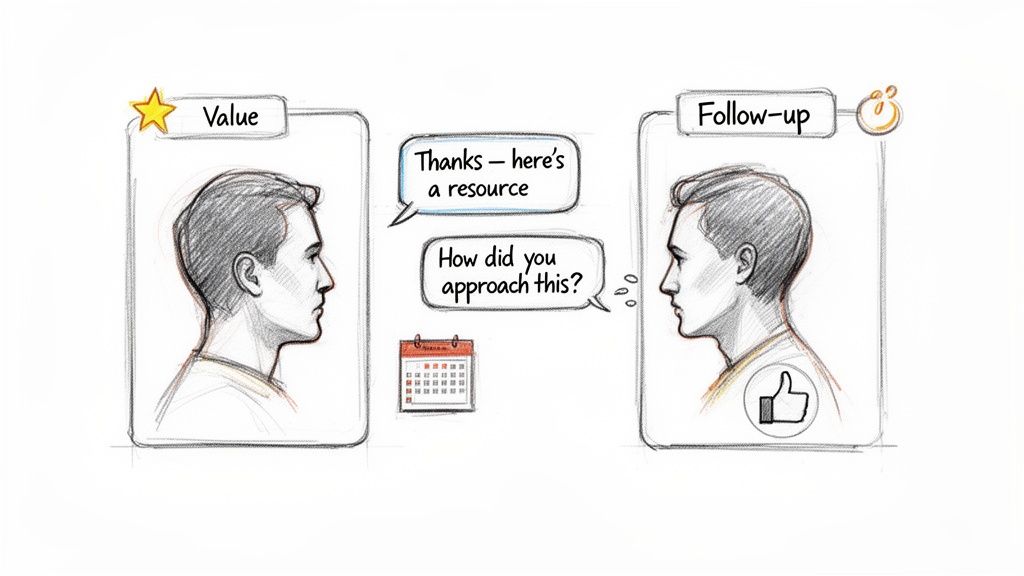
So, they accepted your connection request. Great! Now what? This is the exact moment where most networking on LinkedIn falls apart. People either go completely silent, or they swing for the fences with a hard sales pitch. Getting the connection is only step one.
Your goal is to shift from being just another name in their connection list to someone they actually have a conversation with. You can stand out from the 99% of people who get this wrong by having a simple, value-driven follow-up plan.
Your First Message After They Connect
A generic "Thanks for connecting!" is a wasted opportunity. Instead, lead with generosity by giving them something of value right away. This simple act immediately changes the dynamic from transactional to relational.
Here are a few value-driven follow-up ideas:
- Share a relevant article: "Great to connect, [Name]. I just read this piece on [Topic they care about] and immediately thought of your work at [Their Company]. Hope you find it interesting."
- Recommend a useful tool: "Hi [Name], glad we could connect. Since you work in [Their Field], I thought you might appreciate this tool I've been using for [Specific Task]. It’s been a game-changer for my team."
- Comment on their work: "Thanks for connecting, [Name]. I saw your company just launched [New Product/Initiative]. It looks fantastic—congrats to the team. I'm curious to hear how the launch went."
This isn't about flattery. It’s about showing you’ve done your homework and you’re genuinely interested in their world.
An accepted request is an invitation to talk, not an invitation to sell. That first follow-up is your chance to prove you're there to build a real professional relationship, not just to push your own agenda.
Keeping the Conversation Going
After making that solid first impression, you want to build a real dialogue. This doesn't mean you need to message them every other day. It's about looking for natural opportunities to engage and asking smart, open-ended questions.
A simple, non-pushy follow-up sequence could look like this:
- Day 1 (Right after they connect): Send a value-first thank you message.
- Week 2: Find one of their posts and leave a thoughtful comment. Go beyond "Great post!" and add your own insight.
- Week 4: Circle back with another direct message. This time, ask a question about their work, a project they mentioned, or something happening in your industry. For example: "Hi [Name], I saw you posted about [Industry Event]. I was wondering what your biggest takeaway was from the keynote?"
If you don't get a response, it's okay to back off. There's a fine line between persistence and pestering. Focus on giving value and showing real curiosity to turn a simple connection into a powerful professional ally.
Step 4: Use Content to Attract Connections Organically
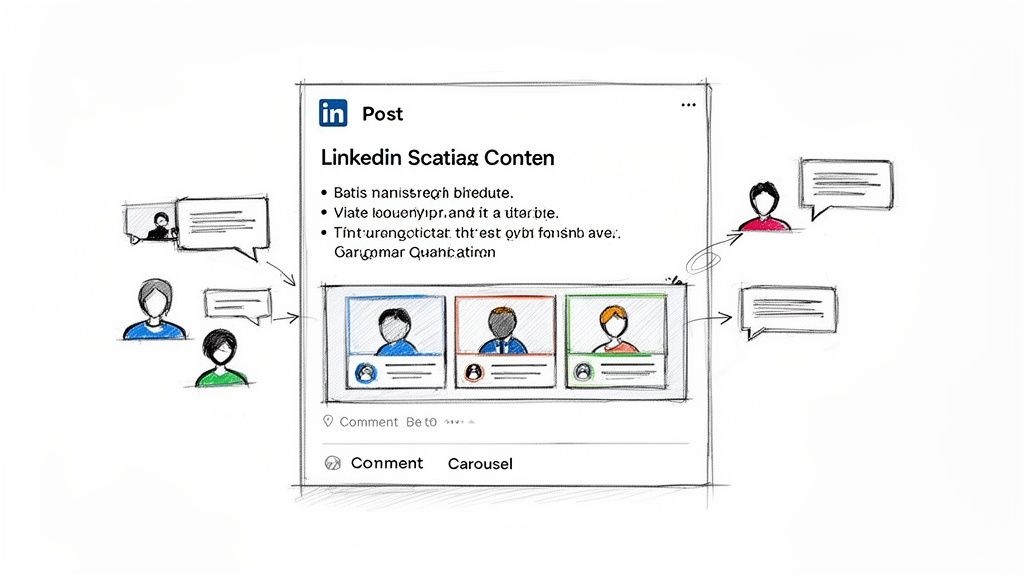
While direct outreach works, a solid content strategy brings your ideal network to you. This is the difference between cold calling and having qualified leads knocking on your door. An inbound approach scales your connections, builds authority, and makes people want to be part of your professional circle.
The secret is to consistently share what you know. Simple posts that deliver real value often perform best.
Content Formats That Draw People In
To get started, focus on a few formats that are easy to create but pack a punch. The idea is to turn your profile into a go-to resource, which naturally prompts connection requests.
Here are a few proven content formats:
- Insightful Text-Only Posts: Share a unique take on a new industry trend, a lesson you learned, or a counterintuitive opinion. These are fast to write and fantastic for starting conversations.
- Simple Carousels: Break down a complex idea into 3-5 digestible slides. Use these to map out a process, share a quick case study, or list key takeaways.
- Strategic Commentary: Find a post from an industry leader and add your own analysis, either in the comments or by reposting it. This positions you as a thoughtful peer.
When you consistently share valuable content, you’re building an evergreen library of your expertise. For more ideas, check out our guide on how to write engaging LinkedIn posts.
The Underrated Power of Strategic Engagement
Creating content is only half the battle. You also need to actively engage with other people's posts. This is one of the most overlooked tactics for growing a high-quality LinkedIn network.
When you leave an insightful comment on a post from an industry leader, you’re not just talking to them—you’re getting exposure to their entire audience. A single, well-crafted comment can put you on the radar of hundreds of ideal prospects.
A great comment should always add to the conversation, not just acknowledge it. Ditch the "Great post!" and try adding a related insight, asking a smart follow-up question, or sharing a brief, relevant experience. This simple shift turns you from a passive spectator into an active participant.
This inbound-outbound flywheel creates a powerful growth engine. Your own posts attract followers, while your thoughtful comments attract high-value connections, establishing you as a go-to voice in your space.
Putting Your Growth on the Fast Track
For those serious about scaling, premium tools can be a game-changer. For instance, upgrades like LinkedIn Sales Navigator can supercharge your ability to find and connect with the right people. Data shows that users of these tools form 3.6x more connections with decision-makers.
As of 2026, an active premium user has, on average, 1,200-1,500 connections, easily outpacing the general user average of 930. Top executives and influencers often reach networks of 1,500-3,000 or more, showing that investing in the right tools can make a massive difference.
Step 5: Measure and Optimize Your Networking Results
To improve your networking strategy, you must track your results. This isn’t about getting lost in complicated spreadsheets; a quick, weekly check-in on a few key stats is all it takes to refine your approach.
Key Metrics for LinkedIn Networking
To get more of the right connections, pay attention to the numbers that tell the real story of your strategy. Here are the core metrics to watch:
Connection Request Acceptance Rate: This is the number of accepted requests divided by the total sent. If this number dips below 30-40%, it's a sign that your personalized messages need improvement.
Weekly Profile Views: A jump in profile views indicates that your activity—whether it's posting content or commenting—is getting you noticed. This is a clear measure of your visibility.
Social Selling Index (SSI) Score: LinkedIn provides this free score, grading you on brand building, finding the right people, sharing insights, and forming relationships. A rising SSI score is a great indicator that your overall approach is effective.
Think of these numbers as the dashboard for your networking efforts. A dropping acceptance rate is like a check-engine light for your messaging. A rising SSI score shows your engine is running smoothly and gaining power.
Turning Data into Action with A/B Testing
Once you start tracking, you can start improving. A/B testing is a simple way to compare two different approaches to see which one performs better.
For instance, you could test two different hooks in your connection request:
- Version A: Mentions a mutual connection.
- Version B: References a recent post they shared.
Send 20 requests using Version A and another 20 with Version B. Compare the acceptance rates. The version with more acceptances becomes your new default template. This cycle of test, measure, and repeat is how you continuously fine-tune your process.
Let's be honest, LinkedIn has a lot of unwritten rules. Once you start seriously trying to grow your network, the questions start popping up fast. Here are straightforward answers to common questions about building a powerful LinkedIn network.
How many connection requests should I send per week on LinkedIn?
While LinkedIn has an "official" limit of around 100 requests per week, the focus should be on quality, not quantity.
For most professionals, the sweet spot is sending 20-30 highly personalized requests each week. This number is manageable, allowing you enough time to research each person and write a thoughtful note. This focused approach dramatically increases your acceptance rate, keeps your account in good standing with LinkedIn's algorithm, and ensures you can meaningfully engage with your new connections.
What is the difference between connecting and following on LinkedIn?
Connecting and following serve two different purposes. The choice depends on your goal.
Follow: Choose this option when you are primarily interested in someone's content. Think of it as a low-pressure way to learn from industry leaders or influencers without needing a direct conversation. You will see their posts, but they won't see yours. It is a one-way relationship for consuming insights.
Connect: Choose this option when you want to build a mutual, two-way relationship. Connecting opens the door for direct messaging, gives you visibility into each other's networks, and places your content in their feed. This is for potential clients, partners, mentors, or colleagues with whom you want to build rapport.
Pro Tip: Combine both. Follow a key person for a week or two. Leave a couple of thoughtful comments on their posts to warm them up. Then send your connection request, referencing something you appreciated from their content. This makes your request feel familiar and shows you've done your homework.
What are the biggest mistakes to avoid when getting connections on LinkedIn?
I see people trip over the same few hurdles all the time. The good news is they are incredibly easy to avoid once you know what they are. Steer clear of these, and you'll already be ahead of most people.
Here are the three biggest blunders to avoid:
- Sending the default connection request. The generic "I'd like to add you to my professional network" message shows zero effort and is easily ignored. Always personalize your request to give them a reason to accept.
- Having an incomplete or unprofessional profile. Your profile is your digital handshake. A blurry photo, generic headline, or sparse "About" section signals a lack of professionalism and gives no reason for someone to connect.
- Pitching immediately after they accept. This is the fastest way to get ignored or removed as a connection. The first interaction should be about building rapport, not closing a sale. Treat it like a real-life networking event; you wouldn't launch into a sales pitch upon meeting someone.
Growing your network is one piece of the puzzle, but creating the content that attracts those connections is another beast entirely. With Brewbrand, you can generate authentic, on-brand LinkedIn posts in minutes, not hours. It learns your unique voice to help you publish consistently, build authority, and attract your ideal network organically. Start scaling your personal brand for free today at brewbrand.ai.
Generate LinkedIn content easier than ever before
Lorem ipsum dolor sit amet, consectetur adipiscing elit. Lorem ipsum dolor sit amet, consectetur.