A Step-by-Step Guide to Growing Your LinkedIn Presence
Learn how to grow on LinkedIn with our definitive playbook. Get expert strategies for profile optimization, content creation, and authentic networking.

If you're asking, "How do I grow on LinkedIn?", you need to stop thinking of your profile as a static resume. It’s not a dusty document you update once a year. Think of it as your digital storefront, your personal media platform. True growth comes down to a simple, powerful formula: an optimized profile, a consistent content strategy, and real, human engagement. Get these three things right, and you'll shift from being a passive observer to a powerful voice in your industry.
Step 1: Build Your Foundation for LinkedIn Growth
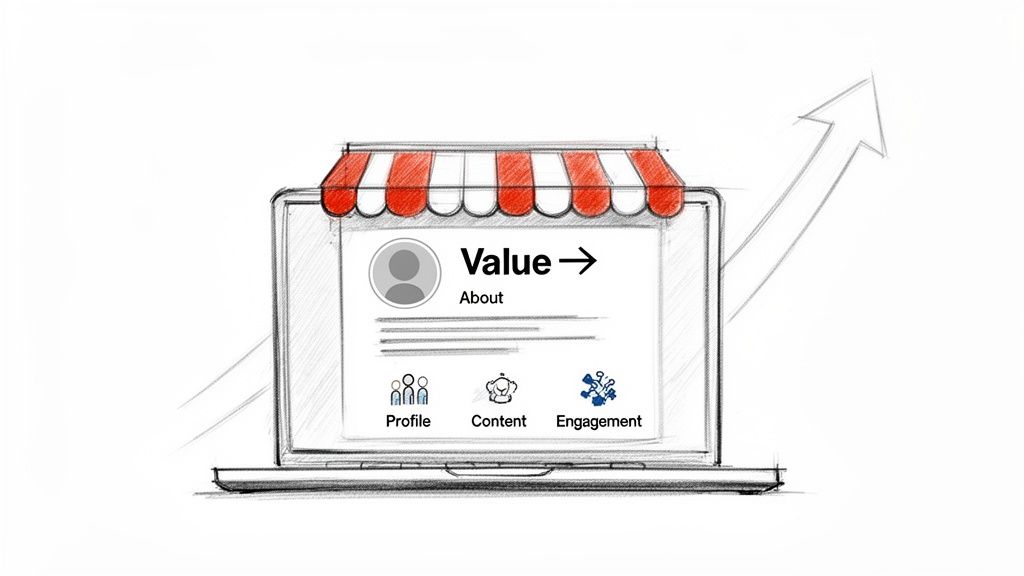
Before you can even think about posting content or networking, you have to get your foundation right. So many people just throw up a profile and think that's enough. But an incomplete or generic profile is like a shop with no sign on the door—people will walk right past without a second glance.
Your profile is the central hub for everything you do on the platform. Every post, every comment, every like will lead people back here. If it doesn't immediately tell them who you are, who you help, and why they should care, all your other efforts are for nothing. It’s that simple.
Your Quick-Win Checklist for Immediate Traction
For those asking, "What are the first steps to grow on LinkedIn?", let's start with high-impact changes that signal you're a serious professional. These aren't just minor details; they are the critical hooks that make someone decide whether to follow you, connect, or just keep scrolling.
Here's a step-by-step checklist to get you started:
- Step 1: Upload a Professional Photo: Your profile picture is non-negotiable. Use a clear, high-quality headshot where you look friendly and approachable. Profiles with a photo get a staggering 21 times more views.
- Step 2: Craft a Compelling Headline: Don't just list your job title. Your headline is your personal billboard. Instead of "Marketing Manager," try something like, "Marketing Manager | I Help B2B SaaS Companies Double Their Inbound Leads." See the difference?
- Step 3: Write a Results-Driven 'About' Summary: This is your chance to tell a story. Use the first person ("I," "my") to connect directly with your reader. Explain the problems you solve and for whom you solve them.
Nailing these fundamentals is the first real step in learning how to build a personal brand that pulls in opportunities instead of you having to chase them.
The greatest secret of LinkedIn growth is perseverance. You build an audience. The audience trusts you, and they become your customers. It's a long game, not a get-rich-quick scheme.
From Passive to Powerful Presence
The difference between a generic profile and a fully optimized one is night and day. A passive profile just lists job duties. A powerful one showcases tangible achievements and tells a story that resonates with a specific audience. This shift is the key to unlocking real growth on LinkedIn.
The table below breaks down exactly what separates a low-impact profile from one designed for high growth.
Optimized vs. Generic LinkedIn Profile: A Comparison
Ultimately, a generic profile is reactive; it just sits there waiting to be found. An optimized profile, on the other hand, is proactive. It uses strategic keywords, clear value propositions, and social proof to actively attract the right people to your network. It works for you 24/7, turning simple profile views into meaningful conversations and connections.
Step 2: Turn Your Profile Into an Opportunity Magnet
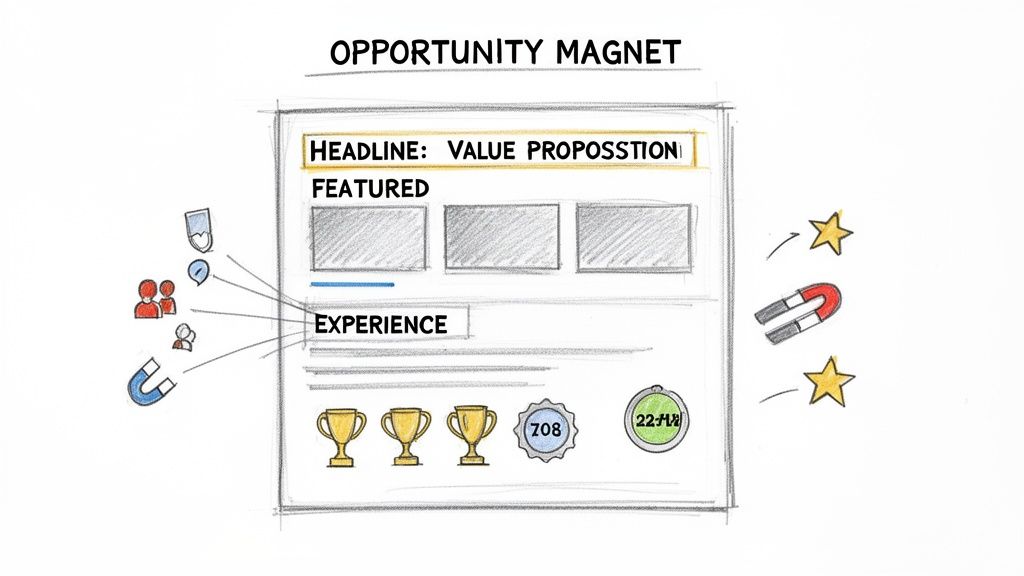
Think of your LinkedIn profile as your digital storefront. Every post you write, every comment you leave, every connection you make leads people right back here. It’s where potential clients, partners, and employers go to decide if you’re the real deal. So, does it just list your job history, or does it actively work for you?
Too many people slap on a decent headshot, a job title, and call it a day. That’s leaving a massive amount of opportunity on the table. To really grow on LinkedIn, you have to treat every part of your profile as a tool to pull in the right people and start conversations. This is how you stop being a passive observer and start building a 24/7 opportunity magnet.
Craft a Headline That Is Your Value Proposition
If you searched "How to write a good LinkedIn headline," the answer is to make it your value proposition. Your headline is the single most visible piece of text on your entire profile. It follows you everywhere—in search results, next to your comments, and on connection requests. Using it for just a job title is a huge missed opportunity.
Instead, think of it as a super-condensed value proposition. It needs to instantly tell people who you help and what you get done for them.
- Generic Headline (Low Impact): "Founder at Startup Co."
- Value-Driven Headline (High Impact): "Founder | Helping B2B SaaS Scale Content & Drive SQLs | Ex-HubSpot"
See the difference? The second example is a magnet for the right audience. It uses keywords like "B2B SaaS" and "SQLs," states a clear benefit, and even drops in a little social proof with "Ex-HubSpot." It immediately answers the question on everyone's mind: "What's in it for me if I connect with you?"
Write an About Section That Tells a Compelling Story
The ‘About’ section is your chance to stop sounding like a resume and start sounding like a person. Don’t just copy and paste bullet points. Write in the first person—using "I" and "my"—to create a direct, personal connection with anyone who stops by.
Here's a step-by-step process for a great 'About' section:
- The Hook: Kick things off with a bold statement about the problem you solve or a core belief you have.
- The "Who": Get specific about who you help. Is it early-stage founders? Marketing agencies? Name them.
- The "How": Briefly explain your unique approach or philosophy for getting them results.
- The Proof: Sprinkle in some real numbers or achievements. Think "increased revenue by 30%" or "helped 50+ clients."
- The Call-to-Action: Don't leave them hanging. End with a clear next step, like inviting them to connect, check out your website, or book a call.
This narrative approach builds trust way faster than a dry list of job duties ever could. It’s also the perfect place to naturally work in keywords for your industry, making you more discoverable when people are searching for your exact skills.
Your personal page is more effective than a company page. That’s where you should lead with expertise, share what you’re seeing and learning, and build trust over time.
This focus on the individual is everything on LinkedIn. The platform has over 1 billion members worldwide and is projected to hit 1.3 billion by 2026. People want to connect with other people, not with faceless logos. If you want to see the sheer scale of the opportunity, you can dive deeper into the LinkedIn stats.
Showcase Your Best Work in the Featured Section
Right below your 'About' section is some prime real estate that most people completely ignore: the 'Featured' section. This is your chance to visually showcase your best stuff and provide undeniable proof that you know what you’re talking about.
Pin a few of your greatest hits here. Good candidates include:
- A high-performing LinkedIn post that sparked a great conversation.
- A link to a case study on your website detailing a big client win.
- A testimonial video from a happy customer.
- A lead magnet, like a free guide or a webinar sign-up.
Think of it as your professional highlight reel. Instead of just telling people you’re an expert, you’re showing them with cold, hard evidence. This instantly builds credibility and gives visitors an easy next step to engage with you further.
Optimize Experience to Highlight Achievements
Finally, let’s give your 'Experience' section a makeover. Stop listing your daily duties and start focusing on your actual achievements. For each role, add two or three bullet points that highlight tangible, quantifiable results.
It’s the difference between this:
- Responsibility-Focused: Managed social media accounts for clients.
And this:
- Achievement-Focused: Grew a client's LinkedIn followers by 200% in six months, leading to a 15% increase in inbound leads.
- Achievement-Focused: Developed and executed a content strategy that generated over 500,000 impressions in Q1.
One shows you were busy; the other shows you delivered real impact. This is what future clients and employers actually care about. When you combine this achievement-focused framing with strong recommendations from colleagues, your profile becomes a powerful engine that brings opportunities right to your doorstep.
Step 3: Craft a Content Strategy That Builds Real Authority
An optimized profile gets you in the game, but a sharp content strategy is how you actually win. Think of it as the engine for your LinkedIn growth. Without consistent, valuable content, even the most polished profile will just sit there collecting digital dust. It’s what turns passive profile viewers into an engaged audience that genuinely trusts you.
The goal isn't to just post for the sake of it. It’s about building authority. You achieve this by creating content that educates your audience, shares insights they can’t get elsewhere, and shows you know how to get results. This approach fundamentally shifts your position from just another person selling something to the go-to expert people actively seek out.
Define Your Core Content Pillars
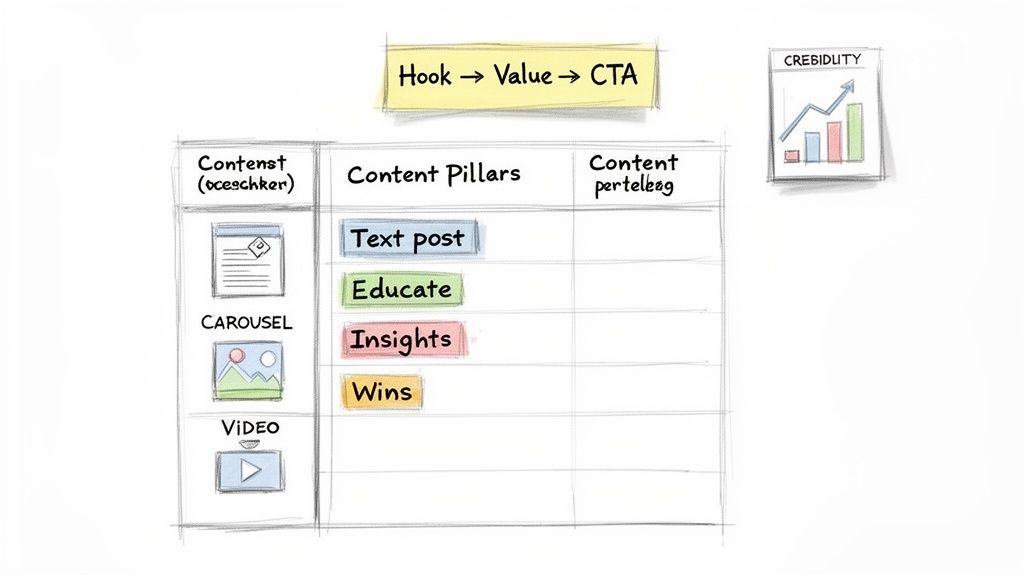
Before you even think about writing a post, you have to figure out your "why." Why should anyone listen to you? What unique perspective do you bring to the table? Your content pillars are the 2-4 core topics you’re going to own. They should live at the sweet spot where your expertise meets your audience's biggest frustrations.
For example, if you're the founder of a marketing agency, your pillars might look something like this:
- Lead Generation Tactics: Real, actionable tips on how to get more qualified leads.
- Founder-Led Storytelling: The real, unvarnished story of building your agency.
- Client Success Stories: Hard proof showing how your strategies delivered actual ROI.
Having clear pillars gives you focus. It makes sure every single post reinforces your expertise in a specific niche. That clarity is everything. I’ve seen time and again that a well-defined purpose is what keeps creators going long enough to see those incredible compounding results. Once you have your pillars, you can map out a full thought leadership content strategy that methodically builds trust over time.
Most people don’t interact with your posts, but they’re watching. When they need what you offer, you’re top of mind. That’s why our sales calls now convert so much higher, 70–80% of new demos today come through LinkedIn.
This insight from founder Maximilian Flietman nails it. Consistent, authoritative content works quietly in the background, building trust so that when a prospect is finally ready to buy, you're the first person they call.
The Anatomy of a Scroll-Stopping Post
Let’s be honest, the LinkedIn feed is a firehose of information. To get noticed, your posts need a solid structure. From my experience, the most effective ones all follow a simple formula: Hook, Value, and Call-to-Action (CTA).
- The Hook: The first line or two is everything. Your only job is to make someone stop scrolling. You can do this with a bold claim, a challenging question, or a contrarian opinion. Instead of saying, "Here's how to improve sales," try something like, "I ignored 99% of sales advice. Here's the one lesson that actually worked." See the difference?
- The Value: This is the meat of your post. Here's where you deliver on the hook's promise. Teach something, tell a personal story, or give a step-by-step breakdown. Use short sentences and plenty of white space. It makes a world of difference for readability on mobile.
- The CTA: Tell your audience what to do next. A good CTA isn't just a link; it sparks a conversation. End with an open-ended question like, "What's the one thing holding you back from trying this?" This invites comments, which the LinkedIn algorithm absolutely loves.
Always remember: the main goal of any post is to start a conversation. Lengthy, thoughtful comments are a huge signal to LinkedIn that your content is valuable, which in turn gives you more reach.
Find Your Authentic Voice
Your voice is your single greatest asset on LinkedIn. It’s your differentiator. People follow people, not corporate-speaking robots. So, drop the jargon and the overly formal tone. Just write like you speak.
Here’s a simple trick: read your draft out loud. Does it sound like something you'd actually say to a colleague? If it feels stuffy or unnatural, rewrite it. Sharing personal stories, struggles, and even moments of vulnerability is what creates a real connection. One of my posts that took off, getting over 100,000 impressions, was just a short, honest reflection on feeling left behind by AI. It resonated because it was human.
Choose the Right Content Formats
Mixing up your content formats keeps your feed fresh and appeals to different people. Some love to read, others prefer to swipe through slides. Here’s a quick look at some of the most effective formats on the platform.
High-Performing LinkedIn Post Formats
Here’s a breakdown of different LinkedIn post formats, their strengths, and how I've seen them used for maximum impact.
A balanced mix is key. For example, you could post a text-only story on Monday, a carousel guide on Wednesday, and a short behind-the-scenes video on Friday.
Ultimately, find a realistic cadence. Aiming for 3-5 posts per week is a fantastic goal. When you’re just learning how to grow on LinkedIn, consistency is always more important than frequency.
Step 4: Become a Master of Authentic Engagement and Networking
Content might get you noticed, but conversations get you clients. You can have the most polished profile and a brilliant content strategy, but the real growth on LinkedIn is a contact sport. It happens in the comments, the DMs, and the connection requests. This is where you stop broadcasting and start building relationships.
If you’re just passively scrolling, you’re getting left behind. Strategic, active networking is what turns your followers into true advocates and transforms silent lurkers into promising leads. It’s all about showing up, adding value, and proving you're a real person worth knowing—not just another profile picture in a crowded feed.
Move Beyond 'Great Post' with Insightful Comments
Want the fastest way to get on the radar of the right people? Show up where they’re already talking. Leaving thoughtful comments on posts from industry leaders, prospects, or partners puts you directly in their line of sight. But a simple "great post!" is a complete waste of your time. It adds nothing to the conversation and makes you invisible.
Instead, think of your comments as mini-posts. Your goal is to genuinely contribute.
- Ask a smart question: "This is a great point on sales cycles. I'm curious, how do you see this applying to a company with a much lower ACV?"
- Share a quick, relevant story: "I actually saw this exact trend with a client last quarter. We found that shifting our focus to X..."
- Offer a different perspective (respectfully): "Really interesting take. I've always viewed it from another angle, where..."
A single, well-crafted comment on a post with high reach can drive more relevant profile views than one of your own posts. It’s a powerful tactic for expanding your network and showcasing your expertise, especially when you're just starting to build a following.
Treat your comments as mini-posts. Aim to educate or add a unique perspective in 90% of them.
This is probably the most underrated strategy on the entire platform. By consistently adding value in the comments, you become a recognized and respected name in your niche. Before you know it, people will start seeking out your opinion, and that’s the first real step toward building genuine influence.
Carve Out a Daily Engagement Routine
Consistency is what separates the pros from the amateurs on LinkedIn. The good news is, you don't need to live on the platform for hours every day. You just need to be intentional. A short, focused routine can make a world of difference.
Here's a daily step-by-step engagement plan for just 15-20 minutes a day:
- Engage with Your Feed (5 mins): Find 3-5 posts from people you already know and leave a thoughtful comment.
- Engage via Hashtags (5 mins): Follow a few key industry hashtags. Jump into 2-3 relevant conversations and add your two cents.
- Engage with Key Players (5 mins): Go directly to the profiles of 3-5 dream clients or industry leaders. See what they're posting or commenting on, and engage there.
This simple habit keeps your name top-of-mind and shows you’re an active, engaged member of your industry. It's a small daily investment that pays compounding dividends over time.
The Art of a Personalized Connection Request
We’ve all received them: the generic, no-message connection request. They have a terrible acceptance rate and start a potential relationship off on the wrong foot. Your goal isn't just to get accepted; it's to open the door for a real conversation down the line. A personalized note is the key that unlocks it.
A strong connection request always gives context. Mention a mutual connection, a piece of their content you enjoyed, or a group you share.
Connection Request: Generic vs. Personalized
Build Relationships, Not Spam Lists, in Your DMs
Direct messages are for conversations, not cold pitches. Sliding into someone's DMs with a sales pitch in the very first message is the fastest way to get ignored, or worse, blocked. For founders and sales leaders especially, the right DM approach is all about prioritizing a genuine connection first.
This strategy works because it’s built on a foundation of trust. An incredible 67% of members trust LinkedIn the most with their data. It’s also where 75-85% of all B2B leads from social media come from. This unique environment makes a relationship-first approach incredibly effective and proves why consistent, valuable interaction is the key for anyone learning how to grow on LinkedIn. If you want to dive deeper, you can explore the latest LinkedIn engagement data.
Step 5: Build a Repeatable Content Creation Workflow
Let’s be honest: consistency is the single biggest challenge for busy professionals on LinkedIn. A post going viral is great, but what truly builds an audience that knows, likes, and trusts you is showing up with valuable content day after day.
The secret isn’t working harder. It's about building a smart, repeatable workflow that crushes writer's block and gives you back hours every week.
I'm talking about a modern process designed for founders, sales leaders, and consultants—people who need to be visible but are always short on time. With the right system, you can stop being a sporadic poster and start being an authoritative voice in your field.
Capture Raw Ideas Effortlessly
Here's a truth about content: the best ideas almost never show up when you're staring at a blank screen. They strike during a client call, while you're listening to a podcast, or in the middle of a team meeting. The foundation of a sustainable workflow is having a dead-simple way to catch these thoughts as they happen.
Don't overthink this part. Just grab what's fastest for you.
- Record a quick voice note on your phone describing a recent customer win.
- Screenshot a compelling statistic you stumbled upon in an article.
- Fire off a quick text to yourself with a contrarian opinion you have.
The whole point is to build a backlog of raw material. This "idea bank" is your best defense against the dreaded blank page. When it's time to create, you’re not starting from scratch—you're just polishing a gem you've already found.
Use Smart Tools to Define and Mirror Your Voice
Once you've got a raw idea, the next job is to shape it into a post that actually connects. This is where modern tools can be a massive help, but only if they don't strip away your personality. Generic AI tools spit out robotic, soulless content that feels completely out of place on a platform built for human connection.
The real trick is to use a specialized tool like Brewbrand, which is designed to analyze your specific writing style. You feed it your past LinkedIn posts, and it learns your vocabulary, your cadence, your sense of humor—even your quirks. It's built to mirror you, not some generic marketing persona.
With this approach, a 30-second voice memo can become a well-structured draft in minutes. The tool can even spin up multiple hooks based on proven copywriting frameworks, making sure your post has the stopping power it needs in a crowded feed. It’s not about replacing your thinking; it's about accelerating the tedious parts of writing so you can focus on what matters: the message.
Don’t just post to show up. Post to connect. Post to teach. Post to earn attention from real humans. Ask yourself: "Would my ideal customer feel like this was written just for them?"
This is where an AI-assisted workflow really shines. It handles the heavy lifting of the first draft, freeing you up to add the personal anecdotes and refine the message until every word sounds exactly like it came from you.
Iterate on Drafts to Make Them 100% You
An AI-generated draft is just a starting point. It’s never the finished product. The most critical step is adding the human touch—this is where you inject your personality, experience, and authentic voice back into the content.
Here’s a simple 4-step review process:
- Read it Aloud: Does it sound like something you'd actually say in a conversation? If not, rewrite those stiff or awkward phrases until it does.
- Add a Personal Story: Can you link the core idea to a real-life experience? A short, specific anecdote makes your content memorable and relatable.
- Check the Hook: Is that first line strong enough to make someone stop scrolling? Test the different hook variations and go with the one that packs the most punch.
- Refine the Call-to-Action: Don’t just end with a generic "what do you think?" Ask a specific question that invites a real conversation.
This content flywheel is what fuels your networking efforts. A great post is the starting gun for genuine connection, moving someone from a simple comment to a meaningful conversation in your DMs.
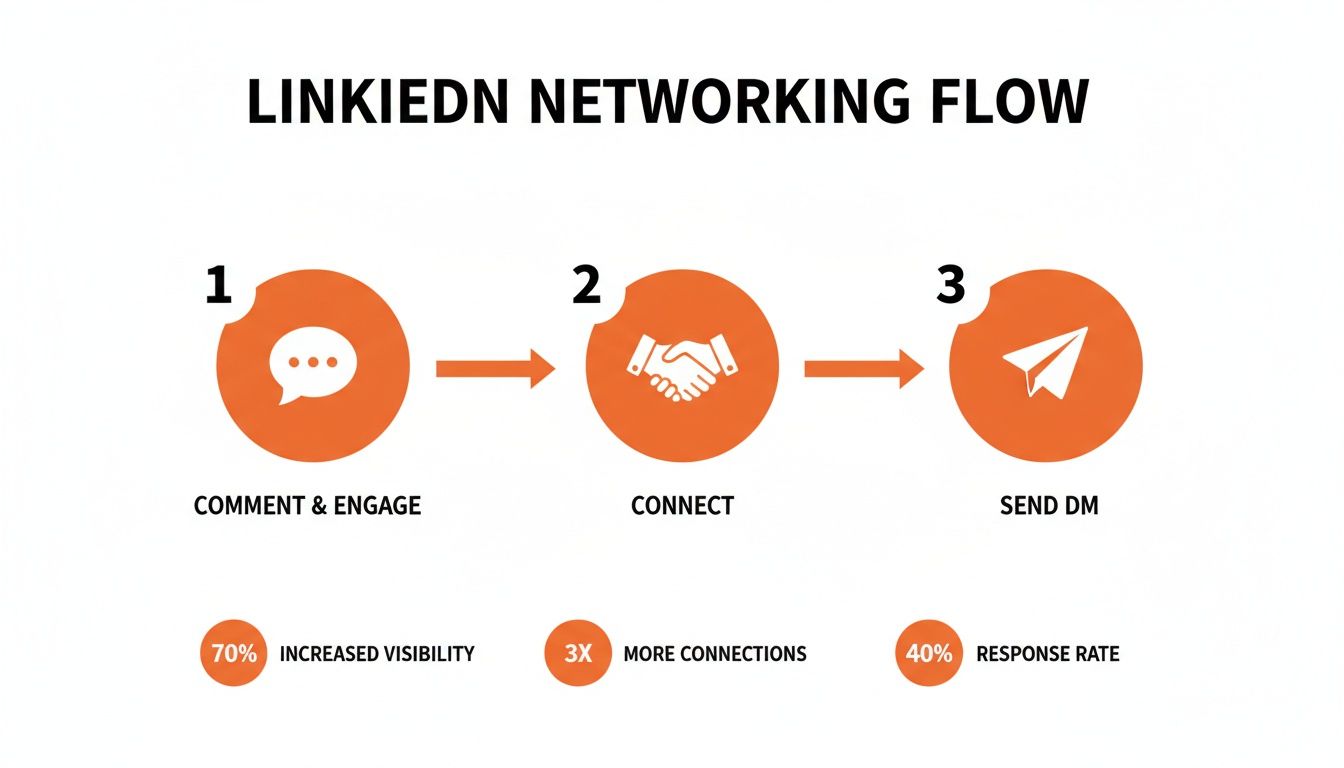
Having a repeatable workflow ensures you always have something valuable to share, which is what gets this exact flywheel spinning. This system transforms content creation from a daily chore into a scalable engine for growth.
By establishing a content pipeline, you can plan your posts with confidence. For a deeper dive on organizing your schedule, check out our guide on creating a LinkedIn content calendar template that pairs perfectly with this workflow.
Ultimately, this entire approach is about empowering you to post daily, save hours each week, and solidify your reputation as a consistent, trusted expert in your space.
Your Top LinkedIn Growth Questions, Answered
Even with the best playbook, you're bound to run into questions as you start putting these strategies into practice. Let's tackle some of the most common hurdles I see professionals face when they're trying to build a real presence on LinkedIn.
Think of this as your go-to guide for those "am I doing this right?" moments.
Question: How long until I actually see results on LinkedIn?
This is the big one, isn't it? Everyone wants to know when the hard work pays off.
Answer: Real, meaningful growth—the kind that brings in steady leads and gets you noticed—takes time. You should expect to put in consistent effort for three to six months to build real momentum.
However, you will see early signs of life much faster. Within a few weeks of optimizing your profile and engaging consistently, you should notice more profile views and a bump in your connection acceptance rate. These are the first green shoots.
The single biggest factor is consistency.
- Post quality content 3-5 times a week. This shows the algorithm you're a serious player.
- Spend 15 minutes a day engaging. Don't just scroll—leave thoughtful comments that spark conversation.
Sporadic activity is a momentum killer. A week of intense posting followed by a month of silence tells the algorithm you're not a reliable source. A manageable, daily routine is your most powerful tool.
Question: What are the biggest mistakes to avoid on LinkedIn?
It's just as important to know what not to do. I see so many talented professionals unintentionally sabotaging their own growth by falling into a few common traps.
Answer: The three mistakes that will sink your efforts faster than anything else are:
- Selling Too Soon: Nothing repels a new connection faster than an immediate sales pitch in their DMs. Your first interaction is for starting a human conversation, not for closing a deal. Build the relationship first.
- Inconsistent Posting: If you post five times one week and then go dark for three, you’re resetting your progress to zero. The algorithm rewards a steady drumbeat of content. A simple content calendar is all you need to fix this.
- Generic Engagement: Comments like “Great post!” or “Thanks for sharing!” are completely useless. They don't add value, they don't showcase your expertise, and they get ignored.
A single, insightful comment on a popular post can get you more visibility than one of your own posts. Your comment should be a mini-post in itself—add an insight, ask a clarifying question, or share a related experience to spark a real conversation.
Just by avoiding these three things, you'll already be ahead of 90% of the people on the platform.
Question: Should I focus more on content or engagement?
This is a classic chicken-or-the-egg dilemma. The truth is, you need both, but the right balance changes depending on where you are on your growth journey.
Answer: It depends on your current audience size.
- If you are starting out (small network): Your time should be split 60% engagement and 40% content creation. The fastest way to get in front of the right people is to leave smart, value-packed comments on posts from established voices in your industry. This puts your name, headline, and expertise in front of their much larger, highly relevant audience.
- If you have a growing audience: You can shift the balance closer to 50/50. Your own content will start to pull its own weight, and you can divide your time more evenly.
You never stop engaging. Engagement is the fuel for the entire system.
- Content builds your authority.
- Engagement builds the relationships that lead to real opportunities.
Question: How important are hashtags on LinkedIn?
Hashtags are useful, but they aren't the magic bullet some people make them out to be. Think of them as a simple categorization tool that helps both the algorithm and users find relevant content.
Answer: The best practice is to use 3-5 highly relevant hashtags per post. Any more than that starts to look spammy and can actually dilute the focus of your post.
A smart hashtag mix usually includes:
- Broad: A high-level tag like
#marketingor#leadership. - Niche-Specific: A more focused tag like
#contentstrategyor#B2BSaaS. - Branded: A unique tag for your company or personal brand, like
#YourBrandTips.
This mix gives your post the best chance of being discovered. But remember, the quality of your hook and the value in your post are what will truly make it successful. Hashtags are just the finishing touch.
Ready to stop guessing and start creating LinkedIn content that sounds exactly like you, 10x faster? Brewbrand learns your unique voice to generate authentic posts in minutes, so you can build authority and drive leads without the grind. Start free on Brewbrand and scale your presence today.
Generate LinkedIn content easier than ever before
Lorem ipsum dolor sit amet, consectetur adipiscing elit. Lorem ipsum dolor sit amet, consectetur.